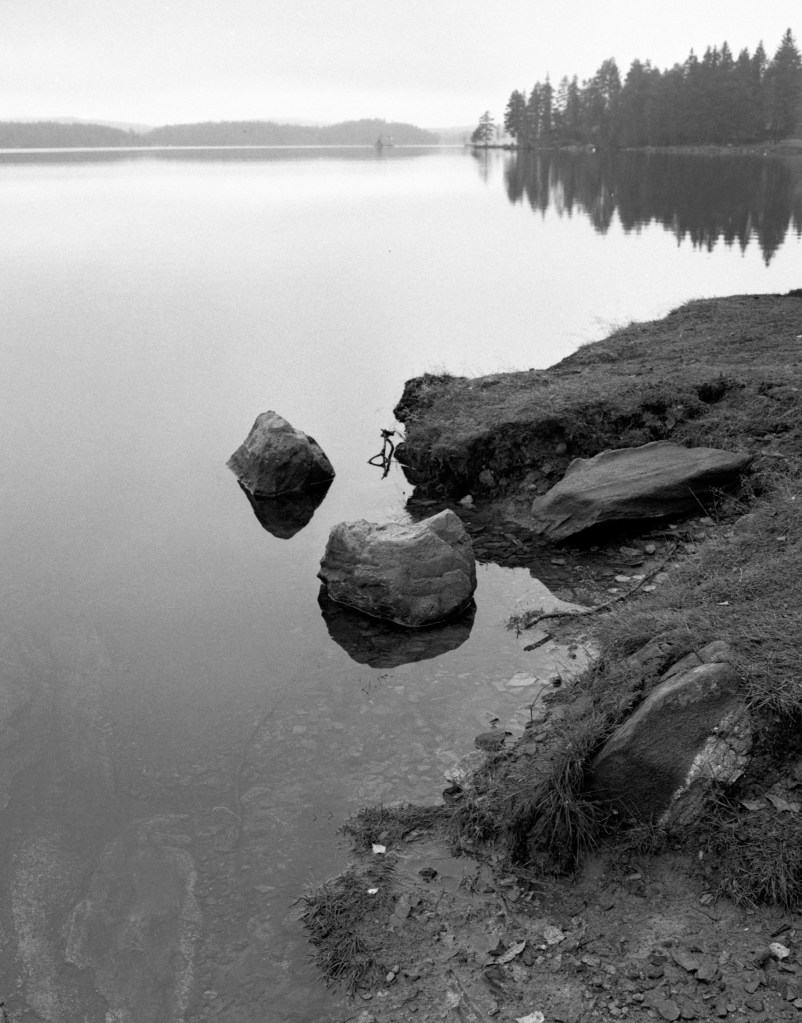
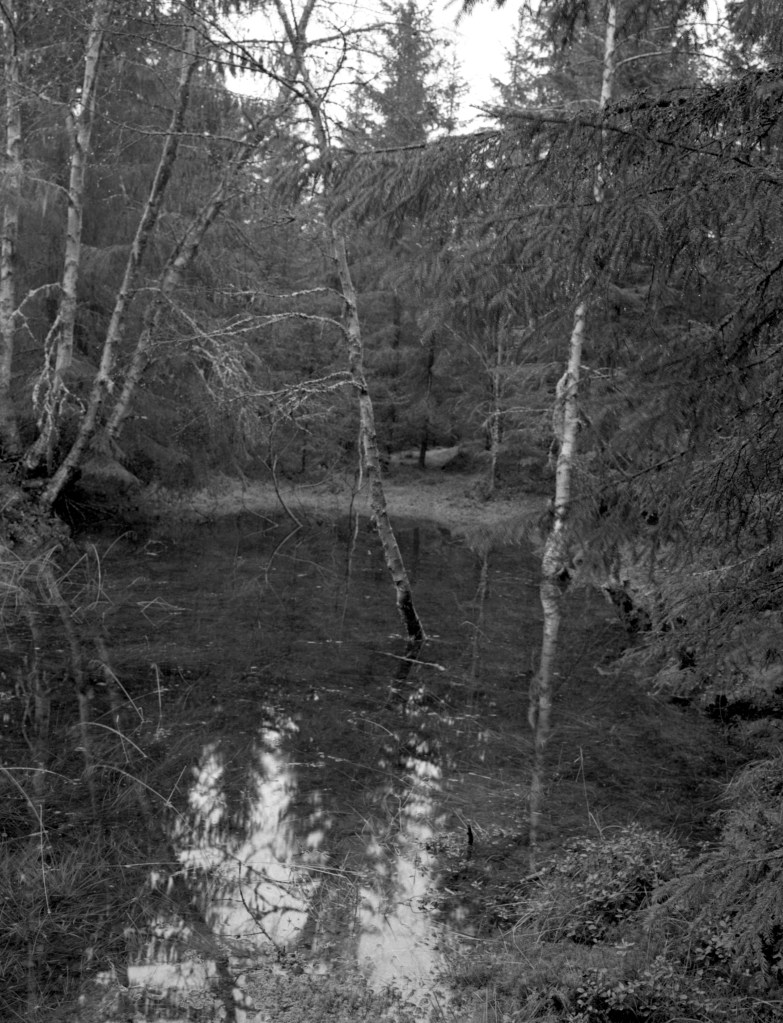
Today was a wet, unpleasant and foggy day in Norway. No real need and point in going out, but there was some interesting fog, and a very white sky that lured me out anyway. The conditions were almost black and white anyway, so I chose to go with a Black and White film. Because of the verylow level of natural contrast, I went with a slow film. Ilford FP4 Plus. I also chose to stand-develop the film in Rodinal 1+100 for an hour, to get some extra contrast and find some beautiful grays.
I chose to use the Bronica ETR, because I wanted to do medium format and that it would give me 15 frames to a roll.
Bronica ETR w 50mm Zenzanon f2,8. Ilford FP4 Plus@125 Rodinal Stand-development 1hour. Scanned with Epson V600
I also got to test out my new scanner. Thank you for the friendly photographer who pointed out to me that my old scanner was probably shot. My new one is far better and gives me lovely scans.
Late autumn in Norway is always beautiful. Thin layers of snow and frost on the ground makes it nearly look like someone has decorated the landscape with some icing sugar. However, today I was not really thinking I would get any of this magic in my shots. When I woke up this morning, it was a foggy and grey morning, and I decided to go for some contrasty shots with fog and artificial lighting from street-lights and and shop windows. I brought with me a selection of films, but planning on using Japan Camera Hunter, Street-pan 400, to get the deep blacks and some find Rodinal grain.
When I got to my chosen location, I had to rethink my whole idea and plan. just next to where I parked my car, and five minutes away from a cup of coffee, appeared this wonderful little lake, and the weather cleared beautifully.
Instead of using JCH Streetpan 400, I went for a roll of Kodak Ektar100. Ideally I would have shot this location with Provia, but since I am nearly never using slide-films anymore, I did not bring any. I rolled the Ektar into the Bronica and quickly came back with some compositions.
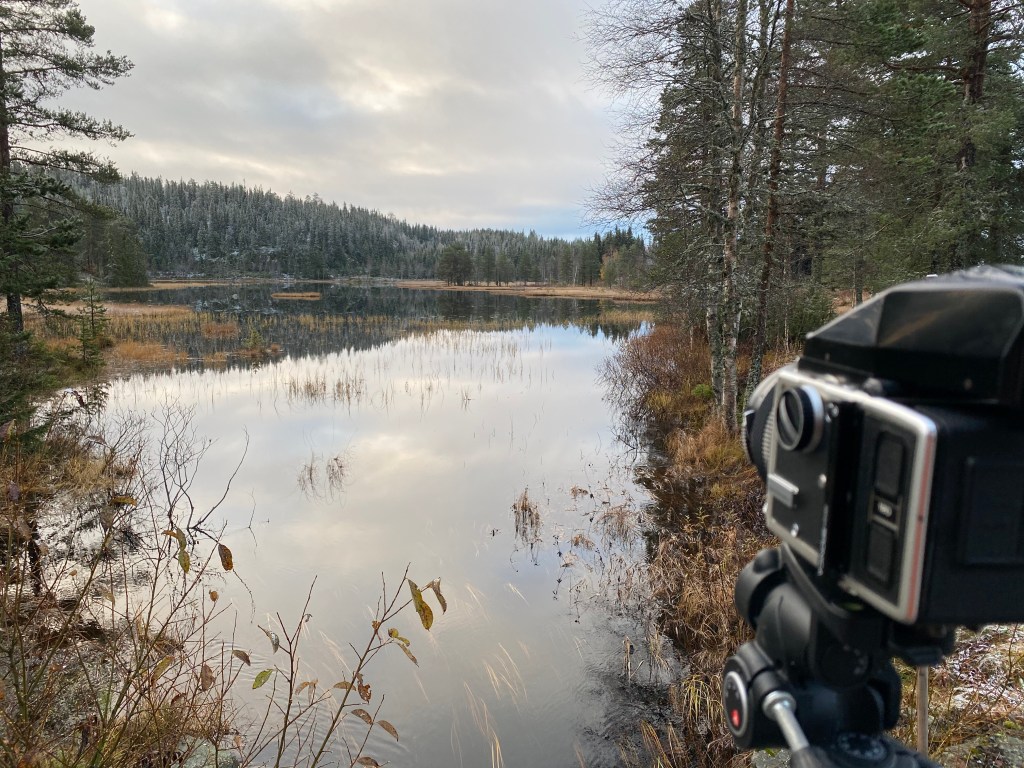
The beautiful view I found. Shooting a location like this with a fresh cup of coffee in my hand has to be considered luxury. (Phone-photo)
Reklamer
I have never shot colour film with this camera before, since it is a fairly new addition to my collection. So a new experience for me there. Kodak Ektar 100 with its vibrant range has been my go-to film for colour landscape photography the last years. It gives me nearly the tones of a Slide-film, and the convenience of a negative film when working.
What I would have wanted for this shoot; however, would be a short telephoto lens or maybe just a 75mm. Currently I only own one lens for my Bronica ETR, a 50mm (35mm equivalent in 35mm). This lens becomes too wide for many of my shots, and does not give me the bokeh I want for closer shots.
Bronica ETR w 50mm Zenzanon f4 1/4sec. Kodak Ektar 100, developed in Tetenal C41. Slightly edited in photoshop
For the shot above I would have wanted a longer lens. I lived the way the snow made the colors soft around the tree stump, however, I got too much clarity in the background for my liking.
Reklamer
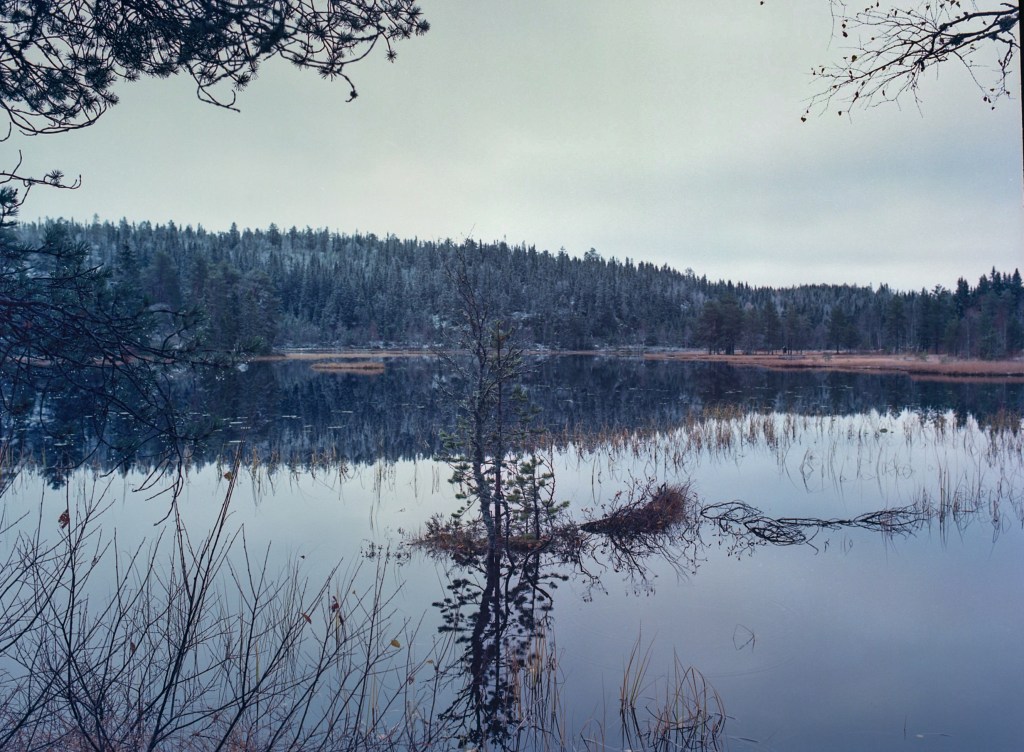
For the shots over the view of the lake. The 50mm was perfect. And for the last shot on the roll, I saw some beautiful grass that moved in the running water. I took a shot of those as well.
Bronica ETR w 50mm Zenzanon. Kodak Ektar 100, Tetenal C41
The late autumn in Norway is beautiful and can give you anything. Today it gave me these lovely shots (among others) next to a place where I could get a coffee. Tomorrow it might give me the foggy conditions I expected today.
I haven’t really done any contrasty BNW-stuff for a while, and the other day I loaded a roll of StreetCandy ATM400 into my little Petri Racer and brought it with me for some days, aiming at whatever caught my eye wherever I was at the time. I haven’t used the Petri Racer for a while, and I found this was an option to use it and its little, interesting lens.
The Petri Racer is a little rangefinder camera that I have used a lot on this blog. It was the camera that made this blog happen and the camera I used for my first two entries. I am very happy with the way the Petri makes the world look. It has a special tone to it that I cannot really put my finger on.
My first pictures for this entry were taken a few minutes after it stopped raining at a car-park when I filled my coffee-cup in the nearby petrol station. I experimented somewhat with the DOF on these images, and they are shot around f4 on the little 40mm lens. My favorite one is here:
Petri Racer, StreetCandy ATM400@400 – Rodinal 1+25, 6 minutes
As I aimed for the contrasty and somewhat grainy look on this roll, I went for a pretty concentrated dilution of Rodinal; 1+25. I guessed this dilution to give me the maximum accutance and give me deep and sharp contrast as well as the lovely Rodinal grain. I don’t really mind the grainy structure of Rodinal, and I find it to suit these kinds of images as it gives them a raw impression.
Reklamer
A bit later that day, I went to an old, derelict school building to set up for the shoot mentioned in a previous entry. The first thing I noticed was the interesting lights in the old hallway. Filled with old chairs, a ladder, dirt and the smell of old building, it really gave an incredible shot. I shot this one on a tripod using f5.6 for 1/2 of a second, and I find that this shot shows the mood of the hallway well.
Petri Racer – Streetcandy ATM400@400 – Rodinal 1+25 6 minutes
Then I went to an old museum where someone had backed their Tractor-trailer into a ditch. There were some interesting contrast to be captured there and I went for it.
Petri Racer – Streetcandy ATM400@400 – Rodinal 1+25 6 minutes
All in all I am very happy with this roll of film. I got the grain and the contrast that I wanted, and the little Petri got another run. Shame it hasn’t been used for a while. It will not sleep as long this time.
Sometimes you come across settings and situations where there just isn’t sufficient lighting to go smooth and grain free photography with reasonable shutter speeds and settings. Especially with living subjects, like people, you need to allow for some «life» in your model and hence use 4 seconds shutter speed. In these situations, an option is to push the film. However, when pushing film, you will lose some of the detail get increased contrast added to your images.
For this entry, I created a situation where I had very limited light, and I went for two 400 speed films which I pushed. My initial Idea was to push both of the two stops to 1600 and see what differences I could spot, but due to a change in lighting conditions, I had to do one of them at 3200, a three stop push.
Ilford HP5+@1600
My first film for this photoshoot was a roll of Ilford HP5+ Medium format film. This is a film I regularly shoot, and I am very familiar with the characteristics of this film at both 400 and 800, but I have never pushed it further than that before. Therefore, I was curious how it would deal with the extra stop of push, both in terms of grain and contrast.
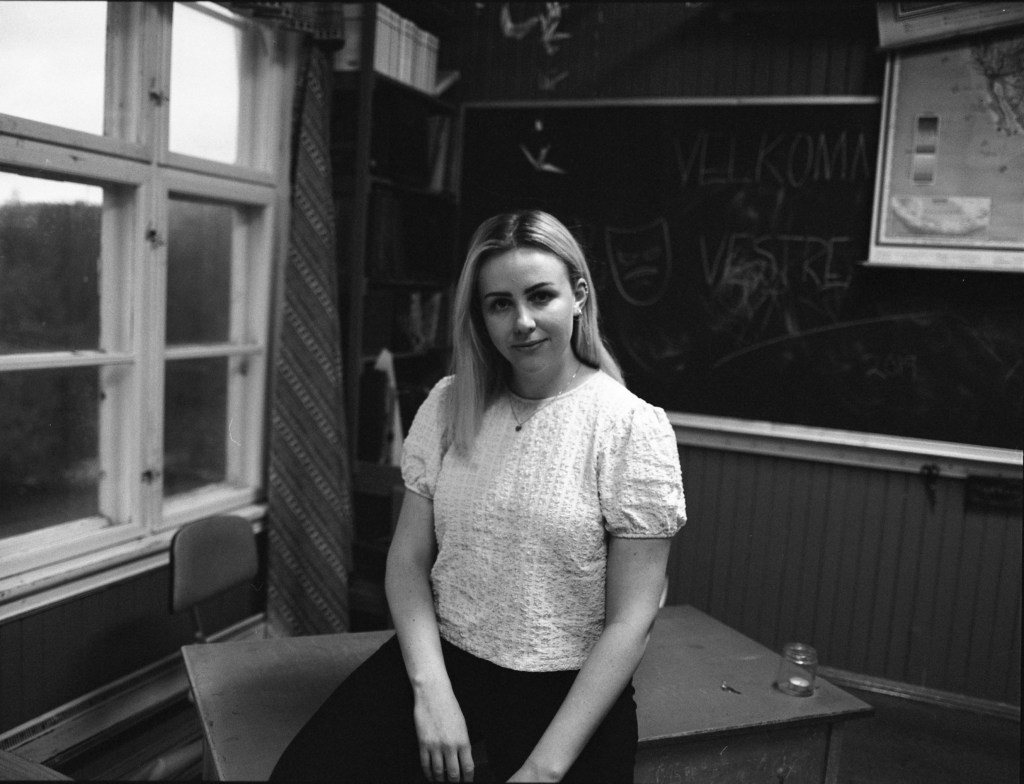
The only lighting used for this shoot was the available light in the old derelict class-room and what I could reflect back using the «sunfire»side of my reflector. I shot as close to F4 as I could and got shutter speeds around 1/60th of a second.
I was surprised to see the negatives when I pulled them out of the tank. I expected a very punchy-looking negative with a substantial lot of contrast and severe loss of detail, but the negatives looked reasonably good. The push was obviously visible, but not as prominent as I would have guessed. My quick scans also turned out some nice images. Although grainy, I like the look of these pictures.
I see that I got a bend mark on one of the images, I clearly was a bit unlucky when reeling the film for development.
Kodak Tri-X400@3200
If I expected grain and heavy contrast on the HP5+, I did not expect much of the images from the three stop pushed one. On my way home, I actually doubted my move and was already drafting my apology letter to the model, who friendly joined me for this experiment. I was, however surprised in two different ways.
Even though I followed the guidelines for a three stop push found in the massive dev-chart and had fresh and well tempered chemistry (20 degrees) some of these negatives came out very thin. I metered in the same way all the way through the shoot, and I obviously developed the whole roll at the same time so the big difference surprised me. I must have made a mistake with my metering at some of these images.
However, some of the negatives looked really nice. Although they were obviously very contrasty and punchy they looked to have kept at least some of the detail I looked for. As you can see in the pictures the push is very visible, and I would not go for a three stop push if it could be avoided.
This shoot was a real gamble, and I am thankful for the model who helped me on this. Although I couldn’t really compare the two films because I had to do different pushes, I must say that I am surprised how well both films coped. However, I would say that the grain and latitude of the HP5+ appeals more to me than the TRI-X. But this is a personal observation.
I have decided to try out these negatives in the darkroom at some point, and I will post my results and workflow from that at a later point.
For a while I have been looking to buy a 645 camera. Preferably a SLR of some kind and many different options have been considered. Both Mamiya 645, Pentax 645 and even some Hasselblads. However, some days ago, I came across a very reasonably priced Zenza Bronica ETR. I have had my experiences with Bronica. I once owned an Zenza Bronica S2 fitted with a beautiful Nikkor 80mm lens. I only sold this because it had the habit of giving me half frames a few times on each roll and I cannot afford wasting expensive film and possibly losing a strong shot due to a camera issue.
I contacted the seller on the ETR and we came to an agreement and got a deal together. Very reasonable and rather quick.
Zenza Bronicas are beautifully designed Japanese cameras, with incredibly sharp lenses and a rugged feel to it. The camera is heavy, about two kilos, and you can get them in different configurations. Later ones are more plasticky and lighter, but I don’t really mind the weight, as I often shoot on a tripod. My ETR came with a prism, eye-level viewfinder and a razor sharp 50mm f2,8 Zenzanon lens.
I went out the other day to test the camera, and I made some really beginner mistakes.
Fist of all, I used the wrong film. I loaded the camera with a Fomapan 100, because I had one lying around about to expire, and I found I could «waste that one» if the camera did not work properly. The biggest problem was that I went out on a very dull and overcast day where there was not really sufficient light to shoot 100 ISO. Because of this I had to shoot around 1/30th of a second, and I forgot to bring a tripod. A lot of motion blur later, I decided to discard the test and go out for another go with a different film.
Reklamer
From my second attempt of testing this camera.
This second time, I went out in the morning as the fog was lifting from the lake (Mjøsa) and went for a short session Trying to capture some magic. Wiser than last time, I loaded the camera with a roll of Kodak Tri-X 400, a film I don’t use that often but had lying around and went down to the docks in Gjøvik.
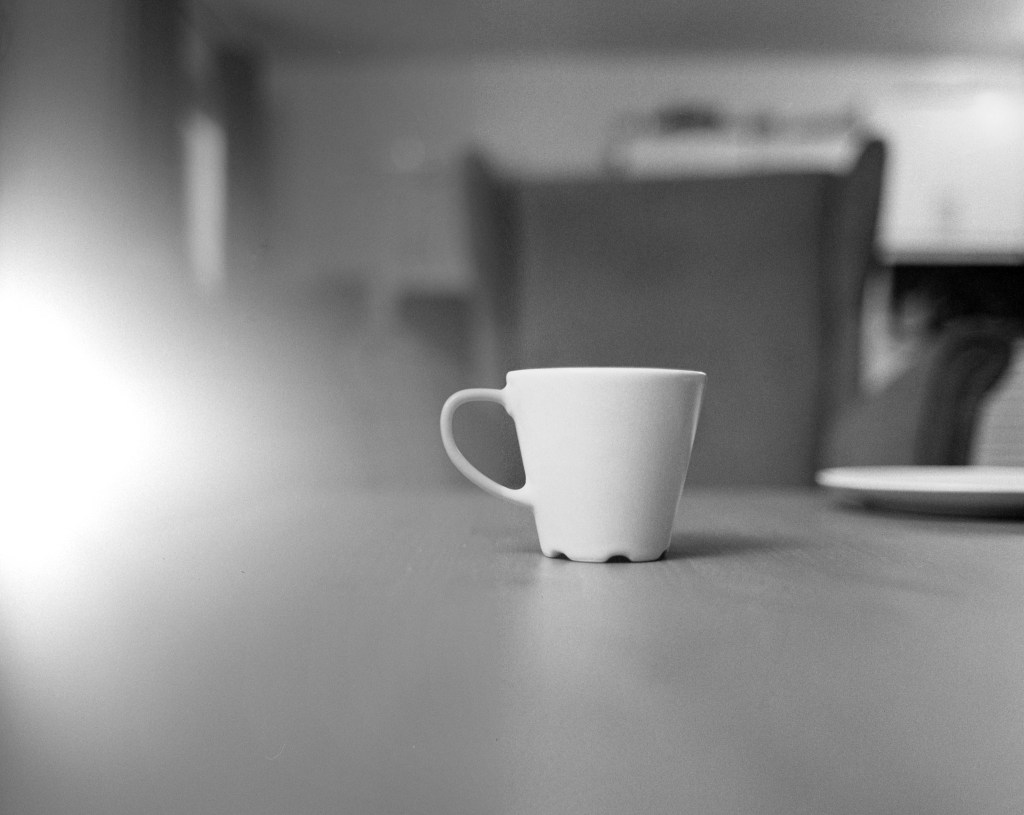
Before I went out, I had a coffee. I documented my coffee with an image taken at f2,8, maximum aperture at 1/15th of a second.
I am really surprised with the smooth bokeh the Zenzanon lens gives me, and I find that the Tri-X grain and contrast gives the image a really nice tone. A tone I don’t often find with Tri-X as I find it a bit to punchy in the contrasts for my taste. Similarly I like the way it handled my location by the lake.
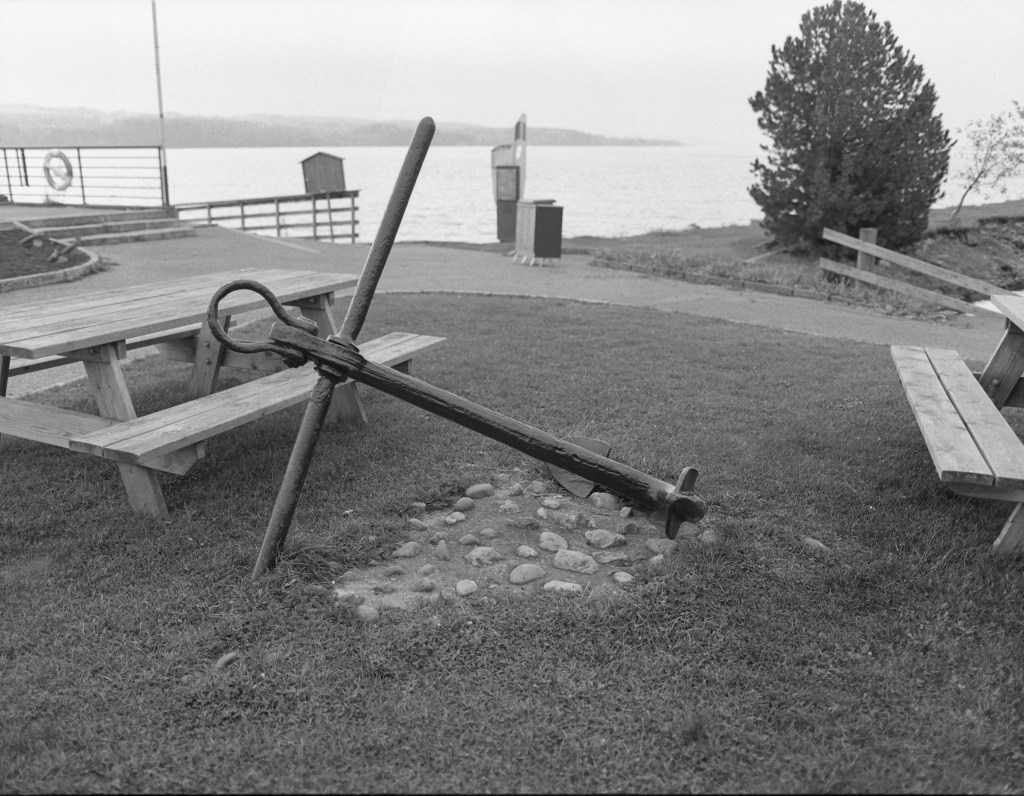
I appreciate the tones I got in the picture of the anchor. Shot at f4, it gave me a perfect depth of field for this image and the Tri-X tones gives the smooth tones. I also love the way the background disappears into the fog behind.
In a slightly under exposed image of some birds fleeing away from the Norwegian winter which is approaching in a months time. I find this image to be a bit «gritty» but I will attempt to make a beautiful print of this image in the darkroom.
All in all, I am very happy with my new Zenza Bronica ETR, as well as my expedition into 645 format, and will shoot it regularly in the future.










 Cheap Camera Adventures