A few days ago, the weather and conditions were perfect for a little afternoon outing, and really worked set itself up for some lovely muted colours. Since I had some C41 chemistry and a few rolls of different colour films, I decided to go for Kodak ProImage 100 and the Canon T70.
I wanted to shoot hand-held, and I wanted a film that is gentle with the colours, but not either over, nor under-saturated. As it later turned out, my C41 chemistry is probably shot. The scans I got had a severe cyan-green cast, and since the C41 mix is three months old, I wouldn’t be surprised if it is a dying blix.
I chose to drive up to an old outdoor-museum, a museum with an old, lovely yellow farm-buildingand some old houses. The area is accessible for everyone at any time, and walking around there is very relaxing, since there rarely are too many people around.
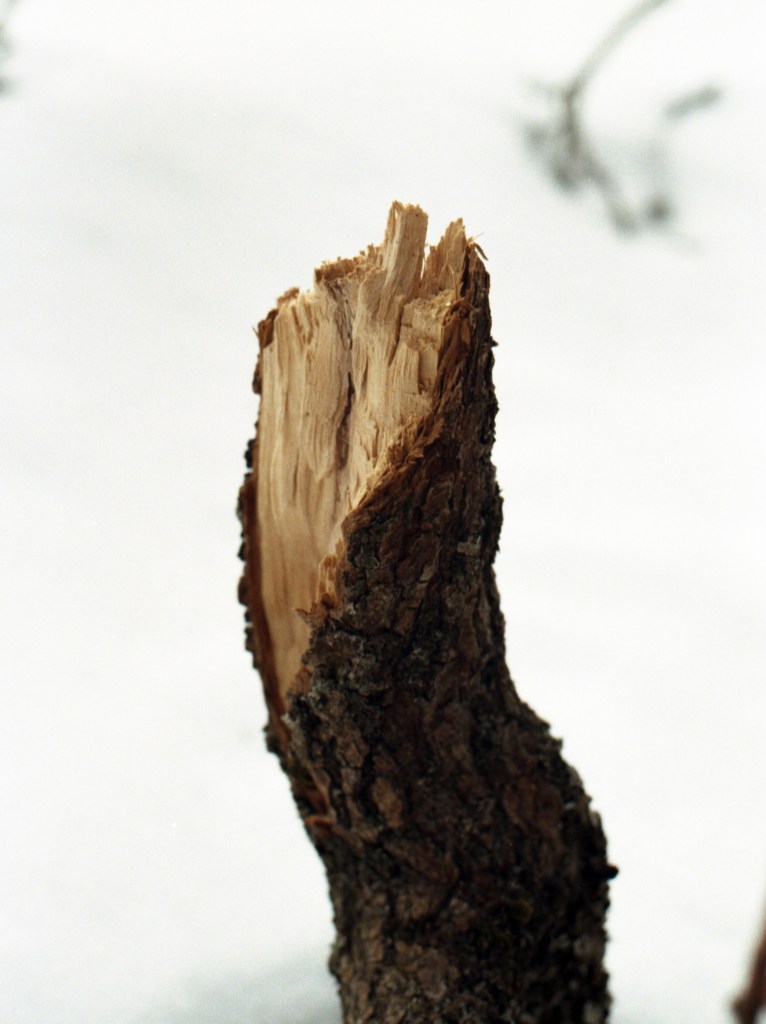
The break point of a fallen branch – Canon T70 w Canon 50mm f1.8 FD – Kodak ProImage100 (somewhat colour corrected)
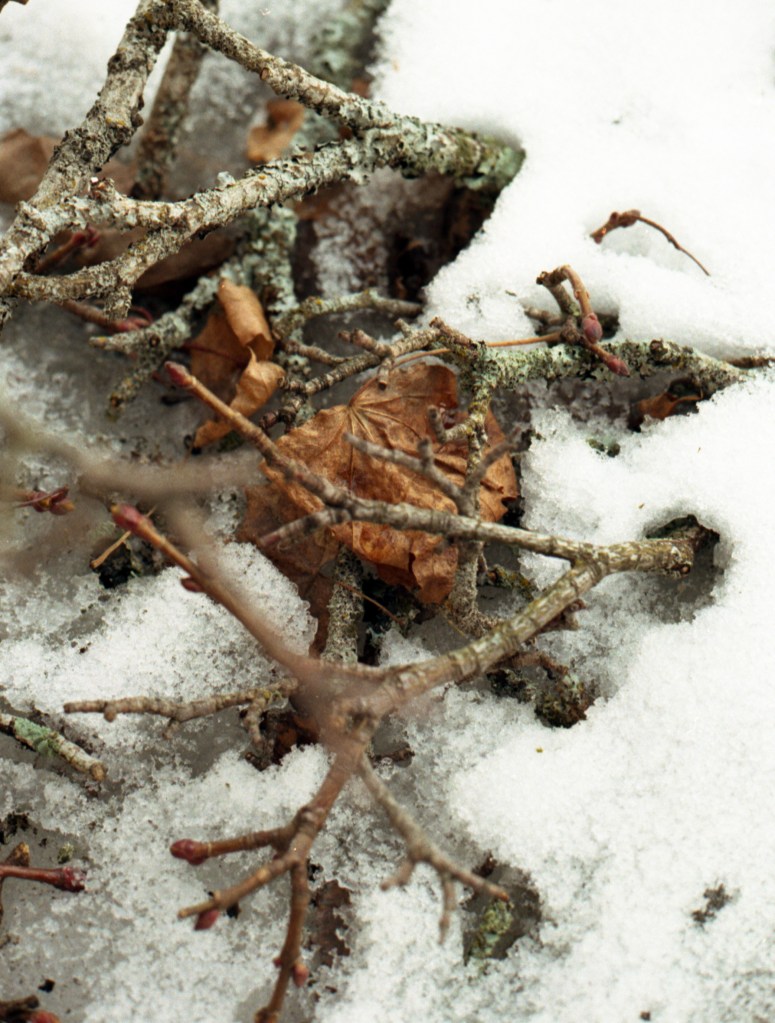
Outside the main farm building, there was evidence of a snowy winter with heavy and mild snow. Big branches had broken off the tree outside the main building and I took the chance of photographing them, as they are likely to soon be removed when the snow melts. The broken branches made for some nice compositions in themselves, but they also «framed» some other nice elements, such as wilted autumn leaves, that have been buried by the snow over a long winter.
Reklamer
A wilted maple leaf – Canon T70 w Canon 50mm f1.8 FD – Kodak ProImage100 (somewhat colour corrected)
This time with the Canon, I went for images demanding wider apertures. The last time I used the camera was a very bright day, and I mainly shot f11 and occasionally f8. This time, my narrowest aperture was f4, and in most cases, the lens seems to perform very well: The images have a sharp and defined focus, and creates a soft bokeh that is very pleasant to the eye. There are no evidence of any vignetting or other issues with the lens at these apertures. But I have found it to have some diffraction when used at f22 (not in this outing obviously), and I will avoid that in the future.
For the sake of balance, and because I happen to have some nice images, I am going to deviate slightly from the line of «cheap cameras» in this entry, and show some images taken with my, not by any means cheap, Hasselblad. Or in my case, some times a hassle-blad. The first thing my Hasselblad did to me after I bought it, was jamming up. And not the cute little sweet jam that can easily be mended, but the proper jammedy-jam-jam that has to be sent off for a very expensive repair abroad.
I recently got it back from repair, and I have brought it along for a few outings lately, and I really find myself to love using it. Not that it really makes any big difference to anyone an image is taken with an expensive or a cheap camera, but to me it has to do with inspiration. Some cameras inspire me to go out shooting and some do not. That’s why i often feature the Olympus, the Konica, Ikoflex and the Bronica ETR. For different reasons, these cameras make me «get out there» and «get the shutter finger active».
Reklamer
Here are some shots I did recently with my Hasselblad, that I find to inspire me a lot. The colour ones are taken with Kodak Ektar, and the BW ones are done with Ilford Pan F plus, that I pulled a stop. The Pan F is developed in Adox Atomal 49 stock for six minutes, which is 20% off the time for box speed. After having used Atomal 49 for a while, I have found this to be a developer I am very happy with, and it might replace Xtol as my number one developer.
A persistent winter fighting an inevitable spring at Kremmerodden – Hasselblad 500CM – Planar 80 – Kodak Ektar
Hasselblad 500 CM – Planar 80mm – Ilford Pan F plus @25 – Ados Atomal 49 Stock
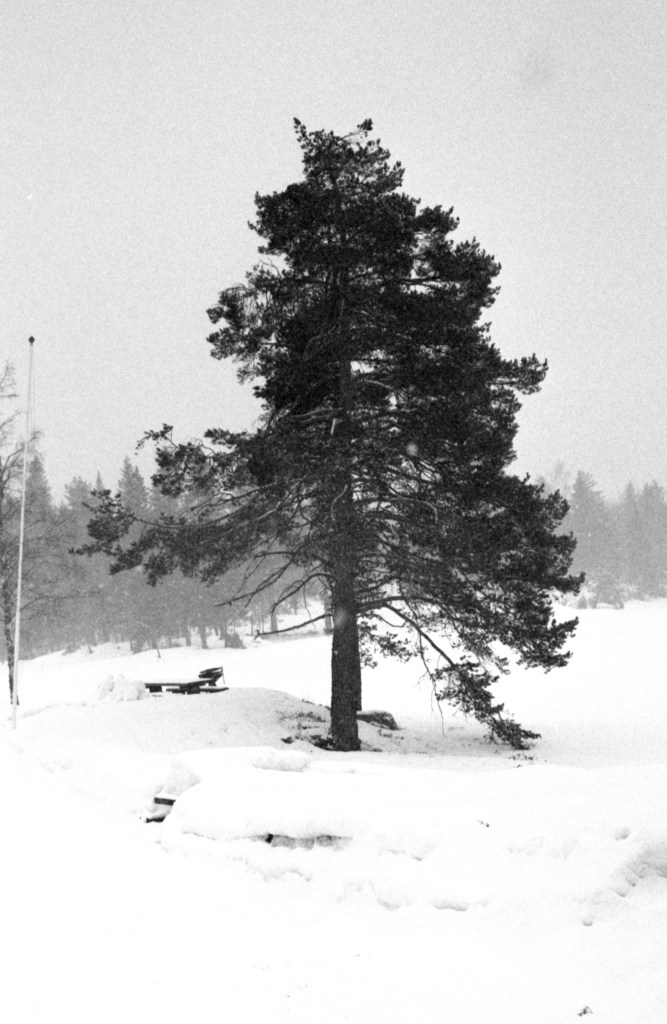
Yet again, the persistent winter of 2021 struck back at us with all its wreath. After a few weeks of impeccable weather and a really pleasant spring mood, we were once again confronted with the face of King Winter. When I went out yesterday, it was blowing a gale and the snow flew thick in the air. Thicker than horse-flies at a swamp in the summer. The weather was bland and uninspiring and being out there was nasty and uncomfortable. Yet, I had something in mind.
I wanted to capture the foggy and snowy day with a gritty and grainy mood. I chose to go for a BW film. The Rollei Retro 400s, which is a film I have used a bit before and that I find to suit my way of shooting very well. My thinking was that the 400 ISO film would give me just the right amount of grain and contrast, as well as giving me the opportunity to shoot hand-held, which is very handy in windy conditions, where camera-shake due to wind is a real danger, even with a sturdy tripod.
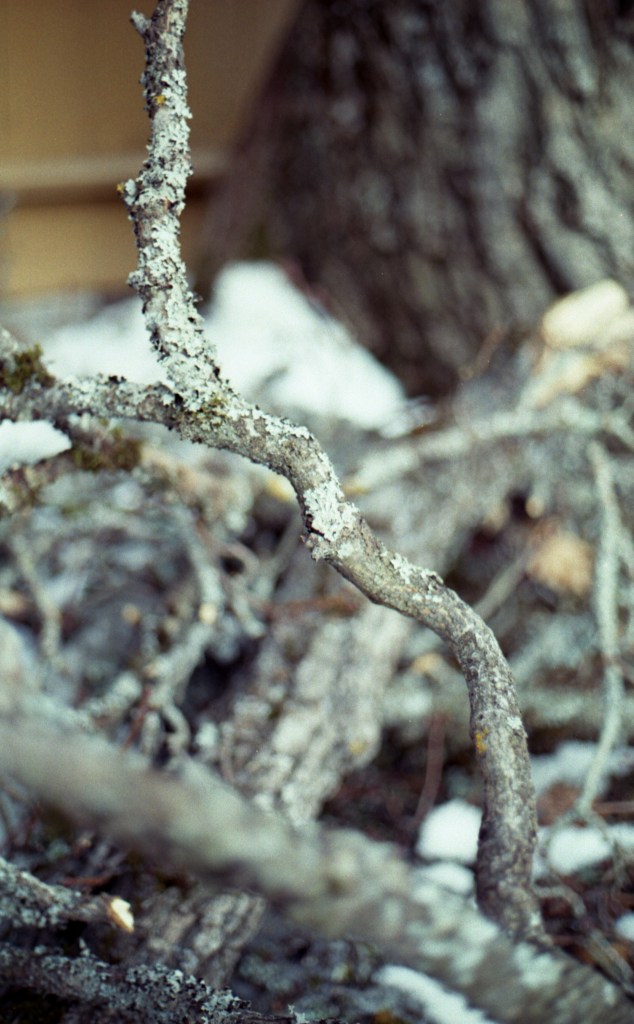
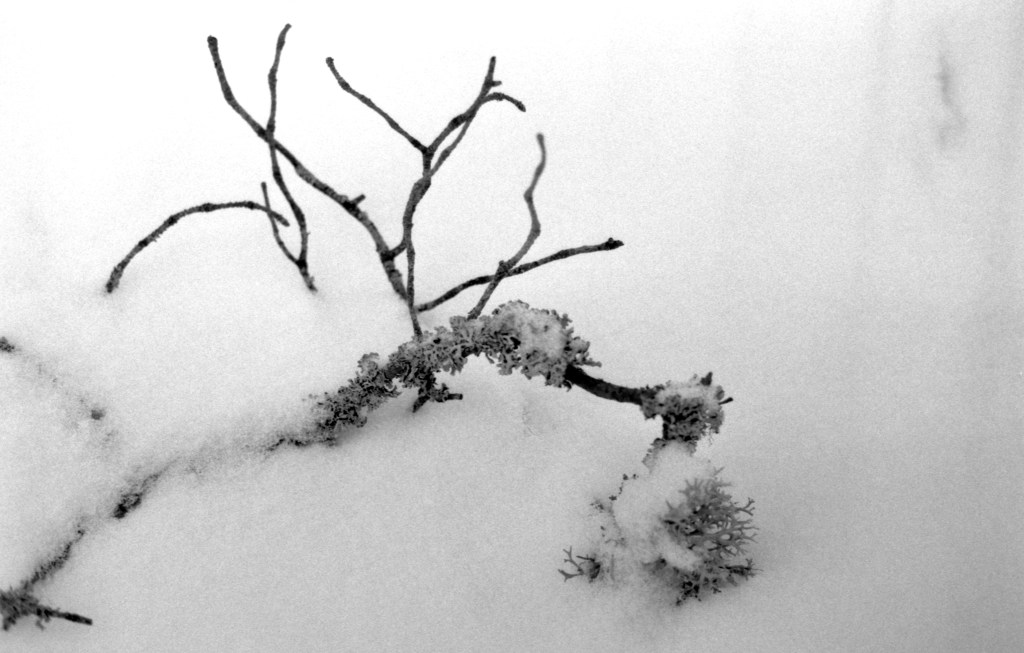
A fallen branch – Olympus OM-1 w 50mm Zuiko f1,8 – Rollei Retro 400s – Rodinal 1+100
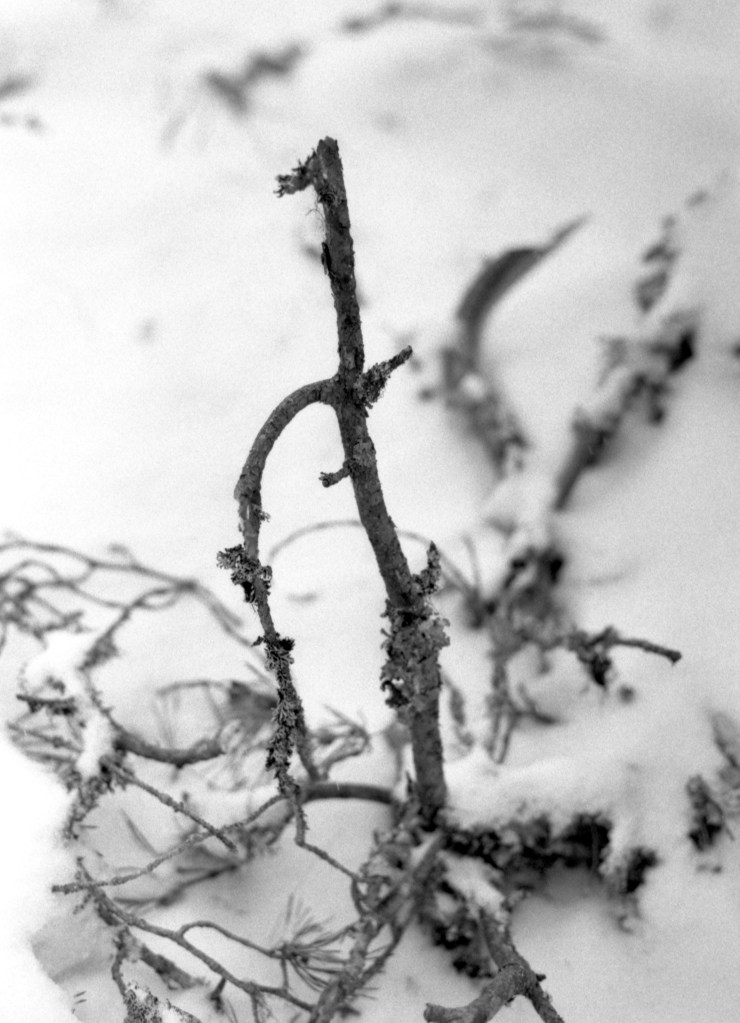
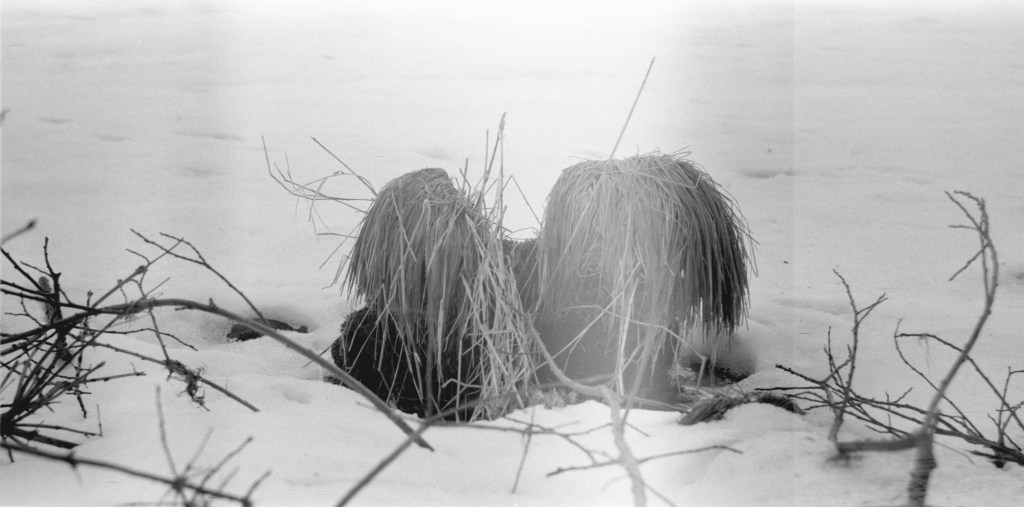
I shot about half a roll of film, focussing on making quick compositions around branches that, over the winter with heavy snow, has broken off bigger trees. The foggy and snowy conditions makes these branches stand out as interesting shapes, and shows them for the beauty they are. WIth the added grain from the film and the additional grain and contrast from the use of Rodinal 1+100 Semi-Stand gave that somewhat “raw” look I was going for.
Reklamer
The camera I chose to use, was my brilliant Olympus OM-1. This is a camera I trust at all shutter-speeds and that I know will work regardless of conditions. However, I noticed two issues on this particular outing. first and foremost, there was a little piece of dust that obstructed my view through the viewfinder. I used it as it was when out shooting, because I did not want to take the lens off in the middle of the show-storm. When I took the lens off, there was a little piece of dust on the focussing glass. How this ended up there is unknown to me, I have not taken the lens off this camera for months, and it has not been there before.
A fallen branch – Olympus OM-1 w 50mm Zuiko f1,8 – Rollei Retro 400s – Rodinal 1+100
It also seems to give uneven exposures at the highest shutter-speed 1/1000th, I even got a blank frame that I know was shot with this shutter-speed. This has also never happened to me before, and I will keep an eye on this in better conditions.
All in all, I got the images I wanted, and all in the matter of around 15 minutes in the snowy gale. Thank you for following and reading, I hope you enjoy my images.
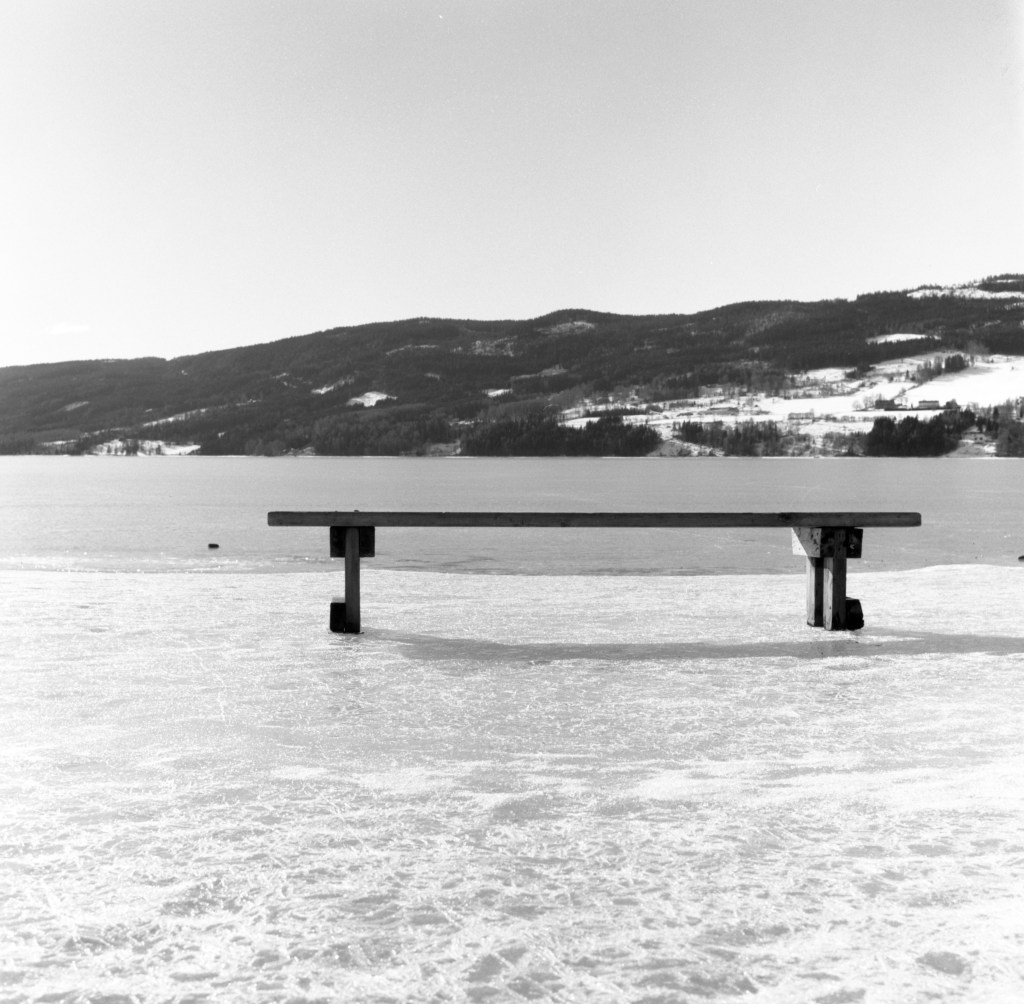
Nothing fills me with such joy and happiness as the day when I for the first time see grass being liberated from the firm fist of the winter-snow. Today was that day, and I immediately decided to go shooting. I loaded the Zeiss Ikon Ikoflex with a roll of Ilford FP4 plus, and went down to Kråkvika by Hov. A location where spring is often present early. And sure enough, there were a lot of spots and spaces where the snow was melted away, leaving the lifeless brownish colour of grass that has been buried for a while under the snowy carpet. The colours weren’t really spectacular, hence the choice of black and white-film.
To me, the Ikoflex is maybe one of the cameras that inspires me the most. There is something about the sensation of using something so brilliantly engineered and with a lens that sharp in a very light and beautiful box that appeals to me. I haven’t used it for a while because the winter was exceptionally cold this year, and I don’t think the Ikoflex would be too fond of the cold weather. Also, my Ikoflex has developed misfiring on lower shutter speeds, so I tend to keep it at 1/100th or 1/300th, which could be too short shutter speeds for winter-time. Whether I will have it repaired remains to be decided, but for my current use, the Ikoflex works well.
Spring landscape with melting snow – Zeiss Ikon Ikoflex – Ilford FP4plus – Adox Atomal 49
I find that filling the roll and finding the right compositions, is a very easy task with the Ikoflex. The inspiration comes naturally when using it, unlike the Zeiss Ikon Nettar, which I find that I can get bored when using. I have heard a lot said in negative ways about the Ikoflex and it being like an «over protective mother» or «insanely difficult and complicated to load», but I cannot understand how any of these can be true. If you read the manual, which I know is a very uncommon thing for people to do today, you will very easily understand that the advance wheel will turn freely when it reaches frame nr 12, and that you have to manually reset it for frame 1. Not at all difficult. I have a video on Youtube showing how it is done.
Reklamer
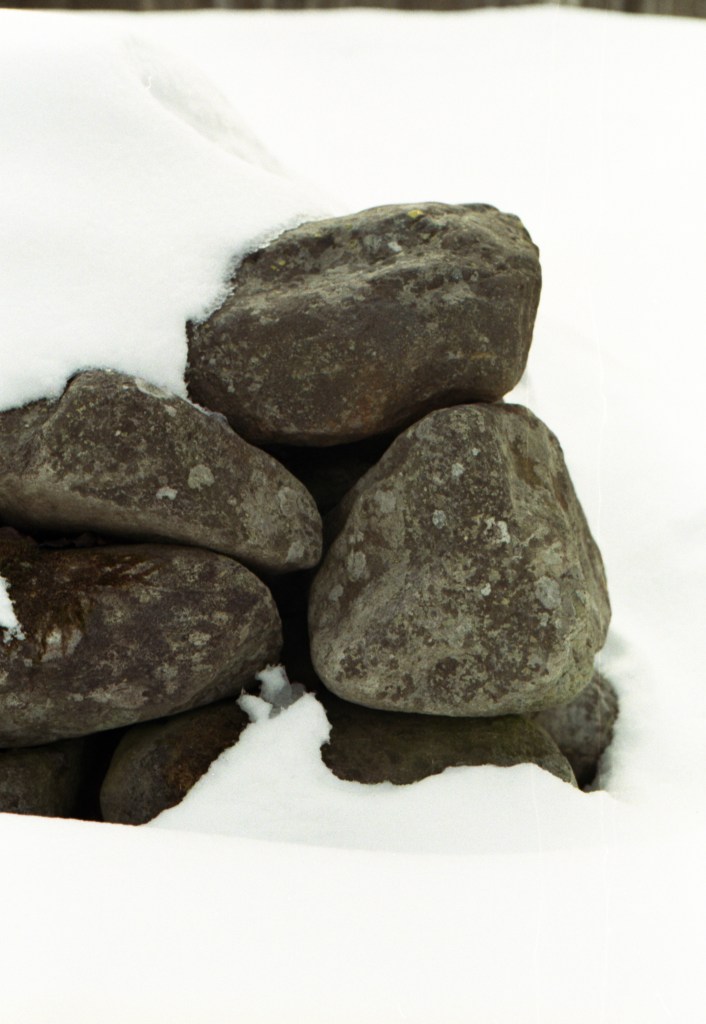
I am a rock – Zeiss Ikon Ikoflex – Ilford FP4plus – Adox Atomal 49
Walking around on a day where the snow is melting and the landscape comes back into sight, makes you notice objects or shapes that would normally either be removed or invisible in the greens and lush landscapes. There is something «rough and contrasty» about these snow-melting days that really appeals to my way of composing.
All in all, I had a very joyful little day out in the sun and I enjoyed every minute of shooting with the Ikoflex again. It is such an amazing little camera and the images really speak for themselves.
I have never worked with any kind of panoramic equipment before. I have held a Hasselblad X-pan in my hand at one point, but I never tried shooting it. Even so, panorama photography is interesting, and I have wanted to give it a proper try. Not that I will really try it properly in this entry, but I recently bought some very cheap 3D-printed (I guess) plastic parts off eBay. Specifically, the small plastic parts that you use for using 35mm film in your medium format cameras. To be honest, I didn’t really expect much results from this. My anticipation was the following:
The film will not be kept dark enough after exposure and will be fogged.
The film might not be kept flat enough in the camera.
Composing the image will be difficult not having a proper viewfinder for it.
Unknown amount of images pr film and difficult to know how far to wind.
The plastic-stuff and a canister of film. Not the one I used for this test.
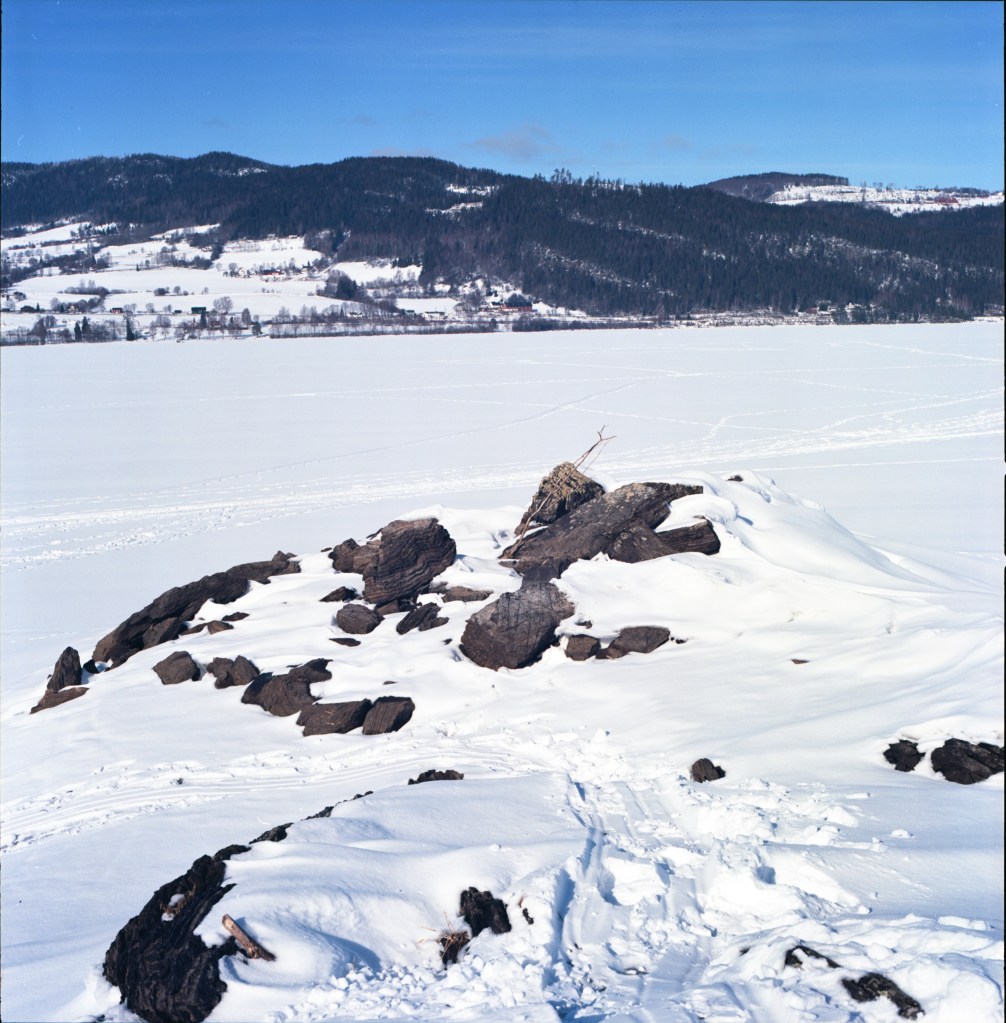
I decided to give it a try in my Zeiss Ikon Nettar. This because it is the only MF camera I have where the film is inserted in the horisontal direction, allowing me to easily shoot landscape without turning my camera into portrait. I decided to go for a roll of Ilford Delta 400 and go for a little walk while the fog was lifting over the lake. I was looking for wide compositions, which was a new experience for me, and I felt that I often reverted back to looking for squares or normal rectangles rather than the super wide compositions that this line-up would allow for.
Didn’t quite nail it with this one. See the light leaks that I got for most of the shots on the roll. Luckily not too bad in this shot.
First of all, I can confirm the first part of my assumption. Using this system, with the 3D-printed parts, will give you severe light leaks between the shots. I know for a fact that it is not the light seals acting up, because I used black tape to ensure no light-leaks would come from that area.
Reklamer
For the most part, I think that the film stayed flat in the camera, and that the adapter kept it reasonably well aligned throughout the roll. I did; however, notice that the film was not as «in the middle» of the viewfinder as I had thought, and I shot a few of the frames «too high» losing parts of my intended compositions.
Over the rocks – Zeiss Ikon Nettar, Ilford Delta 400 Adox Atomal 49 Stock
Even though I like some of these images and the way they look and how they turned out, I am not certain I would use this adaptor system a lot. I will very likely do some more experiments with it and try it out at different occasions, and maybe I am luckier with my next rounds and avoid some light leaks. I find the system to be functional for shooting only one frame at a time. This would mean a lot of «cutting the film out of the camera» and «developing fragments of a roll». Not that I mind doing that, but it is a hassle.
One of my preferred subjects for winter photography is churches. I find them to be inspiring and they always spark some kind of interest in my photographic work. I will elaborate this somewhat in this entry.
On a recent outing, I visited two very beautiful and different churches along with my new acquisition, the Canon T70 and a roll of Fujifilm C200. This film is a consumer level colour film that I tended to prefer using back in the day, around 2004 when I was given my first SLR camera, an Nikon F60. This combination, the F60 and the Fujifilm C200 (or its equivalent at the time) was what sparked my interest in photography. Sadly, out of pure vanity and neglectance, I haven’t used this for a very long time, but when I saw a three-pack of C200 at a discontinuation sale at a “everything shop”, I bought it and suddenly remembered why I loved using this film. It really has some “zing” to it that I really like.
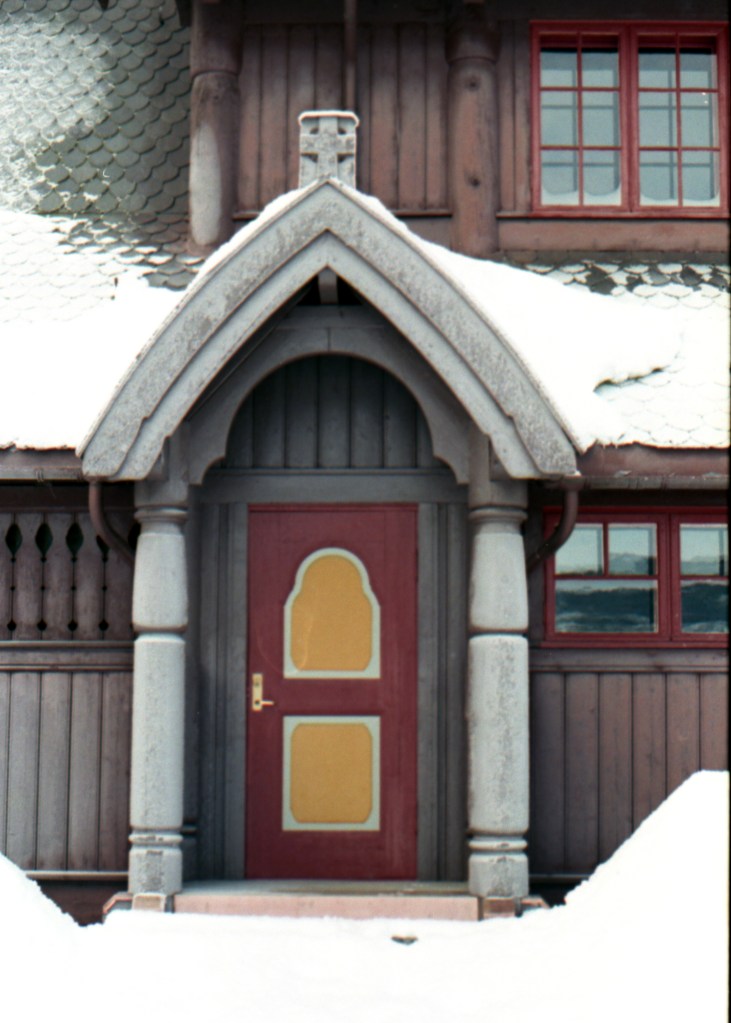
The most spectacular of the churches I visited on this outing, was Skute kirke, near Hov in Søndre Land. Finished in 1915, it sought to be a “modern” take on the Norwegian Stave churches, and the architect Ole Stein was clearly both inspired by Art Nouveau and Stave churches when drawing this church. It was named after one of the neighbouring farmers, Peder Skute, who gave land for the construction under two conditions. All locals should be given the right to a free burial, and the graves should never be removed. This promise has been kept alive until this day.
Side door at Skute church – Canon T70 w Canon 50mm f1,8 FD lens. Fujifilm C200@160
To me, Skute is one of the locations I always return to for church photography. It is such a beautiful and special building that I find to inspire my photography because of its beautiful lobster red colour and its colourful details in doors and ornaments. This is the first time I have been here in winter time, and if possible, the snow made it even more striking.
Their prominence and “standing out” of the environment is one of the reasons I like shooting churches. They are built to be proper landmarks and people tend to be very proud of their church and something they talk proudly of when asked. Often, when I am working around churches with my cameras, I get to speak to locals and employees and am often granted access to the inside as well. Sadly, I didn’t meet anyone at this trip to Skute, and was not able to photograph the incredible Neo-Baroque and Art Nouveau inspired interior, but I met a local lighting a candle on a grave, who welcomed me and was very happy to see someone photographing the church he was so proud of.
Reklamer
Another reason why I tend to shoot churches in winter time is accessibility. In the Norwegian winter, the amount of snow makes your options for locations limited to where it is in some way prepared for people to move about. The area around a church is always plowed and there are always some paths around the graveyards to walk on while taking your photos. Churches also provide some contrast and colour in an otherwise quite uninspiring and monochromatic winter landscape. Making them ideal for photography.
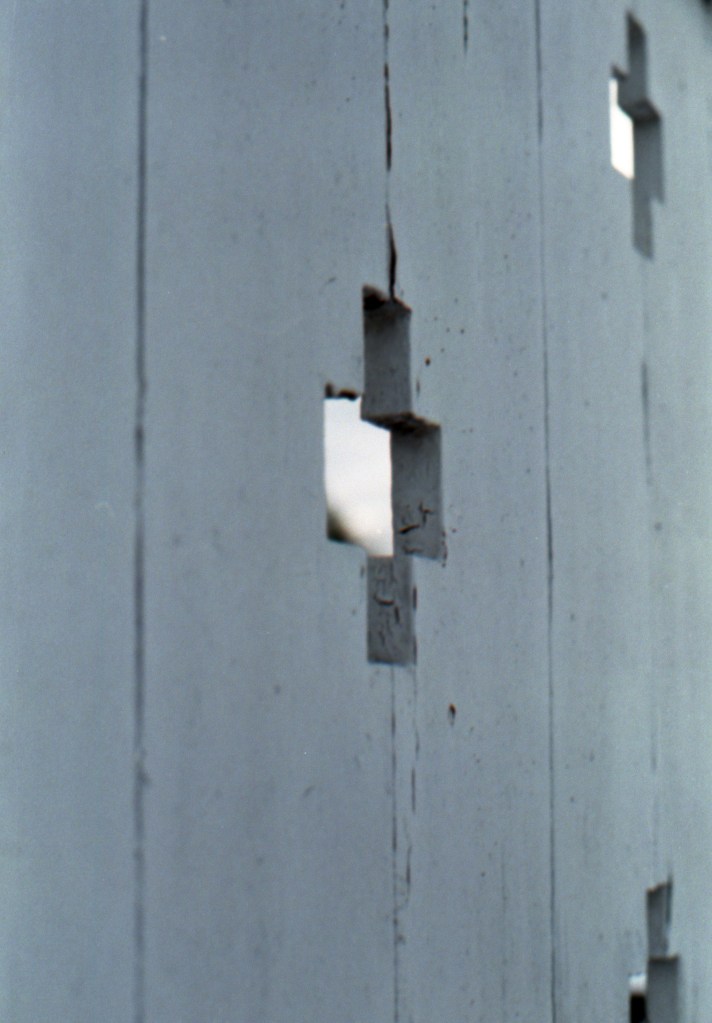
Scenes from Skute church – Canon T70 w Canon 50mm f1,8 FD lens. Fujifilm C200@160
Earlier on the day I visited the much older and more traditional Fluberg Kirke. About 25 minutes away from Skute, this is another church that I tend to revisit. Working around Fluberg is great for detail shots and the lovely aerial view over the lake Randsfjorden with its closest settlements Fluberg and Odnes. This is also just a few minutes walk from Meierilandet, where I did my Expired roll of Mitsubishi MX-III 400, and to get to Skute, you cross the bridge you see in that entry,
Reklamer
Fluberg Kirke was built consecrated in 1703, but its wind flag says 1699 indicating the year it the land was consecrated. At its time, Fluberg was built to be the main church of its are, and hence in the most exquisite way imaginably at the time including three galleries seating in total 450 people for a sermon.
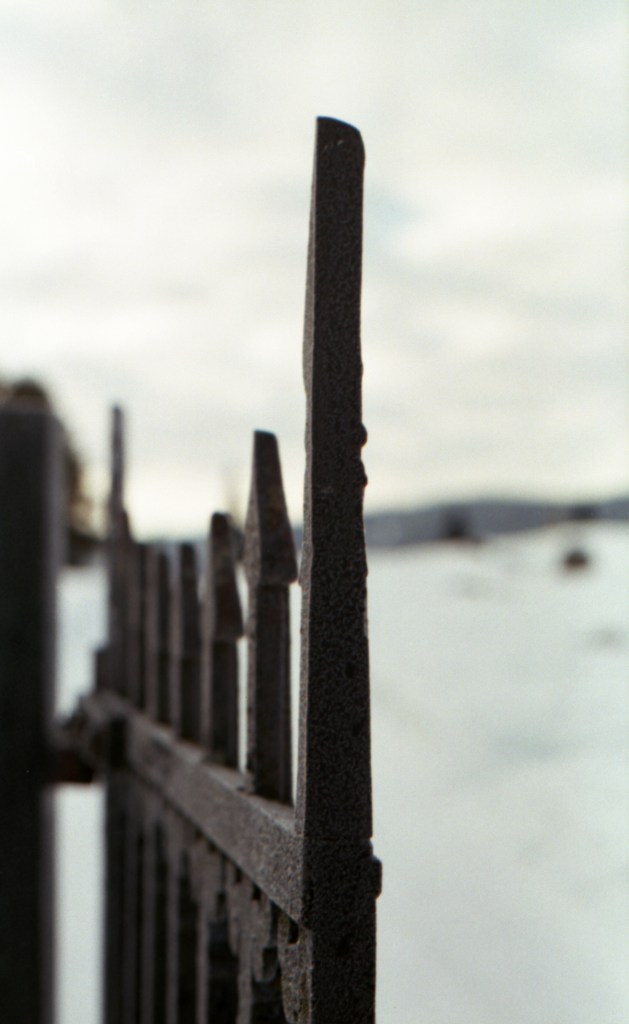
Main gate from Fluberg church – Canon T70 w Canon 50mm f1,8 FD lens. Fujifilm C200@160
On this outing, I looked at shooting details around the church rather than aerial shots of a white church in white snow, and I must say that I am becoming very fond of the Canon T70 camera. This is definitely a camera I will be using more in the future. I will probably extend my collection of lenses suiting it to contain a wide-angle and a short tele-foto lens in addition to the 50mm.
Also, using the C200 again was a fun experience. This time I chose to set the camera light meter to ISO160, on third of a stop over exposure, to make sure the camera would bias that way if hesitating. I find that this works very well for what I wanted to achieve with this shoot. Even though there are better, sharper, finer grained and in general more flexible, but for its price, C200 is a very good choice and alternative.
The endless debate.. The friend-breaker. The source of family feud and potentially divorces. Canon or Nikon. People tend to be very sworn to one of them and show some (somewhat humorous) hatred for the other. Personally, I usually shoot Nikon Cameras. I own a fair amount of them both digital and analog, and the main reason for my choice of Nikon over Canon, is that I find their ergonomics to suit my hands and style more than the Canons. If shown images or specs, I am not able to tell any difference between the two brands, and I see them as equally brilliant manufacturers.
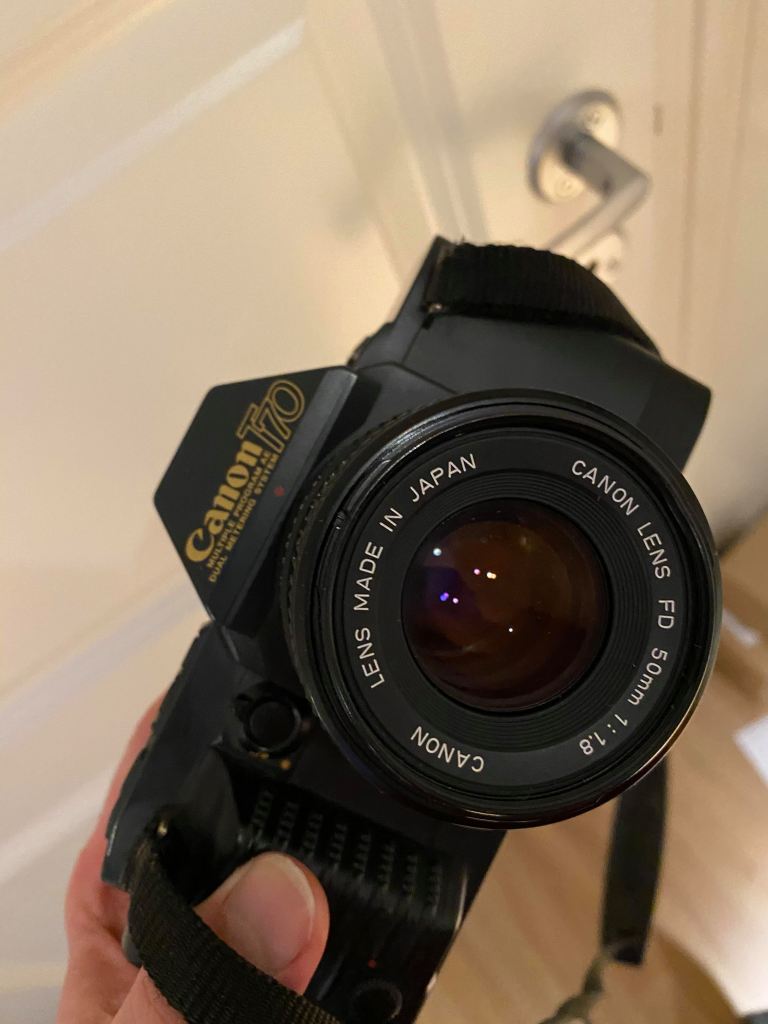
Even so, I have never before very recently owned a Canon camera. A little while back, I came across a Canon T70, and its extremely complex nature sparked my interest. Its incredible «inboard» 8 bit chip and how it was sort of the bridge between Canons older generation of very manual cameras, to the soon-to-follow EOS systems was, I found, intriguing and I started my search to get one for CC-adventures money – less than 100 Euros. I got lucky, and found one way cheaper with 50mm lens included. As a very happy man, I was now the owner of my first Canon camera, a T70.
My very clean and nice Canon T70 from the mid 80s.
Operating a new camera is always interesting, and the T70 has a very interesting button based menu system. It does not read DX-coding, but you set the ISO by pressing the ISO-button and one of the two buttons on the top over the LCD-screen named «Up» and «Down». It is programmed to go 1/3 steps and setting the ISO is very easy and the buttons are big enough to be operated with gloves in winter time.
Reklamer
Another lovely feature with this camera, that I notices straight away, was the fact that it takes AA batteries instead of the CR123A batteries. Both these types are readily available and can be picked up cheaply in most shops, but you more often tend to have AA batteries lying around than CR123A, and hence you are less likely te find yourself in a Cannot Shoot Situation with the T70.
I also like the different safety features it has. You need to press a button to unlock the release mechanism for the film loading door, preventing you from accidentally opening it «mid roll». It has an extra slider beside the rewind button, preventing you from accidentally rewinding the film too early, and it has a little button to unlock the «Power ON» button. A feature that helps you save battery. On the downside, mine has clearly a tiny light-leak, but nothing that in any way affects the images.
Using the camera is a real treat. It is very easy to focus and set, and the main setting is an aperture priority where you set your aperture and the camera will find the suiting shutter speed to go with it based on your entered ISO-speed. You also have settings for full Program-mode and you have two additional settings, one called «wide» where the camera will bias towards a higher f-stop to get deeper depth of field, and one called «TELE» where it will bias towards higher shutter speeds and shallower depth of field. I did not try out these fully automatic modes in my first tryout, but based on the function of the rest of this camera, it would surprise me if it wasn’t spotless.
Holding the T70 is an interesting sensation. The plastic body feels very cheap in you hand, but it is as heavy as a brick and has the noise-level of a helicopter. Even so, this camera feels like what it is, a quality piece of kit, with that feel of «80s science fiction» over its design and the «buttonyness» of an old Volvo dashboard.
This is a very nice camera to use, and clearly one I will use again many times.
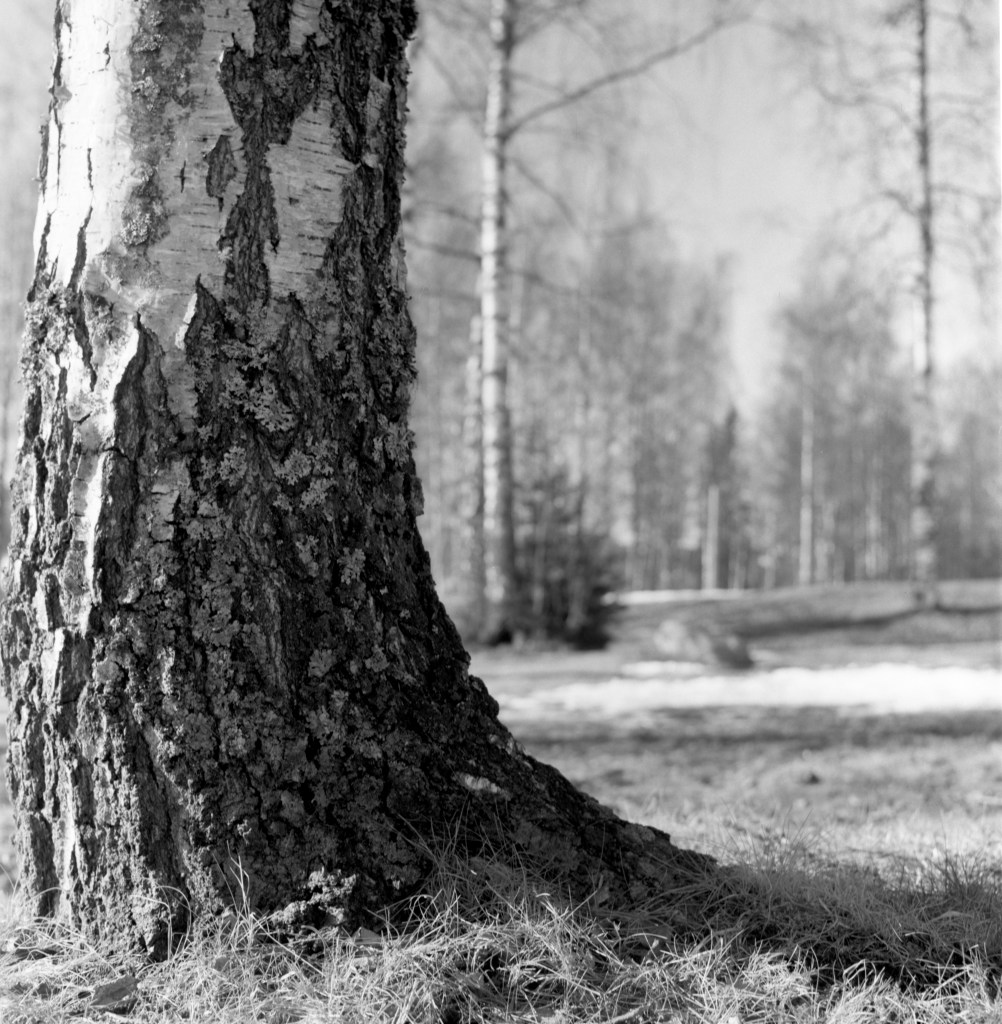
As I have previously written on my blog, I like shooting Kodak ProImage 100 in the winter. There is something about the colours and the subtlety of it, that I find to be exactly the right media for my style of winter-shooting. Some days ago, I gave the Konica a roll of ProImage and went for a little outing to some different locations where I could access the lake. The day were one of those days where it was clearing up after some dull and grey days, and there were very bleak, oranges and purples in the landscape.
I have also found myself to be very fond of the little Konica camera. Yes, it has a bit fewer shutter speeds than the OM-1 that inspired me to buy it, and indeed it hates cold weather. But the camera, and its lens is in mint conditions and takes beautiful images. The lens is very sharp and produces beautiful bokeh. It also feels very sturdy in the hand. From what I gather this is because mine is an early model where the whole body is a metal construction. It does not produce any light leaks at this point and I guess the light meter would work if I gave it a battery.
Tree root in snow – Konica Autoreflex TC – Hexanon 50mm f1,8 – Kodak ProImage 100
Based on the fact that this was marketed as an «entry level» SLR camera in its time, I must say that its performance is incredible. If I was to recommend an entry level SLR to anyone at this point, I would be very tempted to say Konica Autoreflex TC and just smile. I am very happy that I purchased this camera and I will probably keep it as one of my regular users over some time, along side with the Olympus OM-1.
Sometimes, you shoot a roll of film, and you just put it in a drawer. Either you forget about it or you wait until you have shot more of them before you develop. The other day, I found a roll of Ilford Delta 100 35mm, that I couldn’t remember what I used for. I developed it in Adox Atomal 49, and it turned out to be a film I used at a trip during the summer of 2019 at a landscape photography trip to Veståsen in Nordre Land.
What camera I used, is completely blank to me, but based on the time the roll was exposed, and the quality of the exposures, I would imagine it was either done with my Nikon F80 or the Minolta Dynax SPXi. Here; a beautiful view over the little lake «Akksjøen»:
Summer mood at Akksjøen in Nordre Land – Ilford Delta 100 – Adox Atomal 49
This is one of my first rolls that I have developed with the Adox Atomal 49 developer, and I must say that I am very happy with how this developer makes the images look. The grain is very fine and I get the full film-speed without any issues. In comparison with my other Veryfinegraindeveloper Ilfotec Perceptol, where you have to shave off some of your film speed.
Reklamer
I just quickly wanted to share this picture with you, from a distant past without any Covid-regulations nor fear of a world pandemic.
Did you know that Mitsubishi, the manufacturer of cars, air conditioning units and heaters also at some point made film? At least, they had a line of film branded with their name on it at some point, and whether it is a rebranded Fujifilm or Konica film, is unknown to me. What I do know, is that the film I got in my hand is «Made in Japan» and has English writing on it. It also states that it was made at «Mitsubishi paper mills».
Roll with 24 frames of Mitsubishi MX-III 400 colour film.
Since the film was 15 years expired, I decided to shoot it at ISO 160 and use a camera that I trust. I therefore went for my Nikon F80 with a modern 85mm Sigma lens, that is substantially newer than this film was at the time it was exposed in January 2021. I chose to shoot mainly at aperture priority, because of very changing lighting conditions and the fact that I wanted to shoot with gloves in the cold weather.
Reklamer
All in all, I am very pleased with how well the film held up over the years in terms of colour representation. How this film was when it was new is unknown to me, but as it stands today, it gives very nice colours, really capturing the subtle greens and detail in the shadows, really showing the nice day it was when it was taken.
In some images, I saw a weird magenta cast in the images. This was only visible in some of the images, and not consistently over the whole roll. I developed a roll of Kodak Portra 160 in the same tank at the same time as I developed the Mitsubishi, and I could not find any of these colour shifts on this roll, leading me to think there might be unevenness in the emulsion of this film. The images with the colour shifts, were at the end of the roll. Scan settings were identical all over the roll, and should not be impacting the images in any way.
I do like the images and how this film looks 15 years in though, and I have another roll of the same roll in the freezer, that I will meter at ISO 125 to give it a little more exposure. This will be done sometime in the spring, when there is more colour around to play with.


























 Cheap Camera Adventures