The other day, I went out for a little walk by the lake Mjøsa, biggest lake in Norway. Along me I brought the Canon T70 and a roll of Ilford FP4 Plus. It was a rather windy day and the weather was dull and overcast and with some threatening skies promising some downfall in some form. Whether it would come as snow or as rain was anyone’s guess at this point. Since the weather was rather unpredictable, I chose to not bring any video-equipment, so this is a blog-only post. For readers only.
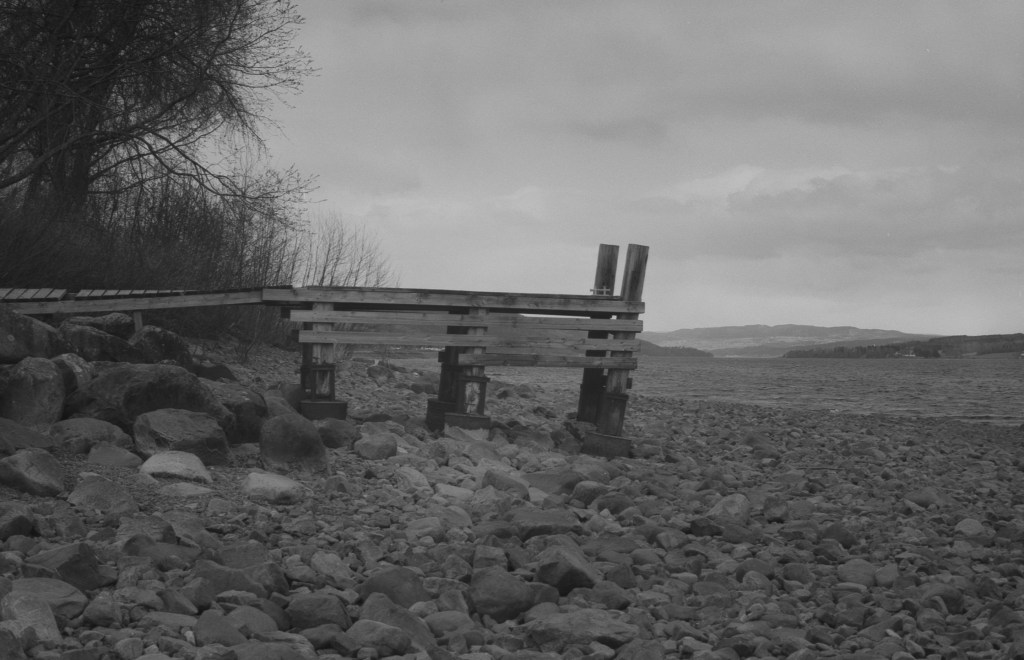
At this time of year the lake is still low and one can walk on what most of the year is submerged by the lake. Once the snow-melting in the mountains picks up some time in the middle of may the water level in the lake will rise and the are I photographed this time will noe be accessible.
Frozen water motion – Canon T70 + Canon 50mm f1,8 FD lens – Ilford FP4 Plus – Adox Atomal 49
I snapped some shots on my way along the lake towards a little woodland area not far from the main path along the lake. I noticed a lot of motion in the water, and I tried to freeze it in action with the higher shutter speeds on the Canon, and even though some of the ended up slightly under-exposed I also got a few decent exposures.
Once again I chose to develop this film with Adox Atomal 49, a developer I know gives me very fine grain and is very good at keeping shadow-details without blowing out the whites. Whether this is considered a compensating developer or not, I am uncertain, but I find it to give me relatively flat negatives that are easy to scan and work with in post-processing. After using 10 liters of this developer I have found that the dilution 1+1 is the right one for my taste. I also like the way you get Perceptol-grain without having to sacrifice film speed. In these times when Kodak Xtol seems to be in shot supply, I have used Atomal instead. However, for my next big-batch I am mixing Ilford ID-11 instead of Adox Atomal 49.
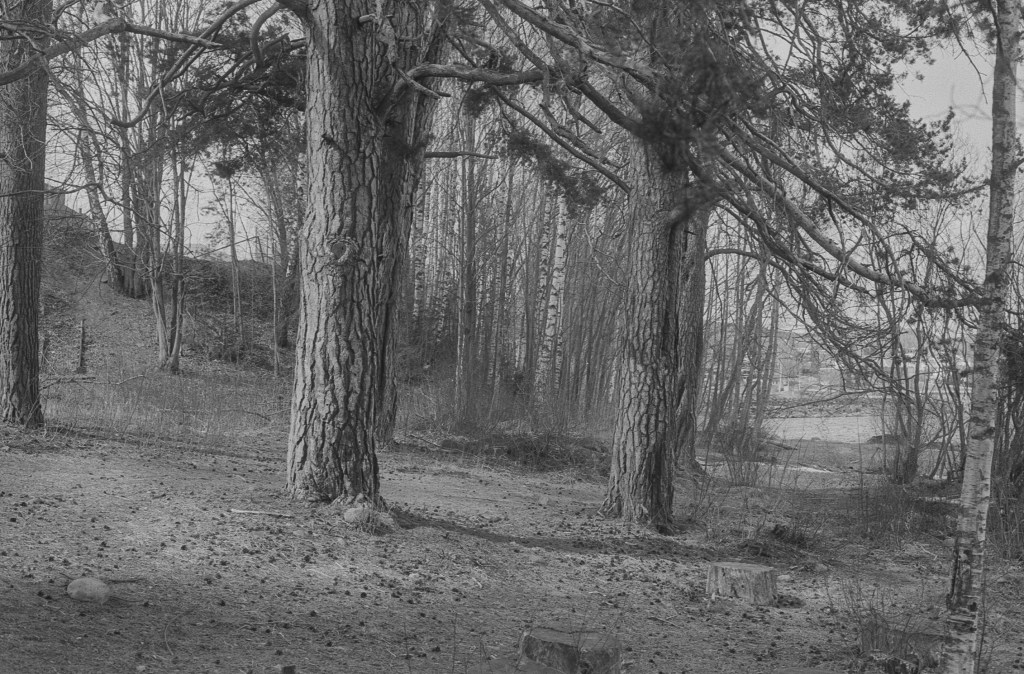
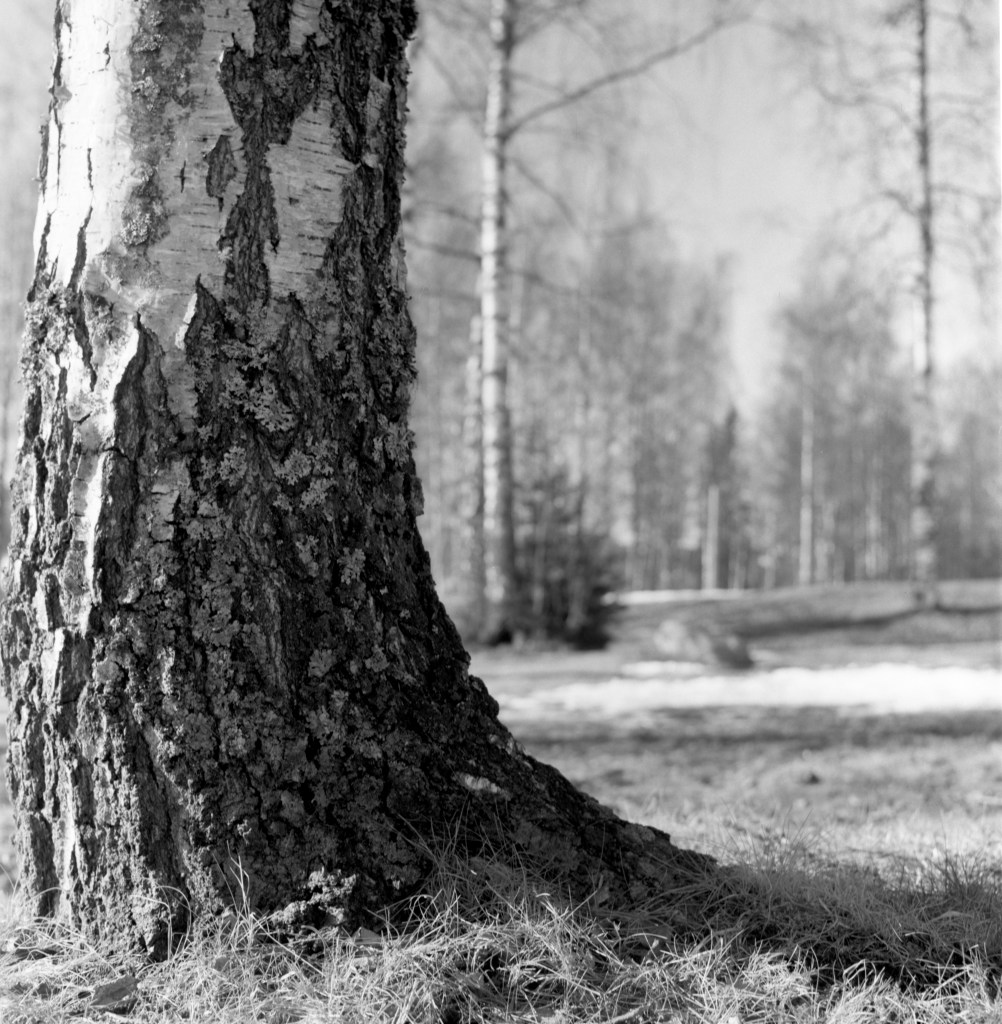
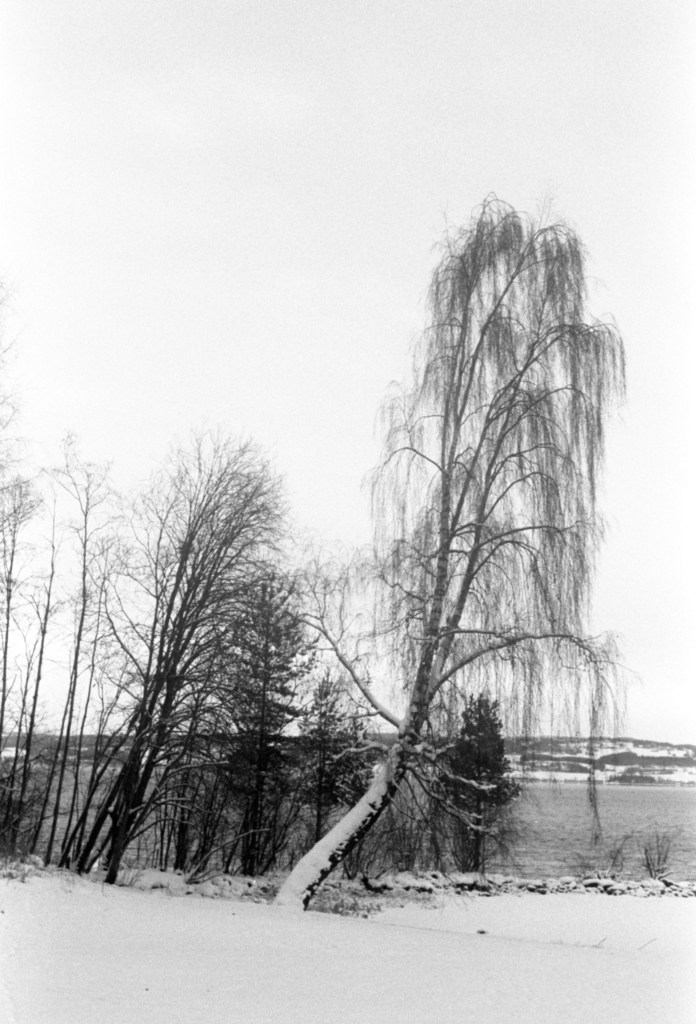
A bent tree – Canon T70 + Canon 50mm f1,8 FD lens – Ilford FP4 Plus – Adox Atomal 49
After a while I approached the trees and the little woodland-area which sadly has shrunk quite a bit over the last years due to construction of new residential areas closer to the lake, but some interesting trees are still left, and with the snow disappearing, it is once again accessible.
I find woodland-photography the most pleasant challenge for me as a photographer. Shooting a decent woodland composition can be very difficult, but at the same time, working in such an environment has a certain peace to it. The feeling you get from being in the woods is unlike anything else.
Better times ahead- Canon T70 + Canon 50mm f1,8 FD lens – Ilford FP4 Plus – Adox Atomal 49
In this second entry in the series “Frames of Norway” I am walking towards the viewing point “Amlisberget” to get the view over the little town Moelv and the lake Mjøsa in the east of Norway. This area of Norway has a very different landscape to it than what one often thinks of as Norwegian landscape. Rather than steep mountains and dramatic valleys and fjords, this area has a calmer, more rounded mood to it. The calm landscape forms were eroded during the last ice-age. There are a huge number of lakes and ponds, and the area has a lot of glacial till and in summer time, the area is one of the lushest farming areas of Norway.
The lake Mjøsa is the biggest lake in Norway and I will feature it in a number of entries in this series, focusing on different aspects or areas around it. Living and working in this area, it is a rather difficult to “forget” about it due to its size, and the landscape around the lake changes a lot from south to north, as well as its history.
A view over Mjøsa from Amlisberget – Canon T70 w Canon 50mm f1.8 – Ilford FP4 Plus Adox Atomal 49
The area around Moelv, has a long history for its industry and being one of the centers for trade and communication in its part of the lake. Being the “mid-point” between the bigger towns around the lake, Gjøvik, Lillehammer and Hamar, just about 20 minutes to each of the bigger towns, Moelv was an ideal loading-area for steamboats doing the so-called “across-trafic” indicating that they were crossing the lake, rather than doing longer trips along the lake. Boats doing this “across-trafic” were in general smaller boats owned by locals or smaller companies, and they would carry goods from smaller ports to the bigger port in Moelv where the bigger boats and ships would take over.
This is an interesting point, today, when we have the bridge over Mjøsa, we see the lake as an obstacle in our travels, but back then, the lake was the biggest and most efficient “highway” of the area with an incredible number of steam and motor boats sailing all over it. At some point, the church in Moelv served for a parish including farms and houses on both sides of the lake and having “church boats” to transport people across for sermons and so on. This connection between Moelv on the east-side of the lake and Redalen on the west side of the lake, is still strong today. This is also where the bridge is crossing the lake.
Woodland and farmland – Canon T70 w Canon 50mm f1.8 – Ilford FP4 Plus Adox Atomal 49
For this outing, I chose to go with a 35mm camera. I wanted to get a very “analog feel” to the images and I figured that being on a new location where I had never been before, I might get “shutter happy” and boom off a lot of shots. And I was right, I filled the whole roll in about half the trip.
A view towards Næroset – Canon T70 w Canon 50mm f1.8 – Ilford FP4 Plus Adox Atomal 49
I chose to go with the Canon T70, the revolutionizing first attempt from Canon on making a computerised camera. A camera loaded with different “safety features” such as sliders and buttons to make sure you don’t accidently open the camera mid-roll or accidentally rewind the film mid-roll. It also has a very good and accurate light-meter, and an apperture-priority setting that is working flawlessly. I also like the fact that this is a 100% Manual Focus camera and that you can focus manually without having to deal with the “sloppy” and “vague” feeling of an AF-lens. This is personal preference of course, but I prefer MF for this kind of use.
The Path – Canon T70 w Canon 50mm f1.8 – Ilford FP4 Plus Adox Atomal 49
I set out into a forest area where there are a lot of ski-tracks in the winter. I parked at Høgring, where the sports team Næroset IL has a little skiing cabin, and I walked from there. Forestry has meant a lot to this area, and previously Moelv had both a cellulose factory and a huge sawmill. The sawmill and its wood-workshop is still active and is one of Norways biggest providers of wood even today under the name of “MOELVEN”. The cellulose factory ceased operations in the late 1930’s due to the big depression in international trade.
A view over Mjøsa and Moelv – Canon T70 w Canon 50mm f1.8 – Ilford FP4 Plus Adox Atomal 49
Because the colours in the Norwegian nature is rather greyish and boring at this moment right after the snow melts, I decided to shoot black and white. I went for a traditional film, the Ilford FP4 plus, one of my absolute favourite films, and I used both yellow filter and a two-stop graduated orange filter. I was a but uncertain how the aperture-priority setting would deal with a soft-grad filter, but it seems to have correctly exposed the sky and overexposed the land-area, which was what I wanted it to do. Concidering the fact that the filter-thread on the lens is damaged, the images turned out rather well.
More forestry – Canon T70 w Canon 50mm f1.8 – Ilford FP4 Plus Adox Atomal 49
I chose to develop with Adox Atomal 49, a developer I have found myself to really like. Especially traditional films like FP4 and HP5 gives great results with this developer, and I find it to lift their abilities. It seems to be somewhat compensating and gives a rather flat negative and great shadow-detail even when the films are shot at box-speed. The down-side is its toxicity, and I find that even though I have loved my two first batches of it, I am hesitant to buy more of it because of this. I obviously collect the rest-developer and deliver it to a designated collection place where it is dealt with properly, but I still don’t like the thought of using something this toxic.
As you can see from many of the images, farming, as well as forestry is important for the area. Moelv was, and still is an important hub for the distribution and sale of grain and farming products in the area. Strand Brænneri was opened by the local farmers in the mid 1800s and was one of the first cooperative agricultural businesses in Norway, and became an important part of building Moelv and the surrounding area into the successful area it became in this time.
A lonely birch – Canon T70 w Canon 50mm f1.8 – Ilford FP4 Plus Adox Atomal 49
I am proud to live and have so easy access to an area with this amount of “cultural landscape”, and where you can really see how nature and man has lived together in peace over so many years.
With this entry, I am opening a new series of entries and also Youtube-videos. In these entries, I don’t care too much about the camera or film, but rather focus on composition and my thoughts behind the choice of location or film in regards to what I wanted to achieve. Everything is allowed in these entries, regardless of price of camera. And yes, obviously I will still have some entries in the old manner too.
For the kick-off of my new series, I chose one of my favorite cameras. My Hasselblad 500c, which not by any means is a cheap camera. I love shooting square format, and the Hasselblad along with my Ikoflex are to me the most inspiring cameras I own. There could be something with the waist-level finder that just makes everything look very lively and nice and makes composition very easy.
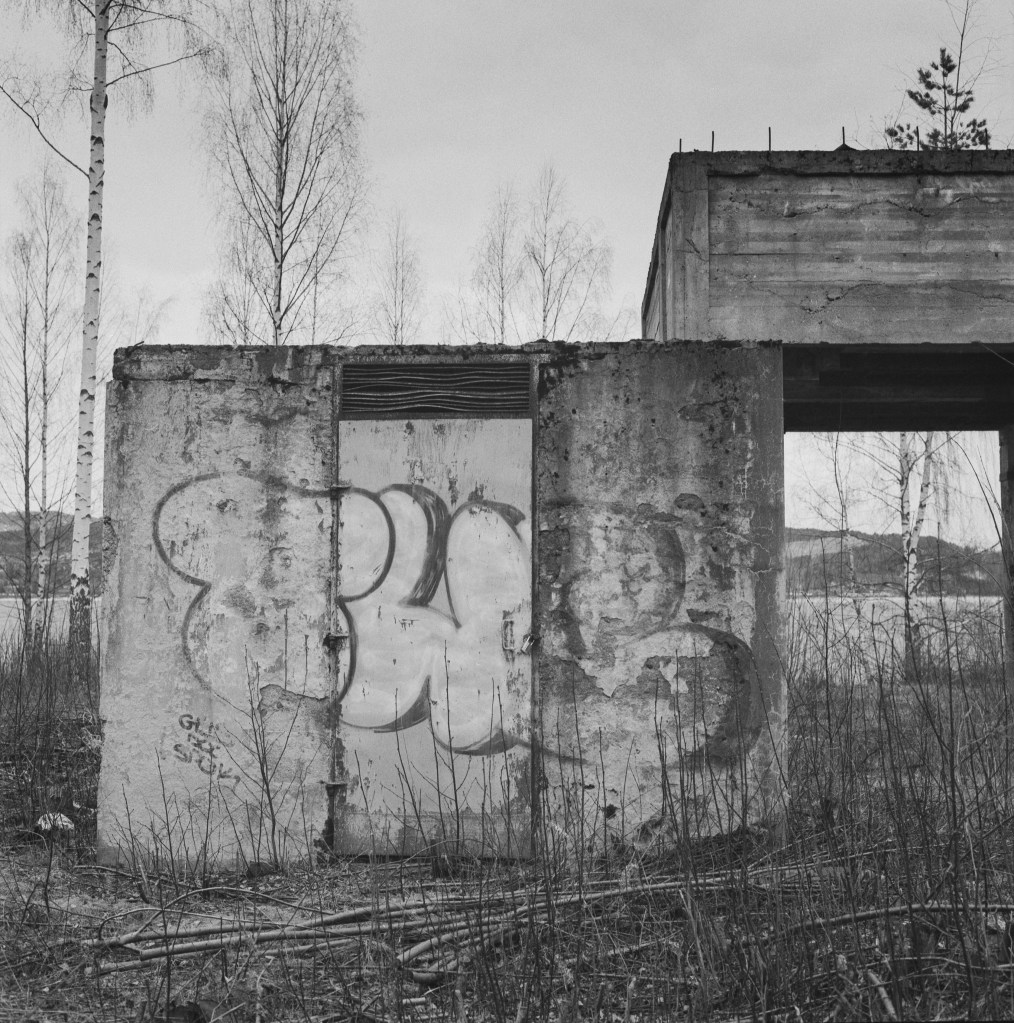
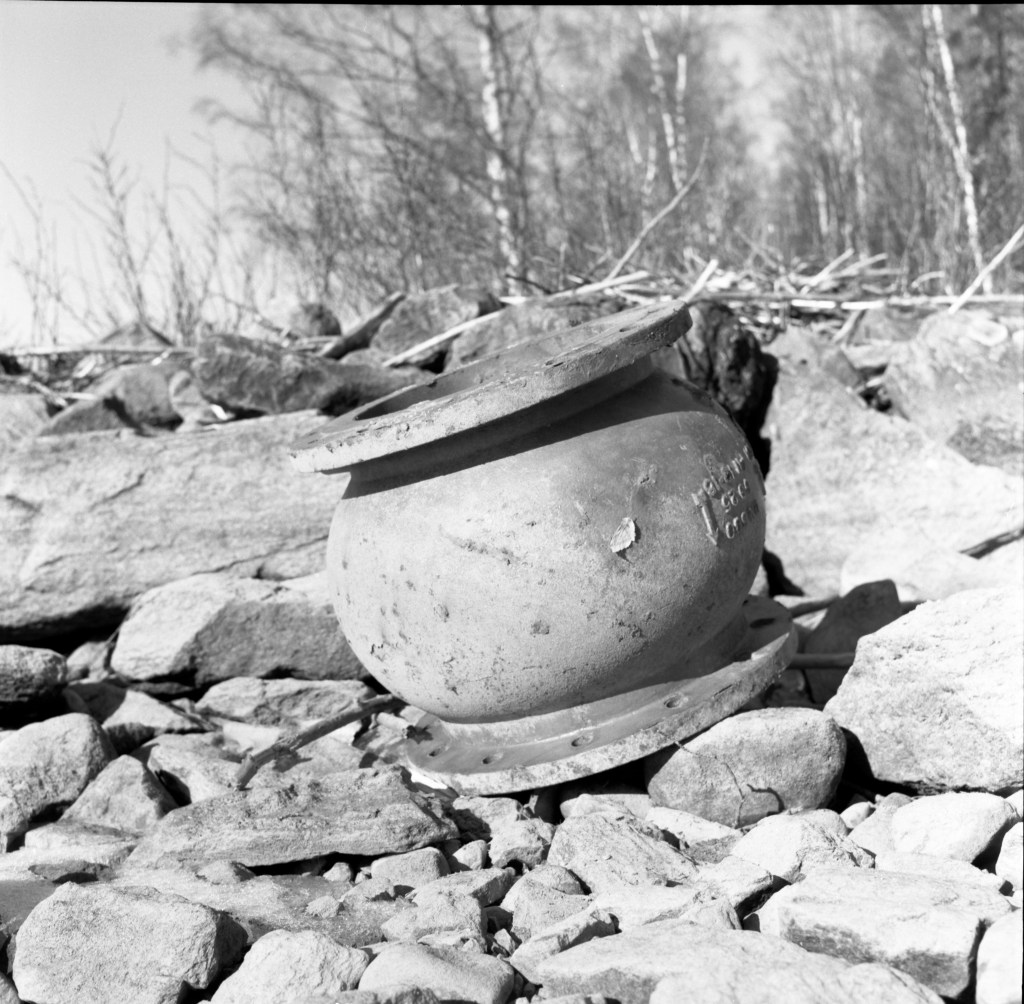
My location for this outing is the site of an old derelict saw-mill just north of Gjøvik. Back in the day, this was a very active saw-mill with close proximity to the lake and easy access for boat-cargo on the lake. There are still a lot of poles and marks in the shallow water after extensive log-driving on Mjøsa.
Remains from the Log-driving on Mjøsa – Hasselblad 500C w 80mm Planar f2,8 -Bergger Pancro 400 – Adox Atomal 49 1+1
Log-driving was a dangerous job and many log drivers would drown while working on floating timber. Sometimes, workers had to do the dangerous maneuver of loosening up jammed logs using a pike-pole. To utilize this tool, they had to walk on the floating logs, and sometimes, they either were hurt when the jam broke up, i.e. being crushed, or they could stamp on a loose log and fall unto the water and get stuck in the water under the massive amount of logs.
In honor of the history of these brave workers, I decided to go with a somewhat gloomy look to these images. To me, gloom means additional grain and a rather «grey» palette. A film I have often had issues with being too grainy or gloomy for my taste is the Bergger Pancro 400. I have used this film just a few times, and I still have some lying around in the freezer. I thawed up one of them and went for this choice.
Remains from the Log-driving on Mjøsa – Hasselblad 500C w 80mm Planar f2,8 -Bergger Pancro 400 – Adox Atomal 49 1+1
It turned out better than I expected, and this film might just be perfect for this kind of shooting. A few pieces of reflection though are the following:
Be very precise when exposing Pancro 400 as it handles underexposure extremely poorly and easily loses the highlights. I tries my best to nail my exposures dead on, and did reasonably well until my lightmeter decided to produce a flat battery. After that I had to rely on a simple app on my phone, which surprisingly worked rather well.
Take your time with this film. I have tried different development cycles for this film, but this is by far my best results with it. I often shy away from very long development times of more than 12 minutes if possible, but to me, it seems like the results with Pancro400 gets better the longer you develop. This process in Adox Atomal 49 1+1 took 23 minutes.
Fix for more than the double time of what you would normally do. As in the previous point. Time is gold with this film. I fixed this one in fresh fixer for 12 minutes, double the time recommended by Bergger, and that seems to give clean negatives. Anything gives harsher grain due to remaining emulsion I guess?
Use it for its potential of making moody and gloomy shots. This is not an «everyday happy snappy film». You have to work with its strengths.
The remains of Biri Bruk – Hasselblad 500C w 80mm Planar f2,8 -Bergger Pancro 400 – Adox Atomal 49 1+1
From my research online, I find that the sawmill was active until the early eighties. I cannot guarantee my accuracy here, but it was defunct before the nineties. In 1994, Lillehammer hosted the Winter Olympics, and the old sawmill was being restored, the goal being it becoming a restaurant. Situated along the road between two venue-towns, Lillehammer and Gjøvik, the location was ideal.
During its restoration, something happened and the old sawmill house caught fire and burned to the ground on Friday the fourth of June 1993. The fire started in the old chip-silo and quickly spread resulting in devastating damage with fire-fighters unable to over-win the fire. Today, only the foundation walls are left, and is what you can see photographed in some of these images.
Ruins of Biri Bruk – Hasselblad 500C w 80mm Planar f2,8 -Bergger Pancro 400 – Adox Atomal 49 1+1
For me, this location has some personal value. My grandfather used to work in this place as a lorry-driver for many years, and when walking around, I can still hear his voice takling about all the interesting and struggle some days they had at work in this old sawmill. What was important for me in this outing, was to capture the mood of the place in regards to its history and how it is a symbol of a very decentralized way of structuring agriculture. And maybe most important, how we still have some remains of a very active workplace in a very smack little settlement.
Remains from the Log-driving on Mjøsa by Biri Bruk – Hasselblad 500C w 80mm Planar f2,8 -Bergger Pancro 400 – Adox Atomal 49 1+1
I hope you enjoyed reading this entry, and that you can catch the mood I am trying to convey through them. I would also love hearing your thoughts about Bergger Pancro400 and if you have different or supporting experiences.
One of my favorite subjects for my photography is driftwood and other types of old wood, such as dry tree-roots or fallen branches that has been lying around for a while and gotten touched and greyed by the elements. To me, this represents a strength and a a token of persistence shown by nature. Yesterday, I was out very early in the morning, before sunrise with just the colours trying to capture them with my Hasselblad. Once my roll of KODAK Ektar was filled, I broke out my Olympus OM-1 with its incredible 50mm Zuiko lens and a roll of Kodak Tri-X in search of some driftwood.
Just a little sneak-in from the Hasselblad because I absolutely love this image – Hasselblad 500C – Planar 80mm f2,8 – KODAK Ektar
My location for the morning was Husodden in Søndre Land. A secluded little headland in the lake Randsfjorden, home to amazing sunrise-light and a wide selection of birds and forest colours in the summer. It is also the home of a little air-strip used by the local flying enthusiasts. I didn’t meet any of them this morning, but I made sure not to be in their way if they were coming.
Reklamer
After sunrise, but when the light was still rather bleak, I got soft and nice contrasts, but seeing the conditions become more and more contrasty, I decided to shoot tie Tri-X at 200 instead of 400. The only filter on the lens was a Hoya UV-filter, that I find to be helpful on this lens. Although it is supposed to be Multi-coated, I have found it to react somewhat with haze if used without. (Could be anything else as well, I am no lens expert)
Details in the old bark – Olympus OM-1 – 50mm Zuiko f1,8 – Kodak Tri-X @ 200 – Adox Atomal 49 1+1
It never ceases to fascinate me how incredibly nice the textures in old wood can be. The image above here was taken of a very small detail on a bigger log, but really shows the worn details in that old bark and how incredibly beautiful that is if you isolate it like this. I also thin that pulling the film a stop was the correct choice for this occasion, as it gave me the opportunities to shoot wider apertures such as this f2,8 with the shutter speed 1/250th. I don’t trust the Olympus at 1/1000th after having some uneven exposures with that shutter-speed. Also, I do appreciate the extra shadow detail, but I don’t think that would have been an issue with Tri-X at this shot anyway.
For development, I chose to go with Adox Atomal 49. A developer I have used a lot the last months. I bought it after having some «bad» experiences with my usual Kodak X-tol where it didn’t mix properly (two batches) and I was curious about trying something new. Ive found Atomal to be a brilliant match with many of the films I use, especially Tri-X and FP4 plus, but also HP5 plus and Fomapan 100. It gives me very fine grain and seems to give very nice grey-tones and full film speed. Trouble is, it is somewhat cumbersome to mix and consists of three bags of powder rather than two. It has also «coloured» my 5L-container red and I will have to get a new jug for the next batch.
This old log – Olympus OM-1 – 50mm Zuiko f1,8 – Kodak Tri-X @ 200 – Adox Atomal 49 1+1
The image above is taken at f 5,6 and shutter speed 1/125. I just love the lines and how it almost seems charred in the dark-area to the right bottom. The balance in this image is very soothing I find, and it really shows why I find the Olympus to be my favorite 35mm Camera.
Since I was at an airfield – Olympus OM-1 – 50mm Zuiko f1,8 – Kodak Tri-X @ 200 – Adox Atomal 49 1+1
I shot 36 images of drift-wood in different ways and I only included my top-picks here. However, on my way back to the car, I spotted the wind-indicatorthingie (whatever it is called) and decided that I would attempt a 37th frame. I find that the «last image» don’t always come out, but I figured it was worth giving it a shot. I think this was f8, but it did not take any notes about this shot.
For the sake of balance, and because I happen to have some nice images, I am going to deviate slightly from the line of «cheap cameras» in this entry, and show some images taken with my, not by any means cheap, Hasselblad. Or in my case, some times a hassle-blad. The first thing my Hasselblad did to me after I bought it, was jamming up. And not the cute little sweet jam that can easily be mended, but the proper jammedy-jam-jam that has to be sent off for a very expensive repair abroad.
I recently got it back from repair, and I have brought it along for a few outings lately, and I really find myself to love using it. Not that it really makes any big difference to anyone an image is taken with an expensive or a cheap camera, but to me it has to do with inspiration. Some cameras inspire me to go out shooting and some do not. That’s why i often feature the Olympus, the Konica, Ikoflex and the Bronica ETR. For different reasons, these cameras make me «get out there» and «get the shutter finger active».
Reklamer
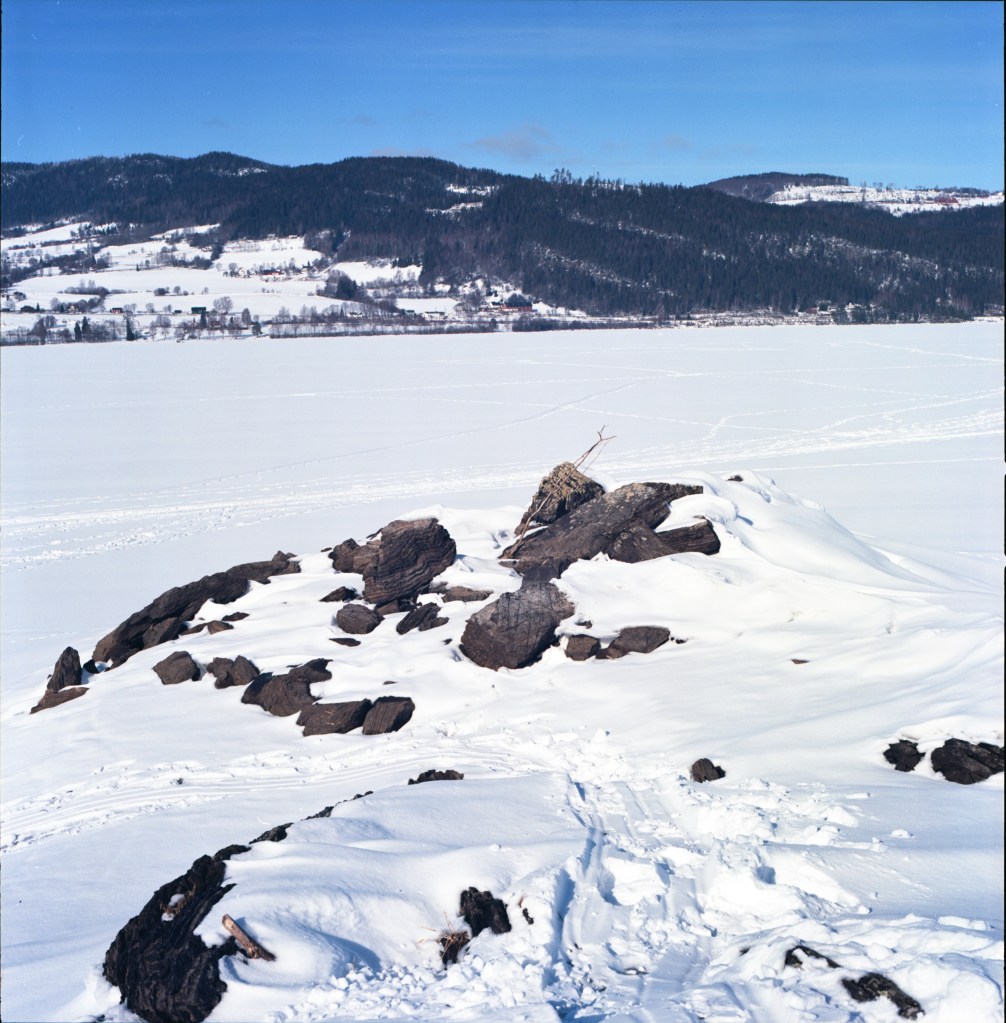
Here are some shots I did recently with my Hasselblad, that I find to inspire me a lot. The colour ones are taken with Kodak Ektar, and the BW ones are done with Ilford Pan F plus, that I pulled a stop. The Pan F is developed in Adox Atomal 49 stock for six minutes, which is 20% off the time for box speed. After having used Atomal 49 for a while, I have found this to be a developer I am very happy with, and it might replace Xtol as my number one developer.
A persistent winter fighting an inevitable spring at Kremmerodden – Hasselblad 500CM – Planar 80 – Kodak Ektar
Hasselblad 500 CM – Planar 80mm – Ilford Pan F plus @25 – Ados Atomal 49 Stock
Nothing fills me with such joy and happiness as the day when I for the first time see grass being liberated from the firm fist of the winter-snow. Today was that day, and I immediately decided to go shooting. I loaded the Zeiss Ikon Ikoflex with a roll of Ilford FP4 plus, and went down to Kråkvika by Hov. A location where spring is often present early. And sure enough, there were a lot of spots and spaces where the snow was melted away, leaving the lifeless brownish colour of grass that has been buried for a while under the snowy carpet. The colours weren’t really spectacular, hence the choice of black and white-film.
To me, the Ikoflex is maybe one of the cameras that inspires me the most. There is something about the sensation of using something so brilliantly engineered and with a lens that sharp in a very light and beautiful box that appeals to me. I haven’t used it for a while because the winter was exceptionally cold this year, and I don’t think the Ikoflex would be too fond of the cold weather. Also, my Ikoflex has developed misfiring on lower shutter speeds, so I tend to keep it at 1/100th or 1/300th, which could be too short shutter speeds for winter-time. Whether I will have it repaired remains to be decided, but for my current use, the Ikoflex works well.
Spring landscape with melting snow – Zeiss Ikon Ikoflex – Ilford FP4plus – Adox Atomal 49
I find that filling the roll and finding the right compositions, is a very easy task with the Ikoflex. The inspiration comes naturally when using it, unlike the Zeiss Ikon Nettar, which I find that I can get bored when using. I have heard a lot said in negative ways about the Ikoflex and it being like an «over protective mother» or «insanely difficult and complicated to load», but I cannot understand how any of these can be true. If you read the manual, which I know is a very uncommon thing for people to do today, you will very easily understand that the advance wheel will turn freely when it reaches frame nr 12, and that you have to manually reset it for frame 1. Not at all difficult. I have a video on Youtube showing how it is done.
Reklamer
I am a rock – Zeiss Ikon Ikoflex – Ilford FP4plus – Adox Atomal 49
Walking around on a day where the snow is melting and the landscape comes back into sight, makes you notice objects or shapes that would normally either be removed or invisible in the greens and lush landscapes. There is something «rough and contrasty» about these snow-melting days that really appeals to my way of composing.
All in all, I had a very joyful little day out in the sun and I enjoyed every minute of shooting with the Ikoflex again. It is such an amazing little camera and the images really speak for themselves.
I have never worked with any kind of panoramic equipment before. I have held a Hasselblad X-pan in my hand at one point, but I never tried shooting it. Even so, panorama photography is interesting, and I have wanted to give it a proper try. Not that I will really try it properly in this entry, but I recently bought some very cheap 3D-printed (I guess) plastic parts off eBay. Specifically, the small plastic parts that you use for using 35mm film in your medium format cameras. To be honest, I didn’t really expect much results from this. My anticipation was the following:
The film will not be kept dark enough after exposure and will be fogged.
The film might not be kept flat enough in the camera.
Composing the image will be difficult not having a proper viewfinder for it.
Unknown amount of images pr film and difficult to know how far to wind.
The plastic-stuff and a canister of film. Not the one I used for this test.
I decided to give it a try in my Zeiss Ikon Nettar. This because it is the only MF camera I have where the film is inserted in the horisontal direction, allowing me to easily shoot landscape without turning my camera into portrait. I decided to go for a roll of Ilford Delta 400 and go for a little walk while the fog was lifting over the lake. I was looking for wide compositions, which was a new experience for me, and I felt that I often reverted back to looking for squares or normal rectangles rather than the super wide compositions that this line-up would allow for.
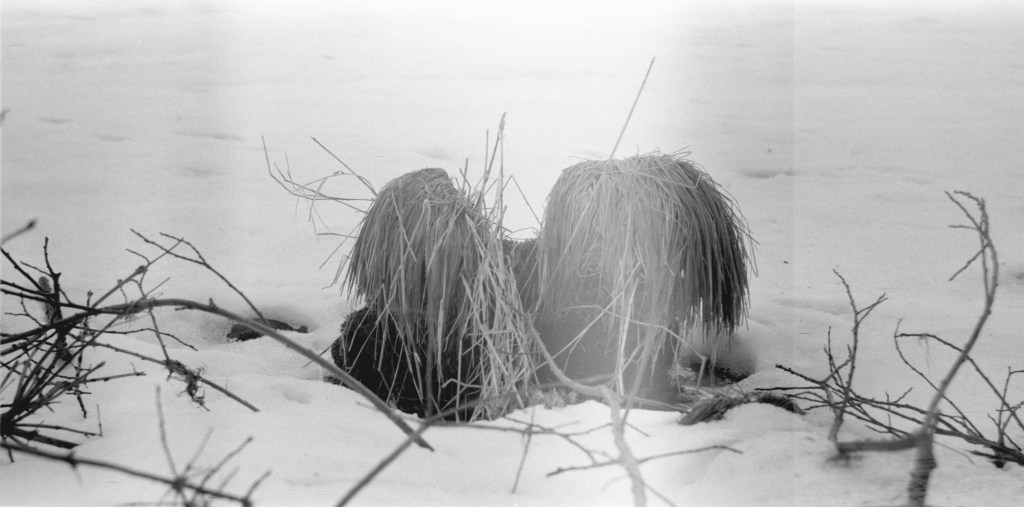
Didn’t quite nail it with this one. See the light leaks that I got for most of the shots on the roll. Luckily not too bad in this shot.
First of all, I can confirm the first part of my assumption. Using this system, with the 3D-printed parts, will give you severe light leaks between the shots. I know for a fact that it is not the light seals acting up, because I used black tape to ensure no light-leaks would come from that area.
Reklamer
For the most part, I think that the film stayed flat in the camera, and that the adapter kept it reasonably well aligned throughout the roll. I did; however, notice that the film was not as «in the middle» of the viewfinder as I had thought, and I shot a few of the frames «too high» losing parts of my intended compositions.
Over the rocks – Zeiss Ikon Nettar, Ilford Delta 400 Adox Atomal 49 Stock
Even though I like some of these images and the way they look and how they turned out, I am not certain I would use this adaptor system a lot. I will very likely do some more experiments with it and try it out at different occasions, and maybe I am luckier with my next rounds and avoid some light leaks. I find the system to be functional for shooting only one frame at a time. This would mean a lot of «cutting the film out of the camera» and «developing fragments of a roll». Not that I mind doing that, but it is a hassle.
The endless debate.. The friend-breaker. The source of family feud and potentially divorces. Canon or Nikon. People tend to be very sworn to one of them and show some (somewhat humorous) hatred for the other. Personally, I usually shoot Nikon Cameras. I own a fair amount of them both digital and analog, and the main reason for my choice of Nikon over Canon, is that I find their ergonomics to suit my hands and style more than the Canons. If shown images or specs, I am not able to tell any difference between the two brands, and I see them as equally brilliant manufacturers.
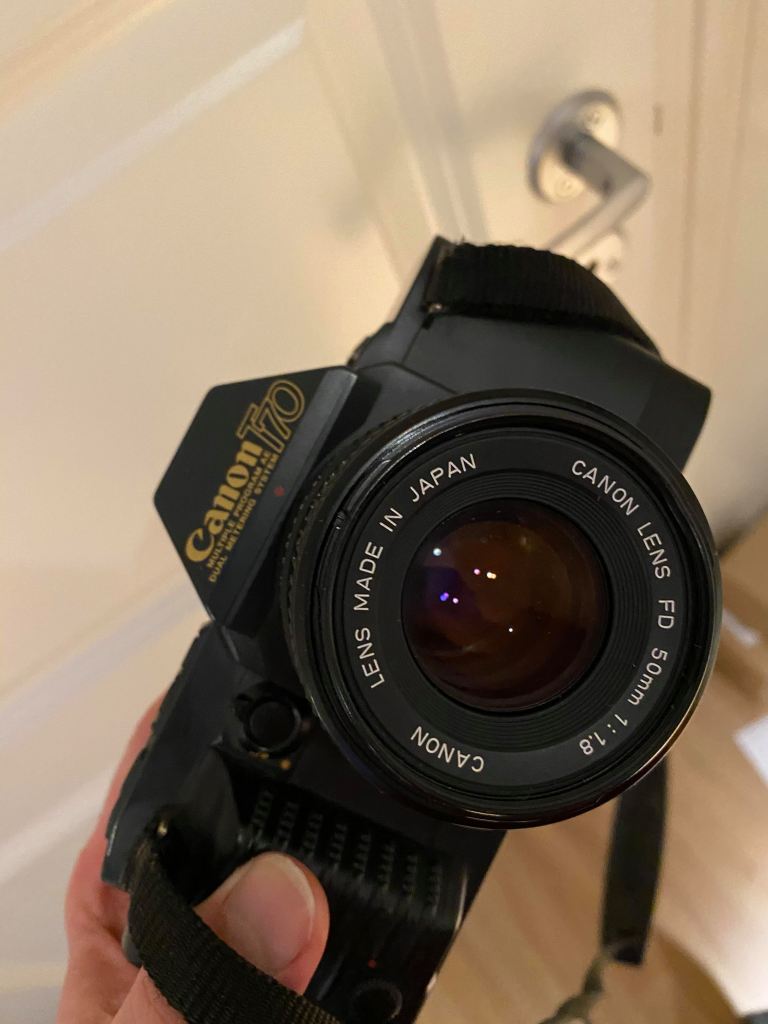
Even so, I have never before very recently owned a Canon camera. A little while back, I came across a Canon T70, and its extremely complex nature sparked my interest. Its incredible «inboard» 8 bit chip and how it was sort of the bridge between Canons older generation of very manual cameras, to the soon-to-follow EOS systems was, I found, intriguing and I started my search to get one for CC-adventures money – less than 100 Euros. I got lucky, and found one way cheaper with 50mm lens included. As a very happy man, I was now the owner of my first Canon camera, a T70.
My very clean and nice Canon T70 from the mid 80s.
Operating a new camera is always interesting, and the T70 has a very interesting button based menu system. It does not read DX-coding, but you set the ISO by pressing the ISO-button and one of the two buttons on the top over the LCD-screen named «Up» and «Down». It is programmed to go 1/3 steps and setting the ISO is very easy and the buttons are big enough to be operated with gloves in winter time.
Reklamer
Another lovely feature with this camera, that I notices straight away, was the fact that it takes AA batteries instead of the CR123A batteries. Both these types are readily available and can be picked up cheaply in most shops, but you more often tend to have AA batteries lying around than CR123A, and hence you are less likely te find yourself in a Cannot Shoot Situation with the T70.
I also like the different safety features it has. You need to press a button to unlock the release mechanism for the film loading door, preventing you from accidentally opening it «mid roll». It has an extra slider beside the rewind button, preventing you from accidentally rewinding the film too early, and it has a little button to unlock the «Power ON» button. A feature that helps you save battery. On the downside, mine has clearly a tiny light-leak, but nothing that in any way affects the images.
Using the camera is a real treat. It is very easy to focus and set, and the main setting is an aperture priority where you set your aperture and the camera will find the suiting shutter speed to go with it based on your entered ISO-speed. You also have settings for full Program-mode and you have two additional settings, one called «wide» where the camera will bias towards a higher f-stop to get deeper depth of field, and one called «TELE» where it will bias towards higher shutter speeds and shallower depth of field. I did not try out these fully automatic modes in my first tryout, but based on the function of the rest of this camera, it would surprise me if it wasn’t spotless.
Holding the T70 is an interesting sensation. The plastic body feels very cheap in you hand, but it is as heavy as a brick and has the noise-level of a helicopter. Even so, this camera feels like what it is, a quality piece of kit, with that feel of «80s science fiction» over its design and the «buttonyness» of an old Volvo dashboard.
This is a very nice camera to use, and clearly one I will use again many times.
Sometimes, you shoot a roll of film, and you just put it in a drawer. Either you forget about it or you wait until you have shot more of them before you develop. The other day, I found a roll of Ilford Delta 100 35mm, that I couldn’t remember what I used for. I developed it in Adox Atomal 49, and it turned out to be a film I used at a trip during the summer of 2019 at a landscape photography trip to Veståsen in Nordre Land.
What camera I used, is completely blank to me, but based on the time the roll was exposed, and the quality of the exposures, I would imagine it was either done with my Nikon F80 or the Minolta Dynax SPXi. Here; a beautiful view over the little lake «Akksjøen»:
Summer mood at Akksjøen in Nordre Land – Ilford Delta 100 – Adox Atomal 49
This is one of my first rolls that I have developed with the Adox Atomal 49 developer, and I must say that I am very happy with how this developer makes the images look. The grain is very fine and I get the full film-speed without any issues. In comparison with my other Veryfinegraindeveloper Ilfotec Perceptol, where you have to shave off some of your film speed.
Reklamer
I just quickly wanted to share this picture with you, from a distant past without any Covid-regulations nor fear of a world pandemic.
We all have our weak-spots as photography enthusiasts. I certainly have a weak spot for the lovely Carl Zeiss Jena Tessar lens. I will not in any way claim that I am even close to a lens and optics expert, but this lens, with its four elements in three groups, gives a sharpness and tone to the images I just love. I had one of these lenses for my M42 cameras, but this lens would benefit from some servicing as the aperture blades keeps jamming when stopping down further than f8, and the focusing ring is very heavy to operate.
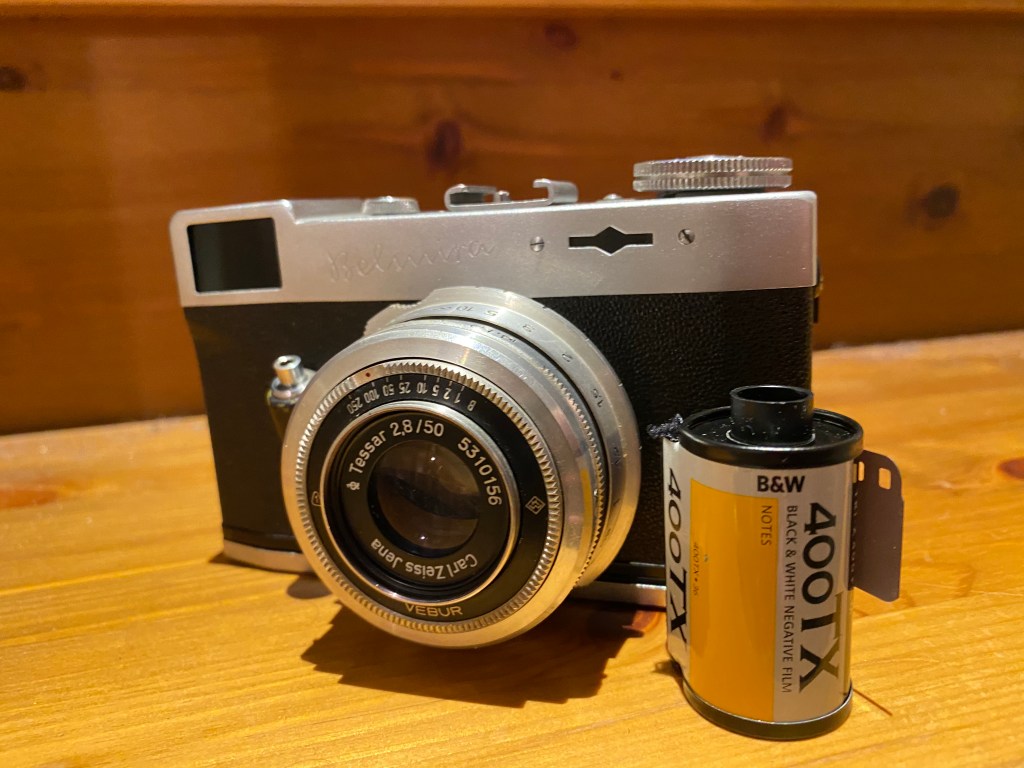
A little while back, I read about a little rangefinder camera from East Germany that was said to be magnificent value for money and deliver splendid image quality and sharpness. The camera was called «Welta Belmira» and was, believe it or not, equipped with a lovely Carl Zeiss Jena Tessar 50mm f2,8 lens. I started looking for one of these cameras to try out, and it was not difficult to find them. However, they were often in very varying condition and it was clear that getting the right and good one would take a while. And so sure it did, but after some months of searching and looking, I found one in decent condition. Yes, it was a bit dusty, and yes it had a dim rangefinder, but the camera in itself seemed to work really well.
My lineup for this test – a Welta Belmira and a roll of Kodak Tri-X400. I also used an external rangefinder unit, because the inbuilt one is very dim and only usable if the light is bright.
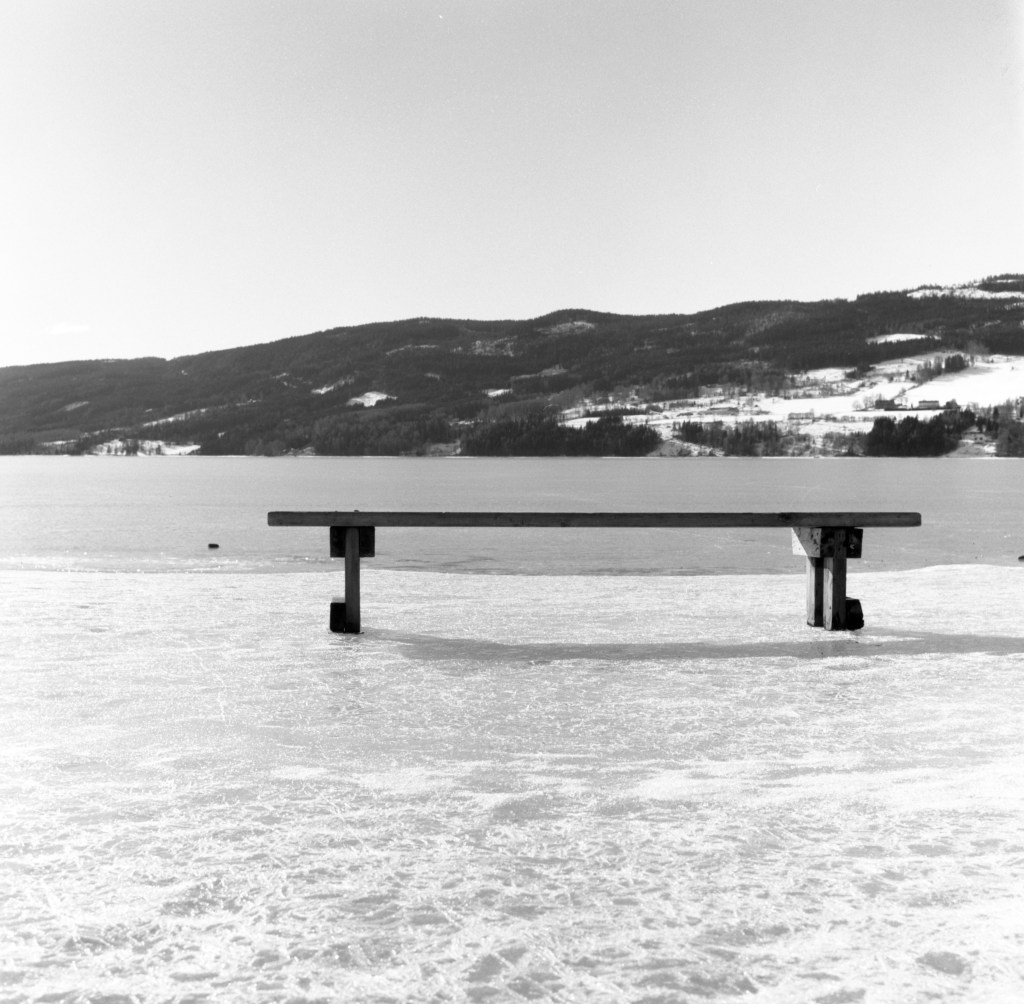
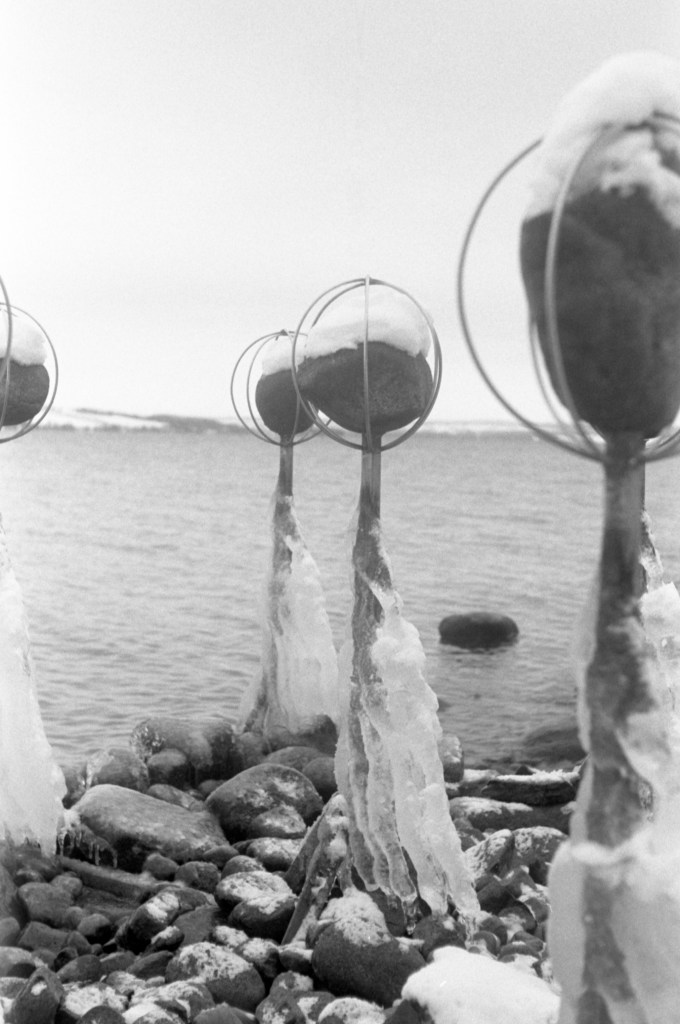
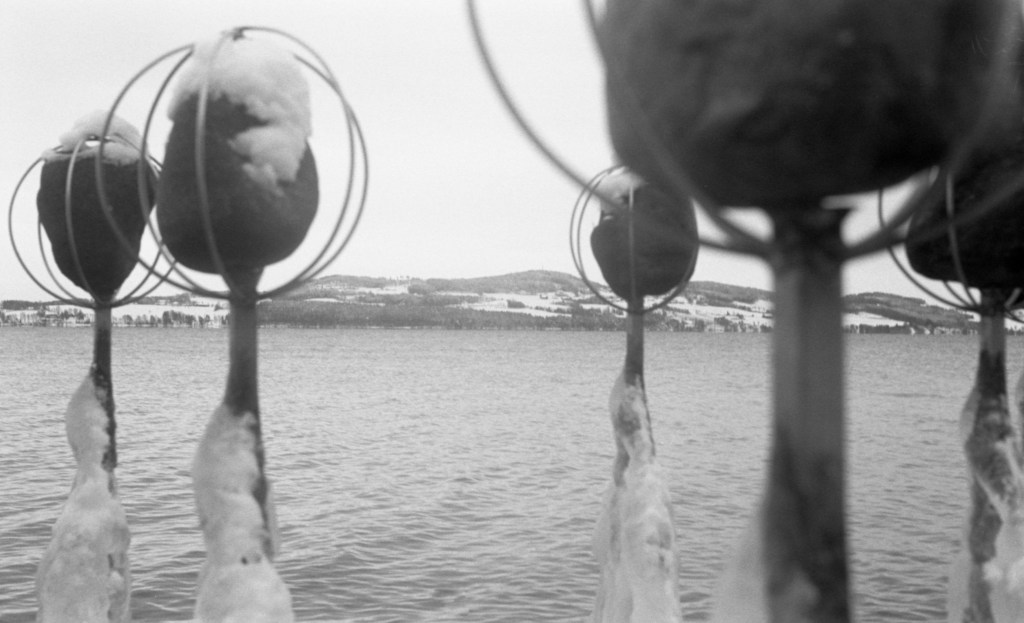
I went out to a location where there is a lovely artistic installation close to the lake, and I have thought for a while to experiment with some photography around this location. The origin of this artwork is unknown to me, but it is only accessible in the winter and spring time, as it will be submerged by the lake most of the summer time.
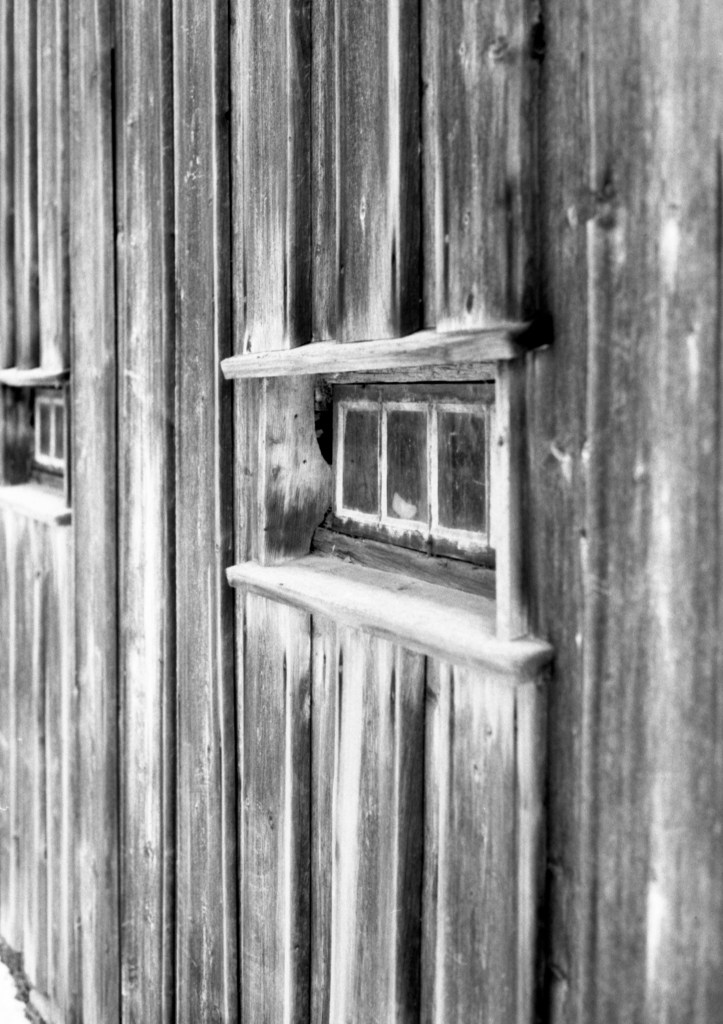
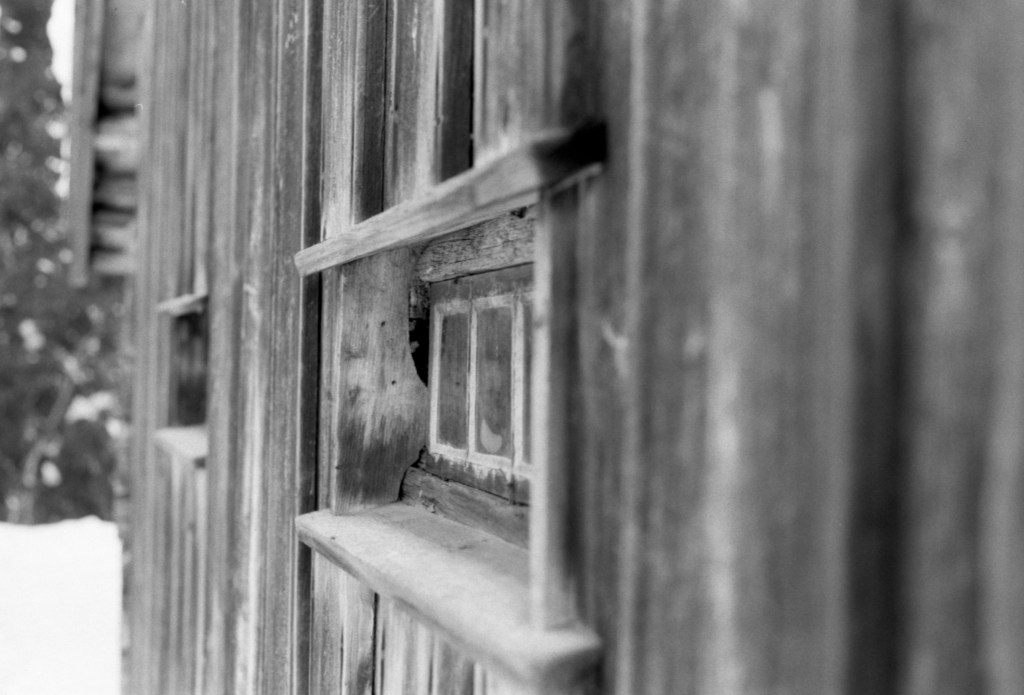
I also with this outing, made my first test of the Adox Atomal 49 developer. I read a bit about it online and saw some images developed in it, and I got curious to try it out myself. Atomal 49 is a very fine grain developer that gives you full film speed unlike Perceptol that will eat some of your speed. For that reason alone, I bought a 5L package of it and decided to give it a try. And based on these results with Tri-X at 35mm, I am very happy with what it looks like. This might well become a developer of preference to me, but I will obviously have to make more tests before deciding.
Back to the camera. I really enjoyed using the camera. It has a very special and differently engineered slider instead of the usual advance lever. It is a bit fiddly to use and has a tendency to stick at different points, but it works faultlessly. The dim rangefinder is not really an issue as long as you have an external one, and the focus ring seems to be pretty much accurate. However, I believe the camera «drags» the shutter speeds a little bit, but slight overexposure is not any issue with any negative film really.




















 Cheap Camera Adventures