Many years ago, when I was given my first analog SLR camera as a gift from my uncle, I got my interest for photography sparked immediately. This was a time where digital cameras weren’t a thing, and Kodak was a company as famous as Coca-Cola to me and my friends. If I talk to children and teenagers today, they might not even have heard of Kodak as a company.
My first SLR camera was a Nikon F60 and with it came a Voigtländer Skopar 28-80mm f3,5 lens. This isn’t by any means the sharpest or best lens in the world, but at the time I was given this package, it was my first try of a real camera with a proper lens on it. I was indeed very happy with it and I shot dusins of rolls of film with it. Usually Fuji C200 or Kodak Gold 200, with the occasional Agfa-film. From that time, I have changed cameras, medias and formats many times, but I have still kept the F60 and this lens. Sadly, the F60 does not work anymore, but I do have a Nikon F80, and I decided to give the old lens a try.
This idea struck me after I tried this lens on my D750, and I was rather underwhelmed by the results I got from that. I then figured it was worth giving it a go, once again with a film and see if it would work.
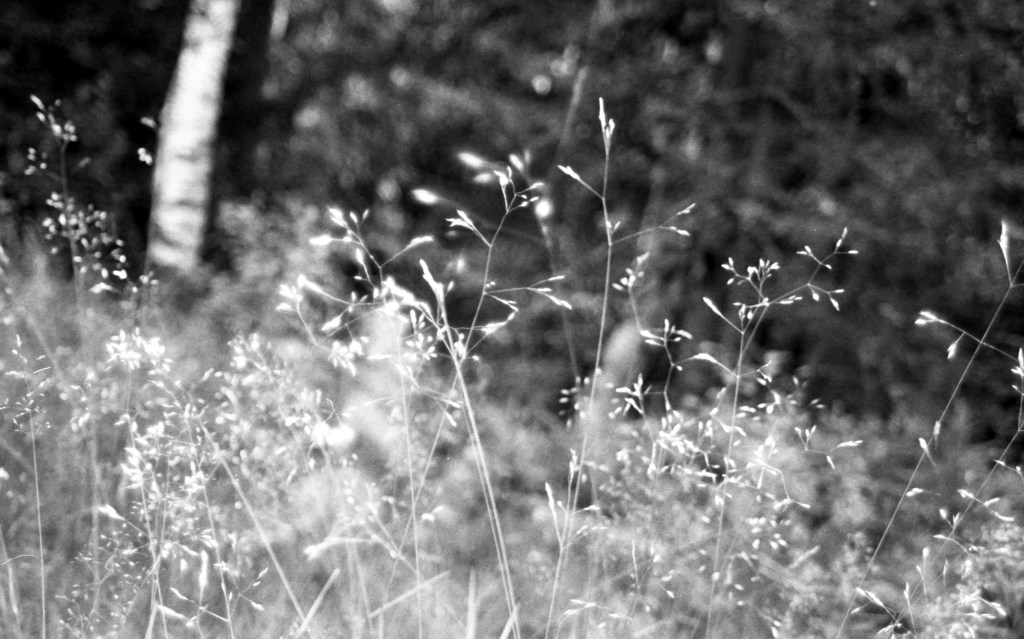
A little birch – Nikon F80 w Voigtländer Skopar 28-80mm f3,5 – Ilford Delta 400 – Ilford ID-11 stock
I then figured that I would take another old friend out for a spin as well. The Ilford Delta 400. I have never really got the love for this film because I often tend to prefer the look of HP5+ to the look of the Delta 400. This however, doesn’t mean that the Delta 400 isn’t a brilliant film, and since I was going in rather bright conditions, I figured the finer grain structure would make my images shine more in the highlights. I also went for a development cycle in ID-11 to really give it the finest grain possible with the developers I currently own.
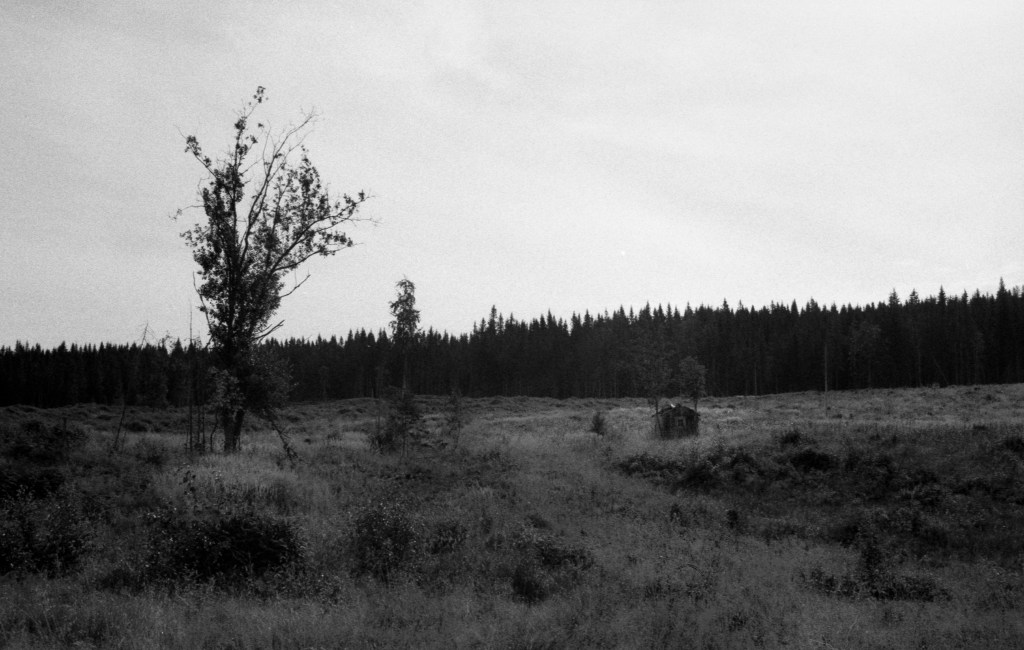
Some grass – Nikon F80 w Voigtländer Skopar 28-80mm f3,5 – Ilford Delta 400 – Ilford ID-11 stock
I went mainly for what I refer to as «small landscape» for this shoot. I define most of my landscape photography work into the two categories «small» and «big» landscape. A big landscape photo is a view, a mountain, a lovely lake and so on. Small landscape are more details and small snippets of wheat my surroundings look like. This category is often easier to find and work on in the East of Norway where I live, where most of the landscape is forest and rather flat areas.
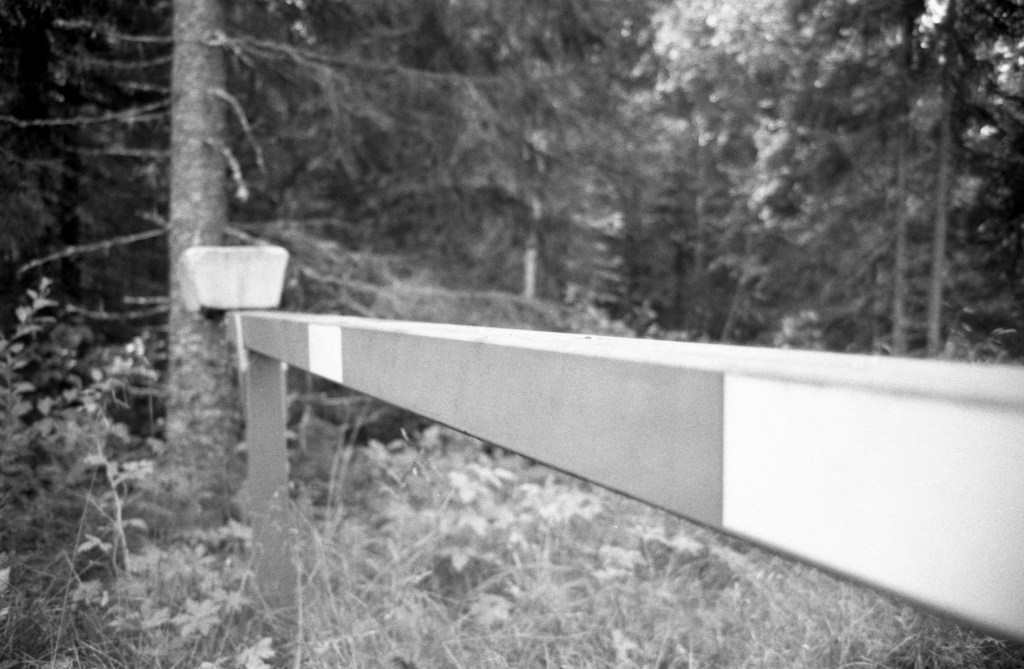
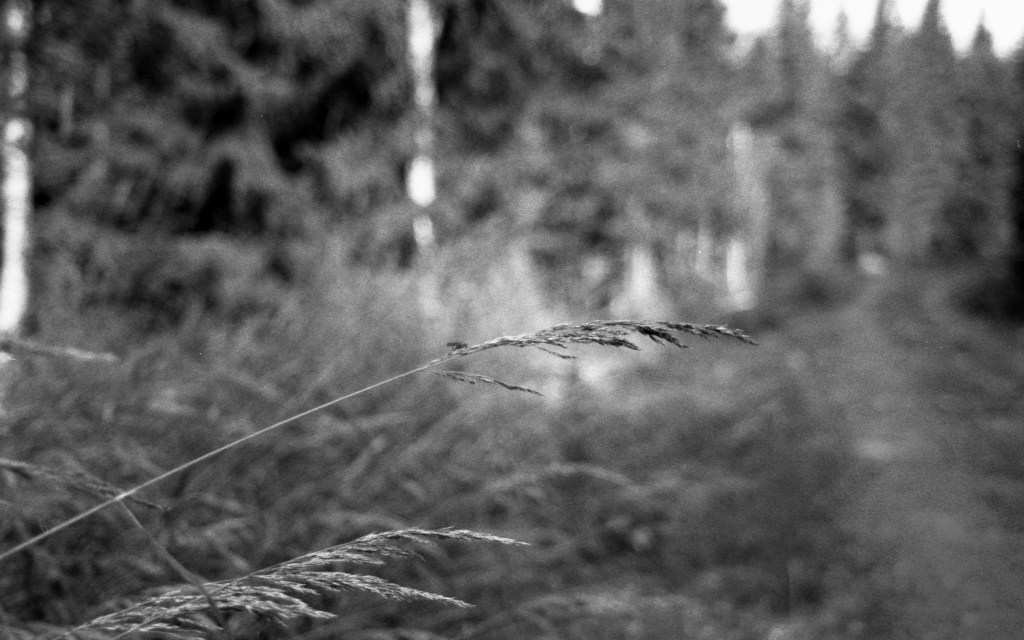
Some more grass – Nikon F80 w Voigtländer Skopar 28-80mm f3,5 – Ilford Delta 400 – Ilford ID-11 stock
All in all, I had an enjoyable little outing with my old lens and the F80. It is clear though, that my eyes for lenses have changed somewhat over the years, and I am not blown away by the sharpness I see in these images, but it could also be down to my rather «simple» scan process for these images and my general preference for medium format negatives.
Over the last couple of weeks, I have done a lot of testing, trial and error of the cheapest film on the European market. The Agfa APX100. I have tried it for different types of scenes and landscapes and even in some cases some urban stuff. All in all, I am slightly underwhelmed by its performance and I have seen it having a really big tendency to become a grey mesh or insanely contrasty. This made me do something that I figured that I should have done far earlier. I looked into the data sheet for the Agfa APX100 looking for its spectral sensitivity curve. And I must say that this sensitivity curve was something I really did not expect. Compared to the films I have shot before and compared it to, the APX100 is not even similar at all.
The curve is jumping up and down all the way, indicating that this film has a dip both between blue and green, as most panchromatic films tend to have, but also a dip into the yellows. This would explain the difficulty I have in soft light where grass and boggy areas are shifting between greens and yellows. I’ll ad the curves for FP4 plus and Fomapan 100 under for comparison. These films have a much calmer curve and I am much more comfortable with films like that.
I then figured that maybe if I chose to shoot very high contrast scenes with this film and develop with Rodinal, that this would be a better use for its qualities. I therefore broke out the panoramic adapter and rolled a full length film, and went out as a cold-front marched in over the town to take images of trees along the lake.
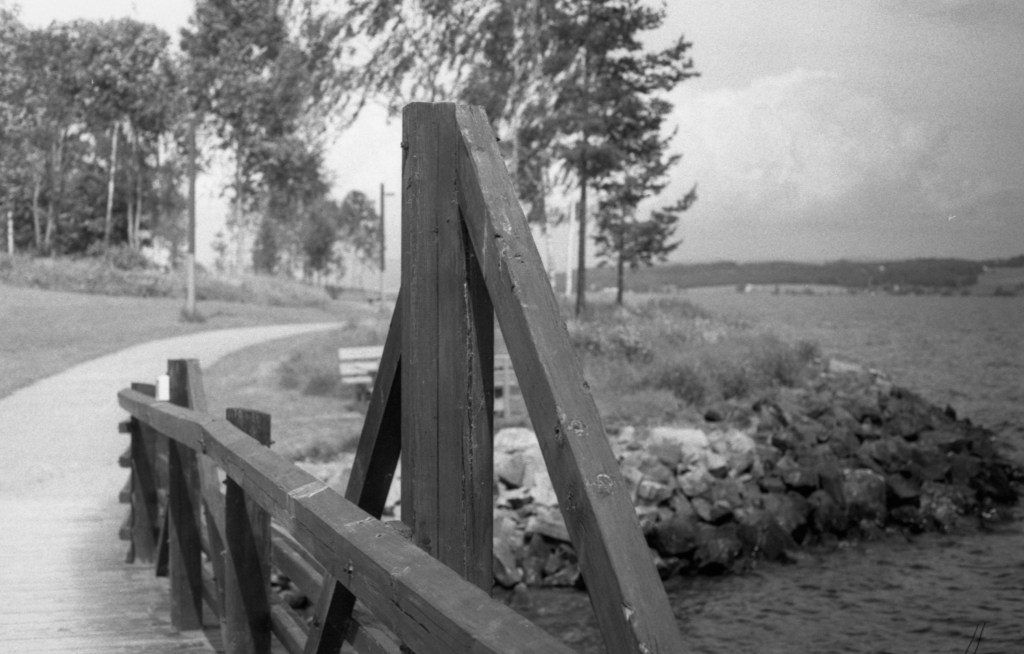
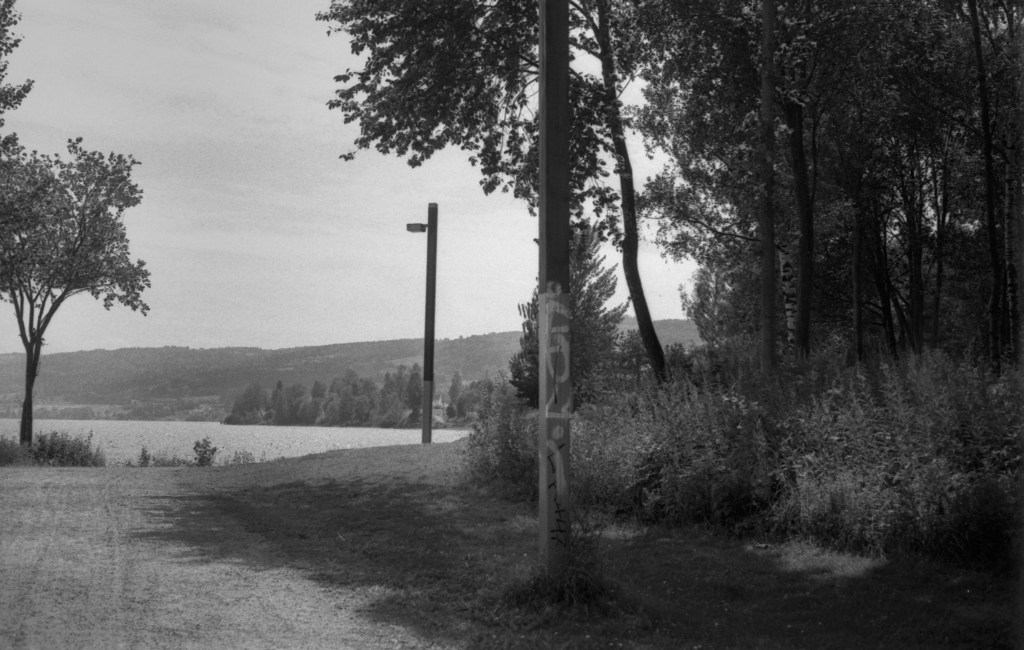
Trees by the lake – Zeiss Ikon Nettar – Agfa APX100@50 – Rodnial 1+100
This time, I really saw something happen that I liked with this film. Even though my stand development technique gave me some slight maks on the negatives and that I got a weird light leak on one of the frames, I am very happy with how this outing went. The high sensitivity to blue made the sky blow out somewhat but the contrasty clouds made them come back in a really nice way, painting the skies beautifully.
Trees by the lake – Zeiss Ikon Nettar – Agfa APX100@50 – Rodnial 1+100
I chose to once again meter my exposures at 50 rather than 100, and I think metering a stop above is a very good idea with this film as it tends to get «inky blacks» very easily. It does also seem that Rodinal is a good choice when working with APX 100. I does really give a nice result. I chose stand-development for this round because I think it is a very relaxing way of developing films giving a very smooth result. And I found it to really get the nice tonality out of the Agfa.
Trees by the lake – Zeiss Ikon Nettar – Agfa APX100@50 – Rodnial 1+100
I should have looked into the data-sheet before beginning the work with this film, but now, a little bit wiser, I will use the film for its best use rather than at its weak points. For the rest of the bulk. For my morning soft-light grass-shoots, I will use FP4 or HP5.
This last week has had really beautiful mornings and the other day, I decided to go for another tryout with the bulk of Agfa APX100. I bought this bulk a while back as I found that it was the cheapest bulk-film on the market and I was curious about its performance and capabilities. So far, I have not been really sold on this film. I find it grainy, slow and to lack latitude. I also find that, even with a very sharp lens and a very accurate camera, I get very inconsistent results. In this entry, I paired it up with my Olympus OM-1 and the 50mm Zuiko f1,8 lens.
From my previous experience with this film, I have found that metering it at 50 – a whole stop over-exposure – and developing for box-speed typically gives me the best results. Also, the yellow filter usually gives me a bit more contrast and definition in my negatives. This was also my tactic for this outing, and my results were just as inconsistent as they have been previously.
Since it was very early in the morning, and I wanted to travel very light, I chose to leave the light meter at home and rely on the light metering app I have on my phone. This is a very simple light meter, but I can easily meter at different places in the scene to get a decent exposure. I have done this in many instances before and never had any issues with poor exposures. If hesitant, I double up with an additional exposure just to be sure that I have at least one usable one. I’ll honestly say, that I only got one out of my 15 exposures this time to be anything that I would refer to as a decent image and what I had in mind while composing.
Over the misty hill. Olympus OM-1 w 50mm Zuiko f1.8 & yellow filter – Agfa APX100@50 Ilford ID-11 1+1
In this first image, which is the only one that I am actually happy with, the film manages the masterpiece of being both over and underexposed at the same time when the range was within about 4 stops. Even so, I find this image to really convey the mood of this morning very well and I like its dark gloominess. However, I know that this image would have looked far better on both Fomapan 100 and FP4 plus, which both are very affordable alternatives to the Agfa APX100, and that gives me more consistent results.
For my second composition, I wandered into the woods looking for a slow-flowing river passing under a very simple bridge. This image did not turn out in any way the way I thought it would. To me, this image is just a grey mesh with a lot of grain and lacking definition on what the real subject was. Even with heavy dodging and burning, I still am not convinced with this result. I also made three bracketed images of this, and all of them are severely lacking on definition.
Crossing the river – Olympus OM-1 w 50mm Zuiko f1.8 & yellow filter – Agfa APX100@50 Ilford ID-11 1+1
In the two upcoming images, you see the main issue with this film, completely lost shadow-detail even with a full stop over-exposure and metered for the shadows. I will keep trying this film for different purposes, but I must say, that it does not look like this film is for me and my use. I’ve read about people using this film for one or two stop push-processes, but I cannot for the life of me figure out why, when I have these issues when overexposing it.
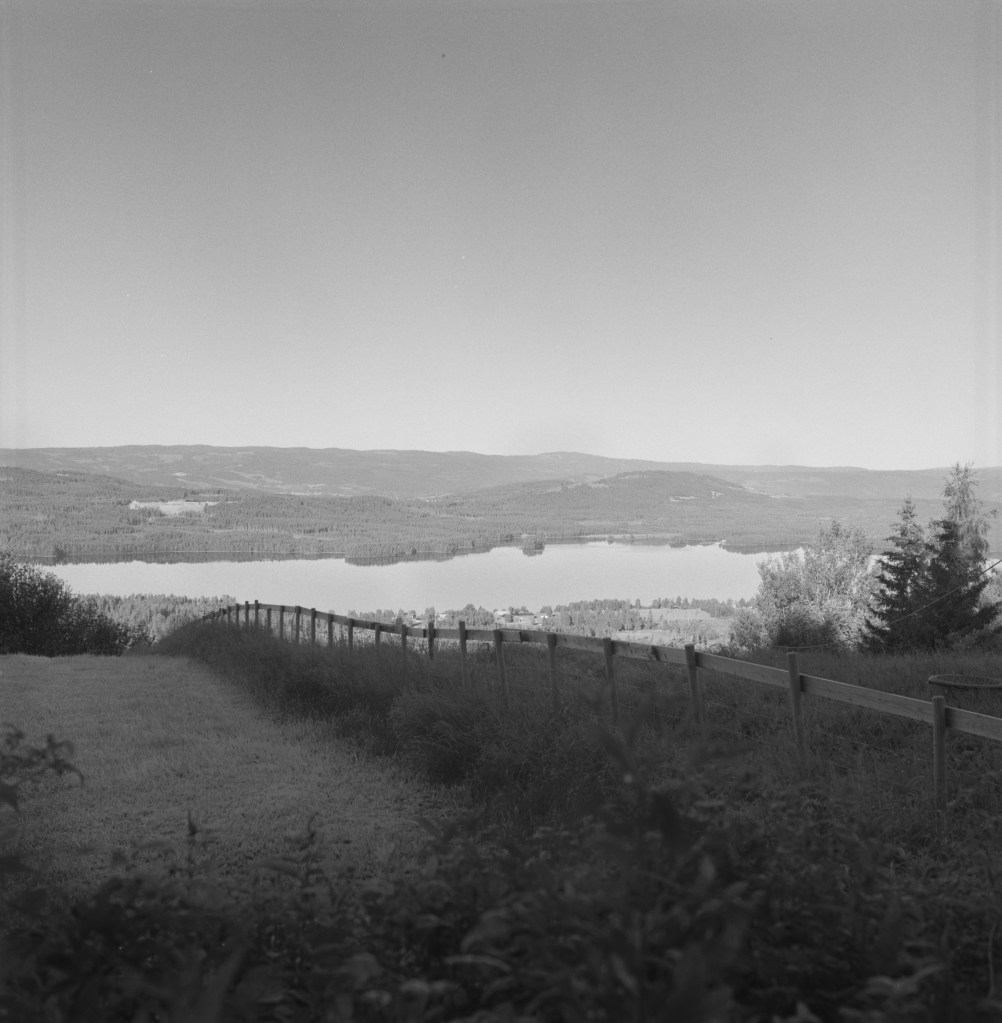
One of the most photogenic lakes around my area is bu far the lovely little lake named Næra. Situated a bit east of Moelv, it is the main bathing-water for places like Næroset, Åsmarka, Lismarka and Moelv and it is also an important area for leisure boating. A few weeks ago, as I was pondering around Åsmarka looking for an infrared-view of Næra, I came in contact with some locals. They told me about what was allegedly a much better viewing point over the lake, and I decided to take their word and go there in an early morning quest.
Armed with the Hasselblad and two rolls of film, Ektar and HP5 plus, my friend Cameron and I went for a morning stroll to the viewing point, and indeed, what a view.
The lake Næra – Hasselblad 500C – Ilford HP5 plus @ 200 Yellow filter – Ilford ID-11
Realizing that I had misread the lighting conditions on this scene, I soon decided that the HP5 would most likely be the best film for the job. My total range within the scene pushed 9 stops, and I was afraid to blow out the skies or the water with the Ektar as I didn’t bring a polariser filter because I broke it a few days prior. I then settled for a yellow filter instead, and chose the approach of pull-processing to give me a flatter negative.
Along the path – Hasselblad 500C – Ilford HP5 plus @ 200 Yellow filter – Ilford ID-11
Our path went through some really lovely forest areas, and at one point, we had a row of telegraph-poles making their way towards the farm I believe is named Harabakken. I like the way that the poles made their way towards the farm and decided to attempt a composition with the HP5+. I would probably have gotten more out of this shot using an orange filter, but I decided to travel light, and only brought the yellow.
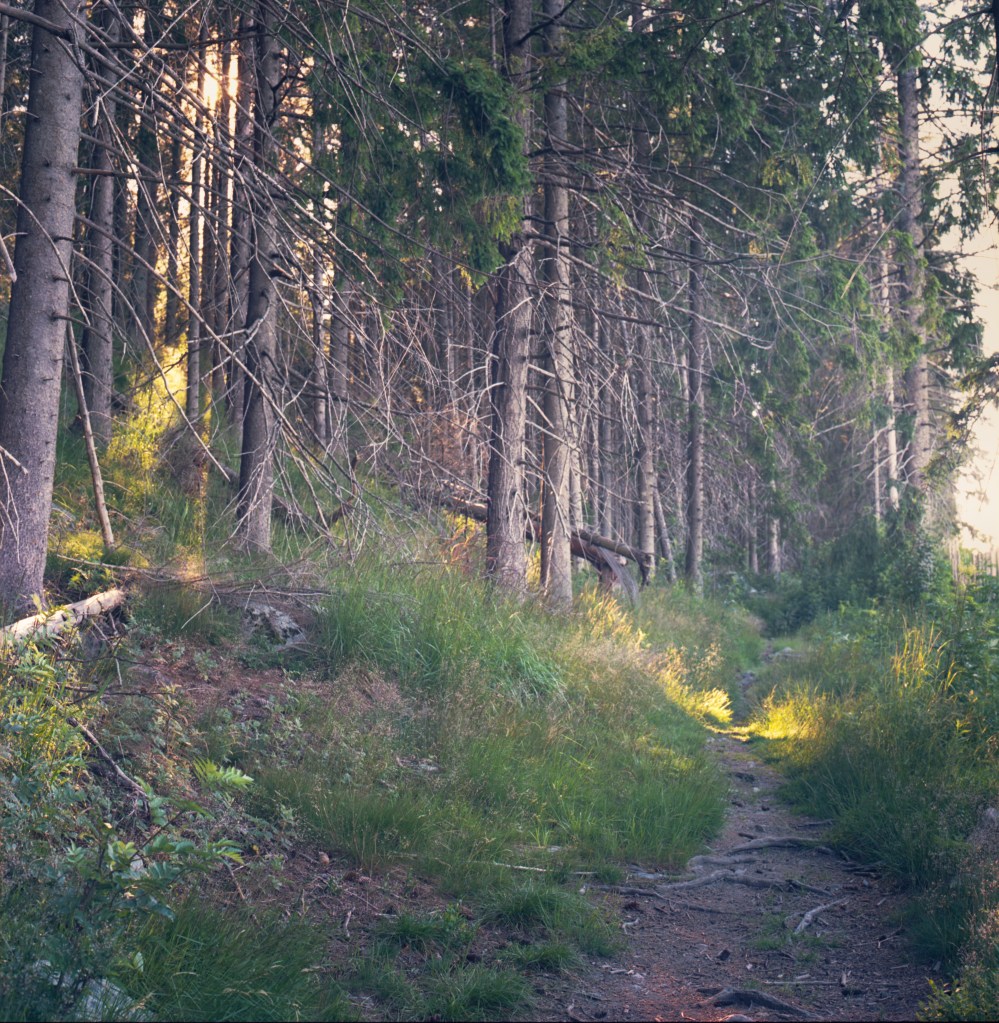
As we stopped to have out coffee, I spotted a really lovely trail of light coming through the forest, illuminating the path and some grass around. I decided to make an attempt with the Ektar-back, attempting to make a square- image.
Light on the path – Hasselblad 500C – Kodak Ektar – Tetenal C41
Our day concluded with a nice stop by another little pond that I am not going to name because it is more secluded and has a very fragile road going to it. We enjoyed another sip of coffee and had an absolutely lovely time out in nature this warm summers day.
I’ll include some more images in a gallery at the end, please enjoy
Around a week ago, I went out shooting with the Canon T70 and a bulk-loaded Agfa APX 100 film. When I pulled the negatives out of the tank, I realized that it had somehow gotten exposed to light at some point and that there were a lot of different light leaks that could not have come from the camera. After inquiring around online, I found that the most likely explanation would be that the bulk-loader itself was not light tight and that it might have impacted the film either when stored inside the bulk-loader, or when rolled. I therefore decided to take the bulk loader into the darkroom, and I rolled up one little roll of film (approximately 12 frames) just to check whether there was a problem with the whole bulk, indicating a problem with the light seals on the loader.
To make sure there were no other differences, I used the same cassette when rolling, and I used the same techniques, only that I did everything in the dark. I then put the roll of film into my Olympus OM-1, which I know have good light seals, and set off to make some test shots.
A bench and a field – Olympus OM-1 Agfa APX 100 – Rodinal 1+100 1 hour
I spotted some light leaks on this roll as well, especially on the last shots on the roll, the one that had been closest to the previous loaded film, but the frames from «deeper in the bulk» seemed untouched by the light leaks. The light leaks were also consistent to one end of the frames vertically, so it cannot be anything with the shutter or light seals on the camera. I guess my experiment showed me that the bulk-loader is not 100% light tight, and I will apply black tape to it next time I fill it with a new roll.
For the film itself. I have found that what works for me, is shooting this film at 50 (or even lower) and using a yellow filter. This gives me the shadow details and a decent spread of greys. However, I will probably not buy this film again. To me, it is grainier than Kentmere 400 and I expect finer grain and more shadow-details at box-speed for a 100 speed film than what I get from the Agfa APX100.
I also this time shot the Agfa at 50, but since I used a yellow filter, I set my light meter to ISO 25, giving an additional stop of compensation for the filter. I chose to go with Rodnial stand development on this particular test, because I wanted to see how the Agfa film would look with this kind of «lazy» development process. I think the process got some grain out of the film, and that if used on a rainy og foggy day, that this combination could work really well. It does really set the «moody» tone in the images. I would, however, get a rather similar result with pushing Tri-X, and this is a film with far broader applications.
A while back, I bought a few rolls of Ilford SFX 200 and shot it with a red filter. A normal red filter, as you would use for normal films. I likes the results and I decided that I wanted to take it one step further and try out the invisible spectrum. I bought a few rolls of Rollei INFRARED 400 and began looking into tips and ideas for dealing with infrared photography. I soon learned that what I thought to be infrared films were actually just normal films with an extended red-sensitivity and that it didn’t really go into the proper Infrared spectrum.
My first decision was that I wanted to try this out with my best equipment. I opted for my medium format cameras, the Bronica ETR and the Hasselblad 500c and bought a filter that would fit both of them. A relatively simple an straight forward 720nm filter off eBay, the brand is Greene or something along those lines and it seems to work very well. Although, no filter factor was provided, so for this round I only did two compositions and bracketed a lot to get to know the filter somewhat. From my experimenting, I found that the correct compensation for this filter is about six stops.
A little forest scene – Hasselblad 500c w 80mm Planar f2,8 – Rollei Infrared 400 Ilford ID-11 – f11 4 seconds
My first idea for this tryout was heading towards a little river passing not far from where I live. The area around the river was too overgrown for me to get any shots of at this point, so I decided to go for a forest scene for my first composition. The exposure time got into the multiple seconds, and the one I was most pleased with was the one at 4 seconds. It gave me the infrared effect that I was looking for.
I then moved on to look at the view over Gåstjernet, a little pond in the same area, and I noticed how nicely the clouds reflected in the water, framing the landscape very nicely within the 6×6 format. I think this became the stronger of the two compositions and I also did the same amount of bracketing on this.
Gåstjernet – Hasselblad 500c w 80mm Planar f2,8 – Rollei Infrared 400 Ilford ID-11 – f16 1 second
My next problem was development. I wanted to use a relatively fine grain developer to get the most out of the effect, and the only one I had mixed was Ilford ID-11. However, there were no instructions on how to use this developer for this particular film so I had to get creative. I extrapolated the Xtol-time, comparing it to other Rollei films and ended up with a development time of nine and a half minutes. This gave me very nice negatives and the ID-11 seems to have worked very well with this emulsion.
A while back, I made a post where I tested out a film I had never tried before. Agfa APX100. I was not 100% sold on this film at that point as I found it to very easily lose the shadows even when meters specifically for the shadows. After this outing, I have tried it on multiple occasions. I have tried pulling it both one and two stops. Shot at 50 with 20% reduction in development time seems to work the best of these. If shot at 25 and pulled, it comes out dull and grey and you have no shadows, nor highlights left to work with.
In this entry, I am covering my experience with shooting it at 50 and making no changes to the development time. A full stop over-exposure and develop for the full film speed. This test; however, became somewhat untrustworthy, as it seems that the film somehow must have been exposed to light. My guess, reading the negatives, is that the exposure to light must have happened after the images were taken, since the frame itself is visible through the light-leak area. I will include a raw-scan that shows the issue.
The interesting light leak situation. (Unedited scan)
Now, I have not had any problems with the bulk-roll nor with the cassettes or loader before, and my Canon T70 has never shown any signs of light leak. Not that this kind of light leak would happen in the camera anyway. It does not show on all the images, but on most of the,. I was able to salvage 4 images from this roll, maybe the best ones, who knows.
My trip this day, went through a forest-area and into a swampy area next to a very rarely visited forest-pond called Sevalstjernet. I chose this location because I knew it would give me a very varied range of objects to photograph as well as nature. I had never visited this pond before, and I strapped on my wellies, a choice that would be crucial for this outing, as I most of the time waded around in bog and fen. With my normal hiking-shoes, I would have been soaking after just a few minutes.
I was also accompanied by a cloud of black-flies. It is nice to have company when you are out walking, but I would have preferred people or a dog rather than flies. On the plus-side, the huge swarm of flies seems to have kept the mosquitoes and horseflies away, so I should maybe me grateful.
A forest watch-tower – Canon T70 w Canon FD 50mm f1,8 – Agfa APX100 @ 50
It also seems like my idea of exposure helped me greatly on retaining the shadows in this film. I do think, however that this film could be over-exposed another stop in normal development without any issue. I do still have some inky-blacks on some of my scans. Based on mob experience this far, I will not buy another roll of APX-100. FP4 plus isn’t that much more expensive, and it is a far better film. An in between, Fomapan 100 is a film I have found to work very well for me.
Some beard – Canon T70 w Canon FD 50mm f1,8 – Agfa APX100 @ 50
One of the things I love with the Canon T70, is its lens. The little, cheap 50mm FD lens performs consistently very well and is very sharp and flexible. I know there are better FD-lenses out there, but there is something to this lens that just appeals to me. I like the way it portrays the world to my images, especially when photographing the «smaller things» like this little beard-moss on a tree. I think this one was shot at f2,8 but it could also be f4. Since I lost all frames before and after this one, I am not sure.
Finally I made it into the swampy area around the lake. I think the correct term for this land would be either fen or mire, but I am not sure whether it is acidic or alkaline ground here. My guess would be acidic given its vegetation, but I might be wrong here. Sadly, what I would think is my best shot of this pond got lost in light-leaks, but I will add the one that survived.
Sevalstjernet with the farm – Canon T70 w Canon FD 50mm f1,8 – Agfa APX100 @ 50
Spring is an incredible time of year in Norway. This spring has been incredibly cold and slow, and even now, in the middle of May, we are bothered with snow in the forest. The good thing about that is that you, as a photographer isn’t very bothered with other people along the paths and you in most cases have the place to yourself. Today, I went out into some local woodland that I know quite well. Yesterday was a very rainy day, and it rained all night, so I figured that the snow was most probably melted away in the forest by now. I was very wrong, and I was not able to walk further into the forest than about four hundred meters before the snow was too deep. Also, the path looked more or less like a stream, and I had the feeling that most people would go for a swim rather than a walk on a location like this.
Nevertheless, I went out this morning and waded myself through the soaking wet forest floor searching for nice woodland-compositions. These kind of conditions, grey, wet and misty days, are the conditions that inspire me the most. They makes the location stand out in a very different way than you would see it on sunny days, and you spot details and areas you wouldn’t see if the light was brighter.
On this particular outing, I went for the Zeiss Ikon Ikoflex, a TLR-camera that I have owned for a while, and that I absolute love using. There is something about this camera that inspire me. The world looks very nice through the waist-level viewfinder on the Ikoflex, and there is something about the way the lens renders the images that really suits my eye. I chose to shoot at shallow depths of field in this particular outing for two different reasons.
First of all, I wanted to emphasis the relaxing bokeh-feeling this lens gives and how smooth the sharpness of this lens is at around f3.5 and f4. It gives a very relaxed feeling to the scene. Secondly, my particular Ikoflex has some faults with its slower shutter-speeds and below 1/50th can give a very unpredictable result when used. From no activity at all, to just a random shutter-speed. I should probably have it serviced, but I guess fixing this one would be too expensive compared to its value, and it serves me well as it is at this point.
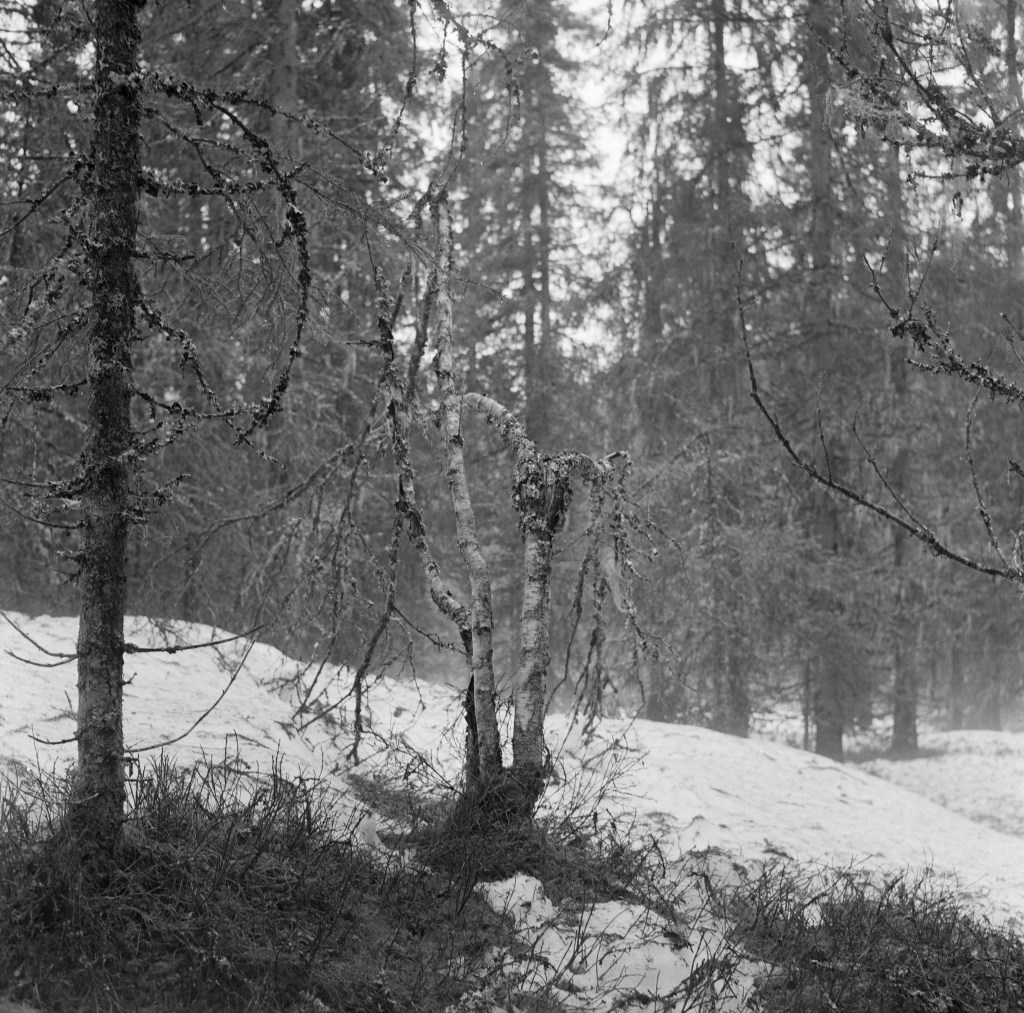
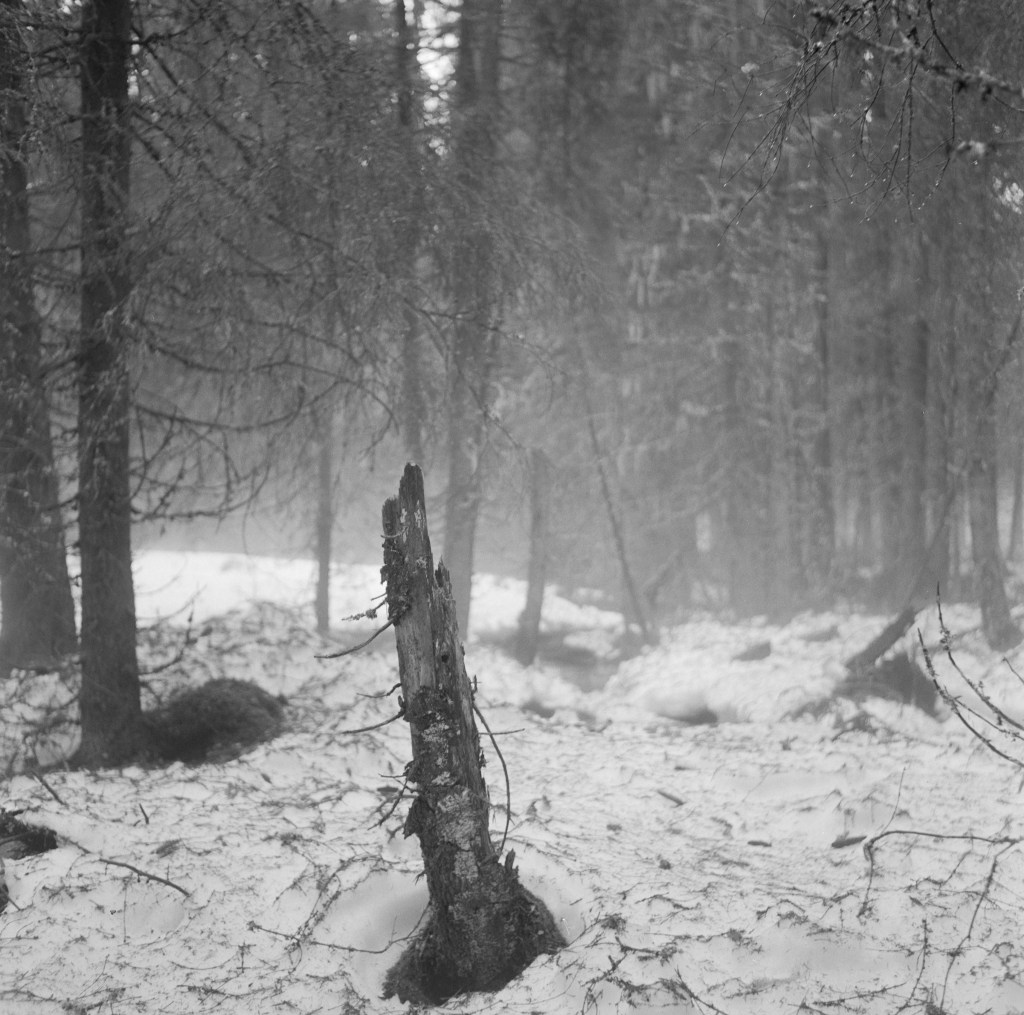
Scene of melting – Zeiss Ikon Ikoflex, Ilford HP5 plus, Ilfotec ID-11 1+1
For that last reason, I chose to go with a very flexible film to give me some wiggle-room with my exposures. I went for a roll of Ilford HP5 plus that I shot at its box-speed of ISO 400. After seeing the conditions in the forest when I came there, with that layer of mist that I didn’t expect to find there due to the conditions in general, I was very happy about this choice of film for that reason as well. Ilford HP5 plus is fantastic at capturing the mood of a misty forest.
Old mans beard – Zeiss Ikon Ikoflex, Ilford HP5 plus, Ilfotec ID-11 1+1
Even though the walk this time wasn’t that long, and the way there was rather wet and unpleasant; I actually had to jump across a stream of melting-water to reach the path; I got some images that I am very happy with. I also really enjoyed my little adveture into the wet and misty forest, and I will certainly be out again in these kinds of conditions soon.
From a wet and misty day in the woods – Zeiss Ikon Ikoflex, Ilford HP5 plus, Ilfotec ID-11 1+1
I am not usually bulk-rolling film, but not long ago, I got hold of a 100ft roll of Agfa APX100 for very cheap money. I decided to give it a go, as I have previously been very fond of affordable films like the Fomapan 100 which I also tend to bulk-load, as it is relatively inexpensive to do. I have found my way of exposing and developing Fomapan 100 that gives me the results I want. This method includes exposing at EL 50 and shave 20% off the recommended development time with Kodak Xtol 1+0.
As the Agfa APX100 is a brand new film for me, I decided to shoot it at box-speed and develop as the massive development chart suggests. As Kodak Xtol have been out of stock in Norway for a very long time now, I decided to use Ilford ID-11 to develop this film. I chose the dilution 1+1.
Winter leaves as Spring emerges – Konica Autoreflex TC – 50mm Hexanon f1.8 – Agfa APX100 Ilford ID-11 1+1
Immediately, when looking at the negatives and their scans, they appear slightly under-exposed, and it is clear to me that this film needs more exposure than I gave it at this first tryout. Especially definition in the darker areas is easily lost, and I think that a slight pull could give me a flatter negative that will be easier to work with in post-processing. My next roll will be tested with the method I use for Fomapan 100, and I will evaluate those results as well.
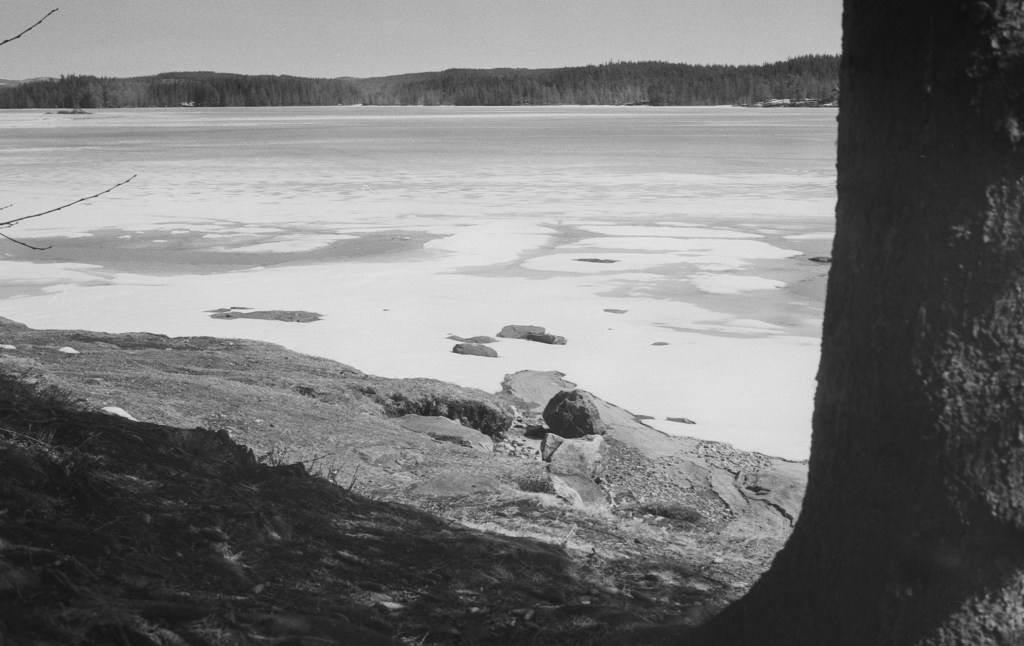
Spring by a frozen lake – Konica Autoreflex TC – 50mm Hexanon f1.8 – Agfa APX100 Ilford ID-11 1+1
For this test, I chose to go with the Konica Autoreflex TC. A camera I bought this autumn and that I have found to work very well and be reasonably accurate at shutter speeds faster than 1/60, which is the area in which I chose to shoot this time. The lens is a very standard Hexanon 50mm f1.8, a lens that is reasonably sharp and is easy to focus. Some of the images were shot using a yellow filter and some without the yellow filter.
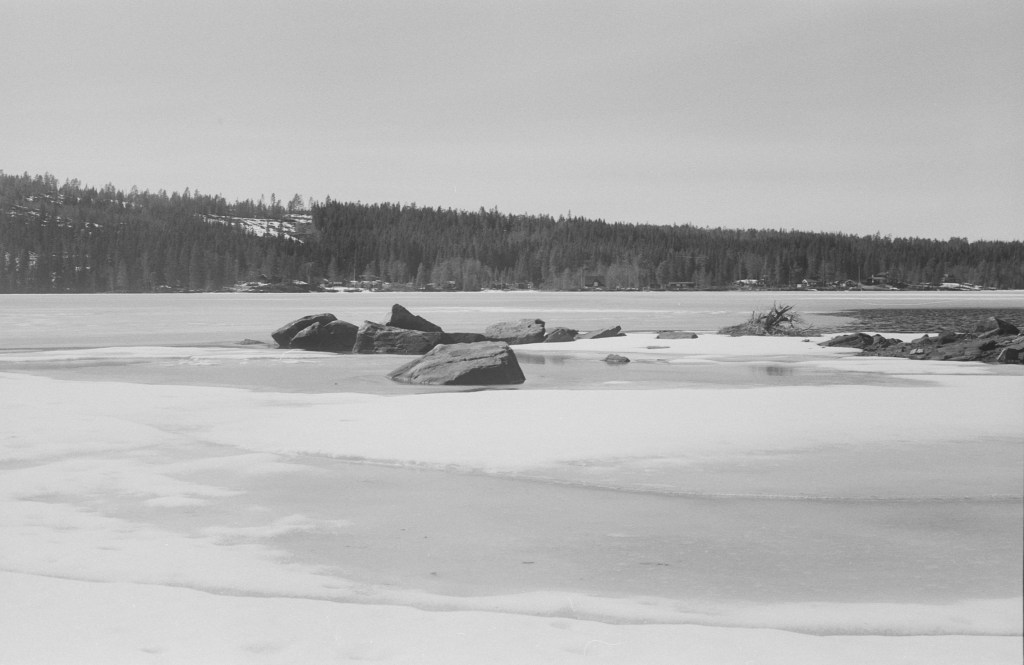
The film has the amount of grain that I would expect from a 100 ISO traditional film and it seems to me as it behaves very much like the Fomapan 100 in its sensitivity. The lighting conditions on the day were quite contrasty, and I find that to be very clear from the negatives. They seem more contrasty than I would expect from these conditions with my standard go-to slow film, FP4 plus. That said though, it is important to clarify that I am basing this on just one outing and one roll of film, and that I by no means am a film-expert. I will use this film some more over the coming weeks, and find out how well it works for me and how I can get it to work for my style and preference.
Rocks in the ice – Konica Autoreflex TC – 50mm Hexanon f1.8 – Agfa APX100 Ilford ID-11 1+1
What I found when working with these scans in Lightroom, was that getting the correct contrast-levels was tricky. You cannot go to far before you lose your shadows and you easily blow out the whites. The images taken with the yellow filter in general give a better balance in the contrasts.
Darker areas are easily lost – Konica Autoreflex TC – 50mm Hexanon f1.8 – Agfa APX100 Ilford ID-11 1+1
In this second entry in the series “Frames of Norway” I am walking towards the viewing point “Amlisberget” to get the view over the little town Moelv and the lake Mjøsa in the east of Norway. This area of Norway has a very different landscape to it than what one often thinks of as Norwegian landscape. Rather than steep mountains and dramatic valleys and fjords, this area has a calmer, more rounded mood to it. The calm landscape forms were eroded during the last ice-age. There are a huge number of lakes and ponds, and the area has a lot of glacial till and in summer time, the area is one of the lushest farming areas of Norway.
The lake Mjøsa is the biggest lake in Norway and I will feature it in a number of entries in this series, focusing on different aspects or areas around it. Living and working in this area, it is a rather difficult to “forget” about it due to its size, and the landscape around the lake changes a lot from south to north, as well as its history.
A view over Mjøsa from Amlisberget – Canon T70 w Canon 50mm f1.8 – Ilford FP4 Plus Adox Atomal 49
The area around Moelv, has a long history for its industry and being one of the centers for trade and communication in its part of the lake. Being the “mid-point” between the bigger towns around the lake, Gjøvik, Lillehammer and Hamar, just about 20 minutes to each of the bigger towns, Moelv was an ideal loading-area for steamboats doing the so-called “across-trafic” indicating that they were crossing the lake, rather than doing longer trips along the lake. Boats doing this “across-trafic” were in general smaller boats owned by locals or smaller companies, and they would carry goods from smaller ports to the bigger port in Moelv where the bigger boats and ships would take over.
This is an interesting point, today, when we have the bridge over Mjøsa, we see the lake as an obstacle in our travels, but back then, the lake was the biggest and most efficient “highway” of the area with an incredible number of steam and motor boats sailing all over it. At some point, the church in Moelv served for a parish including farms and houses on both sides of the lake and having “church boats” to transport people across for sermons and so on. This connection between Moelv on the east-side of the lake and Redalen on the west side of the lake, is still strong today. This is also where the bridge is crossing the lake.
Woodland and farmland – Canon T70 w Canon 50mm f1.8 – Ilford FP4 Plus Adox Atomal 49
For this outing, I chose to go with a 35mm camera. I wanted to get a very “analog feel” to the images and I figured that being on a new location where I had never been before, I might get “shutter happy” and boom off a lot of shots. And I was right, I filled the whole roll in about half the trip.
A view towards Næroset – Canon T70 w Canon 50mm f1.8 – Ilford FP4 Plus Adox Atomal 49
I chose to go with the Canon T70, the revolutionizing first attempt from Canon on making a computerised camera. A camera loaded with different “safety features” such as sliders and buttons to make sure you don’t accidently open the camera mid-roll or accidentally rewind the film mid-roll. It also has a very good and accurate light-meter, and an apperture-priority setting that is working flawlessly. I also like the fact that this is a 100% Manual Focus camera and that you can focus manually without having to deal with the “sloppy” and “vague” feeling of an AF-lens. This is personal preference of course, but I prefer MF for this kind of use.
The Path – Canon T70 w Canon 50mm f1.8 – Ilford FP4 Plus Adox Atomal 49
I set out into a forest area where there are a lot of ski-tracks in the winter. I parked at Høgring, where the sports team Næroset IL has a little skiing cabin, and I walked from there. Forestry has meant a lot to this area, and previously Moelv had both a cellulose factory and a huge sawmill. The sawmill and its wood-workshop is still active and is one of Norways biggest providers of wood even today under the name of “MOELVEN”. The cellulose factory ceased operations in the late 1930’s due to the big depression in international trade.
A view over Mjøsa and Moelv – Canon T70 w Canon 50mm f1.8 – Ilford FP4 Plus Adox Atomal 49
Because the colours in the Norwegian nature is rather greyish and boring at this moment right after the snow melts, I decided to shoot black and white. I went for a traditional film, the Ilford FP4 plus, one of my absolute favourite films, and I used both yellow filter and a two-stop graduated orange filter. I was a but uncertain how the aperture-priority setting would deal with a soft-grad filter, but it seems to have correctly exposed the sky and overexposed the land-area, which was what I wanted it to do. Concidering the fact that the filter-thread on the lens is damaged, the images turned out rather well.
More forestry – Canon T70 w Canon 50mm f1.8 – Ilford FP4 Plus Adox Atomal 49
I chose to develop with Adox Atomal 49, a developer I have found myself to really like. Especially traditional films like FP4 and HP5 gives great results with this developer, and I find it to lift their abilities. It seems to be somewhat compensating and gives a rather flat negative and great shadow-detail even when the films are shot at box-speed. The down-side is its toxicity, and I find that even though I have loved my two first batches of it, I am hesitant to buy more of it because of this. I obviously collect the rest-developer and deliver it to a designated collection place where it is dealt with properly, but I still don’t like the thought of using something this toxic.
As you can see from many of the images, farming, as well as forestry is important for the area. Moelv was, and still is an important hub for the distribution and sale of grain and farming products in the area. Strand Brænneri was opened by the local farmers in the mid 1800s and was one of the first cooperative agricultural businesses in Norway, and became an important part of building Moelv and the surrounding area into the successful area it became in this time.
A lonely birch – Canon T70 w Canon 50mm f1.8 – Ilford FP4 Plus Adox Atomal 49
I am proud to live and have so easy access to an area with this amount of “cultural landscape”, and where you can really see how nature and man has lived together in peace over so many years.