I am usually not a big user of slide film. I have shot some rolls in the past, but due to both cost and availability, I have not really gone deep into the positive films. In this entry, however, I am shooting slide film. And not just any slide film, I am shooting a roll of Provia 400F that expired in 2002. 23 years ago. I’ve obviously heard the warnings about shooting expired slide film and how temperamental it can be, but the guy I got this film from claimed that it had been stored in a freezer for most of its life. Hence I took the risk.
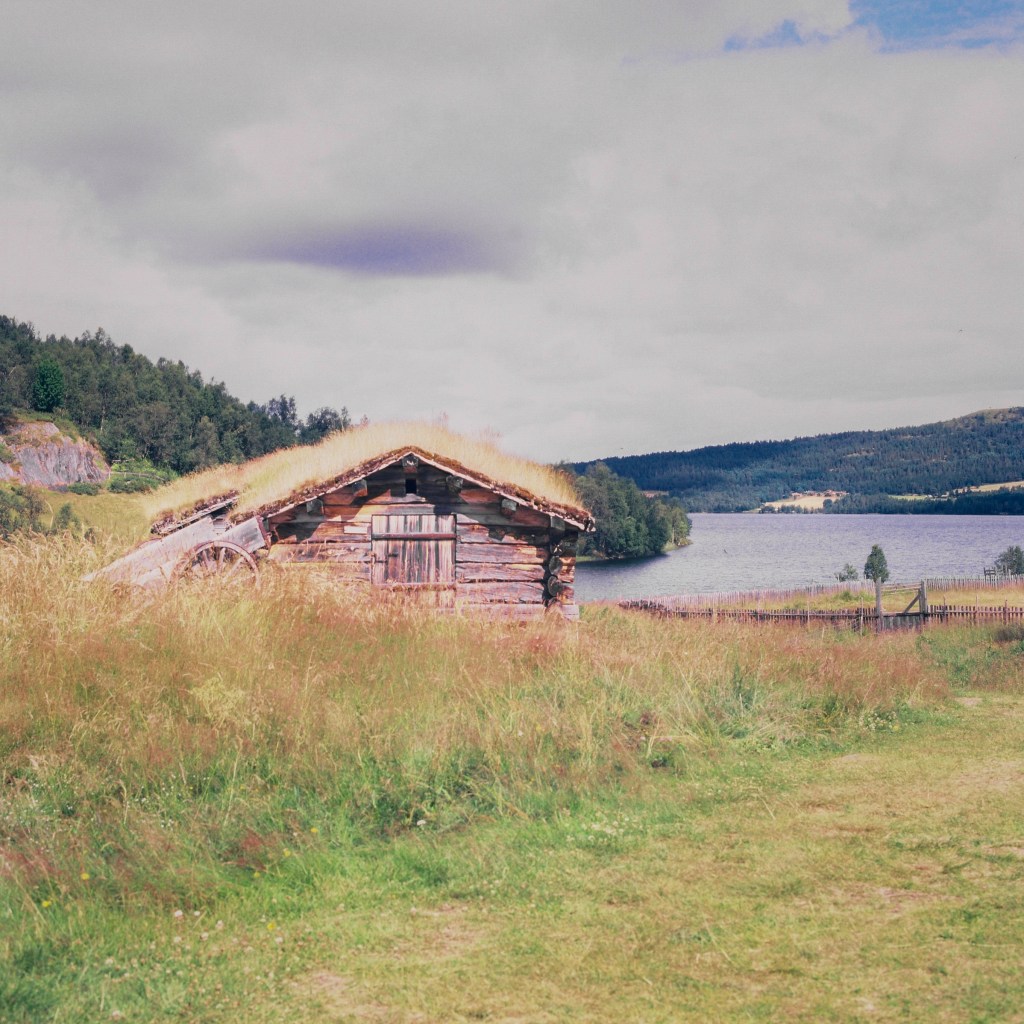
A Norwegian flag on a very Norwegian location. Hasselblad 500C with 80mm planar – Fujifilm Provia 400F expired 2002
I decided to use a reliable camera which gives me a great deal of control. My Hasselblad 500C. A camera that I absolutely love to use. I chose the most Norwegian of locations I could come up with. Kalven Sæter around Lemonsjø in Vågå Kommune. The day was mainly overcast with some rays of sun, and I chose to double my shots, to make sure I got the best results. I shot one frame at box speed and one shot a stop over. Overall, the box-speed shots came out best.
I’ve heard all those horrible stories about severe color casts etc, but with this roll, I seem to have been lucky. I got a slight cast towards magenta, but nothing I couldn’t deal with in post. The images came out very sharp and slightly green-cold tinted as I would expect from Fujifilm. I do miss Fujifilms colors in the market these days. It was one of my favorite film brands to use.
Overall, I am impressed with how this film turned out. The development in E-6 was done by Stavanger Foto, and they also scanned the film. I have been very happy with them for development before and they did not disappoint this time either. The slides and scans came out great.
Would I recommend anyone shooting old expired slide film? Probably not, but I mean, why not? As an experiment it is good fun to have some slides lying around. They look magical and the new films are far too expensive to shoot a lot of.
Finally, after a spring seeming never to produce any heat or greens in nature, summer temperatures have finally arrived. And what arrival it took on. Temperatures shot up 20 degrees in just a few hours and from dull and bland grey weather we suddenly saw blue skies without any noticeable clouds. Weather where one has to think about how to deal with the conditions. I decided to go to a local woodland-area called Sevalskogen. An area I just noticed for having really nice «old-forest» conditions and being relatively untouched for a while.
This is also an area that was heavily disputed in the 1920s and 30s. In these years this farm was owned by former Vardal Kommune, the municipality, until it was sold to a private farmer in 1932. At this time, the forest and the uncultivated fields were still owned by the municipality, and was broken up and sold out as so-called «bureisningsbruk». These were plots that people could buy and build their own farms on. This was a very unpopular decision and after just a few (I believe 4) plots were sold, the rest of the land was given back to Seval farm. This lot of land was obviously smaller than the original farm, both with forest and land. All the farms that were built in this time still stands today.
A fragment of the path – Hasselblad 500c w planar 80mm f2,8 – Fujifilm pro400h
To accompany me on this little outing, I chose the Hasselblad 500c. I have found myself to lean very much towards medium format lately, and I love using cameras with a waist-level viewfinder. I chose to roll the camera up with some Fujifilm pro 400h, a film that was sadly discontinued in January this year. I find this film to be a perfect mix of subtle colours and sharp green tones, and I find it to lean towards more of a water-color feel in the way it renders the images.
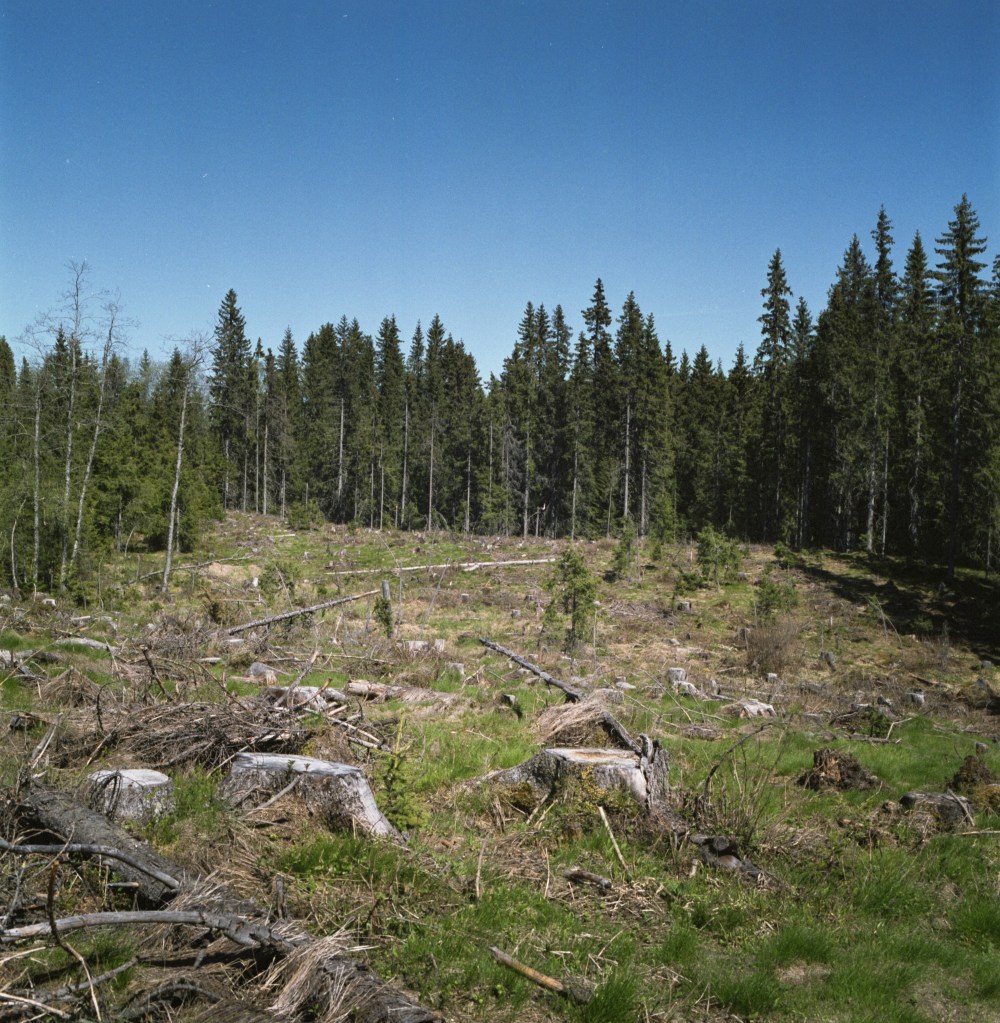
I went out with a happy spirit, but I found myself to really struggle with «getting going» this time. Just to get started, I made myself a very simple path-scene as you can see above. It is not under any circumstance a very strong composition, but it really helped me to get «into it» and get the right feel. I then progressed on and embarked into a felling-field. And here, the path mysteriously disappeared. My guess is that it has somehow been consumed by lack of use and new lush vegetation rising above the chopped down trees.
The felling field – Hasselblad 500c w planar 80mm f2,8 – Fujifilm pro400h
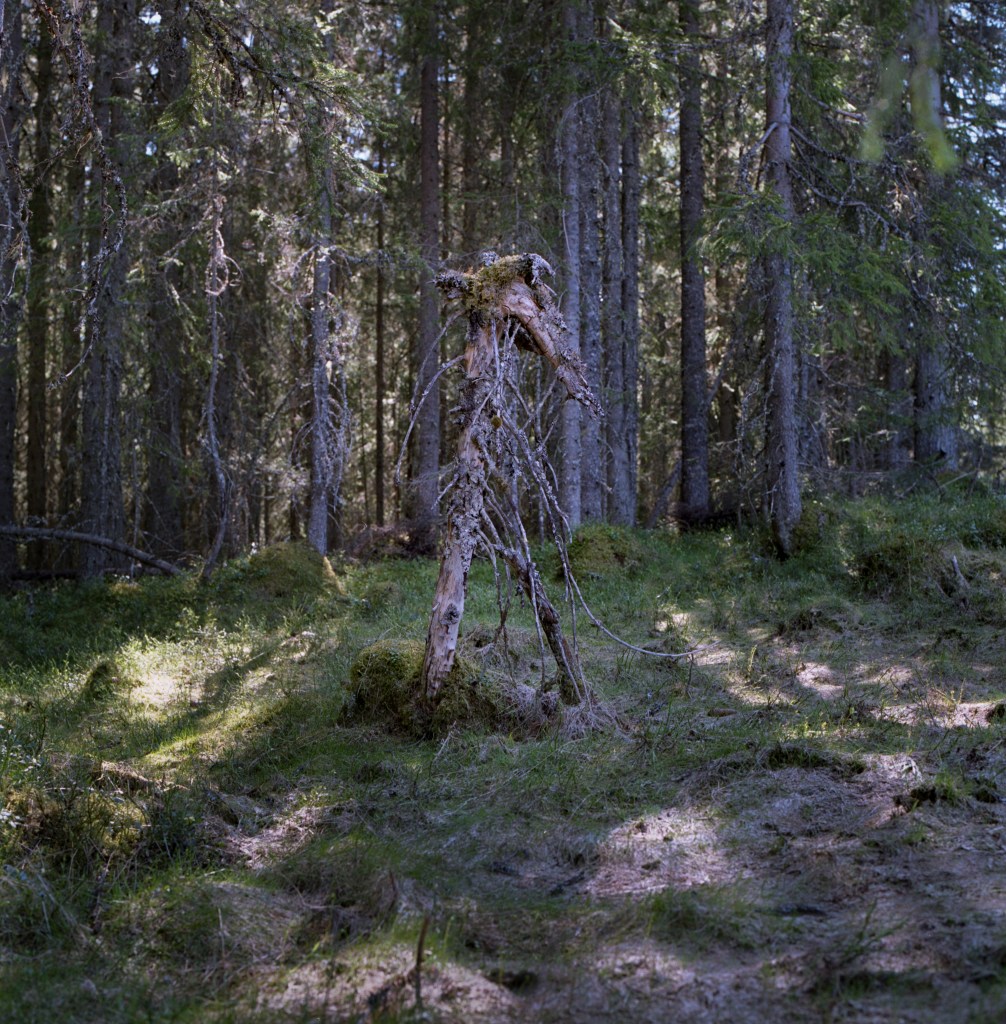
Although I couldn’t find the path, I saw a lot of small amphibians and I would guess there would be some adders lurking around the area, and since the path was a bit confusing, I decided to abandon the search for a path in the sunshine, and rather focus on the area I was already in. I turned my attention to a little tree-stub and attempted my luck there instead.
A tree-stump thingie – Hasselblad 500c w planar 80mm f2,8 – Fujifilm pro400h
I then started my walk back to the car, and I came across a scene with lovely windflowers and some forest in the background. I decided to capture it and I will share it with you here.
Windflowers sparkling in the green – Hasselblad 500c w planar 80mm f2,8 – Fujifilm pro400h
A little while back, I bought some rolls of Fujifilm C200 colour negative film. A consumer film I remember very well to have used as a photo-interested teenager. Back then I had a Nikon F60, a camera that sadly has stopped working and that is too expensive to have repaired. I upgraded it with a Nikon F80 after it died. When I tried C200 again, I was excited to see how well this film actually performs, even today in 2021. On my first tryout I shot it at 160 just to be sure that I biased towards over-exposure and not under-exposure. I realized that I lost some shadows at 200, and I decided to go out once again the other day, but this time, I shot it at ISO 100. One stop over-exposure. I was a bit nervous about this tactic as I don’t know the films characteristics that well. I was afraid I would get the very «washed out» colours you get when you over-expose Fuji-films too much, but I needn’t worry.
My chosen camera for this outing, was the Canon T70. A camera that I find to have a very good light-meter and aperture-priority setting. Since I was out walking and scouting for possible locations, I shot it using aperture-priority. The camera is manual focus and you can set your aperture, so this program gives med decent control over my exposures even if I am not controlling the shutter-speeds myself.
An iPhone snap of the Canon T70. When this image was taken it was on frame 24.
Over-exposing colour negative film is normally not an issue. The dynamic range is made to deal well with over-exposure and you get more details in the shadows. Exactly what I wanted for this outing. My location this time is Steinsodden, a little islet that is accessible by foot in spring-time when the water in the lake is low. Once the snow-melt in the mountains pick up and reach the big lakes, this islet is inaccessible without either using a boat or getting wet. The name of the Islet is «Steinsholmen» or «Steinsborga» as the locals say. It is home to the ruins of a medieval castle that you can read more about if you google «Mjøskastellet». The ruins are protected, and when I was there id didn’t see any reasons to photograph it, as some moron has figured out that putting up barrier-tape around was a marvelous idea. It is just ugly and dis-respectful to the historic site and I guess the medieval king who got it built will haunt this moron forever! (At least I hope)
Reklamer
But.. No-one reads this blog for my thoughts about barrier-tape in nature, you want to see my images:
The path – Canon T70 w Canon 50mm f1,8. f8 – Fujifilm C200@100 Tetenal C41
The first image I am going to show here, is this lovely image of the path leading towards the islet. I just love all the leading lines giving this image the depth it has, and I also love seeing that I have retained so much shadow-detail with my process of over-exposing. I was a bit concerned as the day was very sunny, but not even the sky in the background is completely «blown out». Also, with my Epson v600 scanner, this film is very easy to scan. I am having trouble getting good scans of 35mm Ektar, but the C200 really is a star.
Some nice rocks – Canon T70 w 50mm Canon f1,8 – Fujifilm C200@100 – Tetenal C41
I really love the way this image turned out. I cannot remember whether this image was taken at f4 or f5,6, but it gives a very nice focus area, and a very smooth and sift background. It is so nice that the snow is melting and that I once again can take these nature-detail images that I love looking for. I have not corrected this image for sharpness or haze, but I have tinted the colours slightly, as they were a tad too green for my liking.
Reklamer
The last one that I will show in this post, is a shot at your famous f11. The main setting of the landscape photographer. It is an early afternoon view over the lake and the weather was indeed very sunny and harsh. Even so, I see that the film coped very well with the over-exposure and I am very pleased with how it turned out.
I am actually surprised how well this film works and considering its price, it is quite good value for money. I might very well be shooting it again soon.
One of my preferred subjects for winter photography is churches. I find them to be inspiring and they always spark some kind of interest in my photographic work. I will elaborate this somewhat in this entry.
On a recent outing, I visited two very beautiful and different churches along with my new acquisition, the Canon T70 and a roll of Fujifilm C200. This film is a consumer level colour film that I tended to prefer using back in the day, around 2004 when I was given my first SLR camera, an Nikon F60. This combination, the F60 and the Fujifilm C200 (or its equivalent at the time) was what sparked my interest in photography. Sadly, out of pure vanity and neglectance, I haven’t used this for a very long time, but when I saw a three-pack of C200 at a discontinuation sale at a “everything shop”, I bought it and suddenly remembered why I loved using this film. It really has some “zing” to it that I really like.
The most spectacular of the churches I visited on this outing, was Skute kirke, near Hov in Søndre Land. Finished in 1915, it sought to be a “modern” take on the Norwegian Stave churches, and the architect Ole Stein was clearly both inspired by Art Nouveau and Stave churches when drawing this church. It was named after one of the neighbouring farmers, Peder Skute, who gave land for the construction under two conditions. All locals should be given the right to a free burial, and the graves should never be removed. This promise has been kept alive until this day.
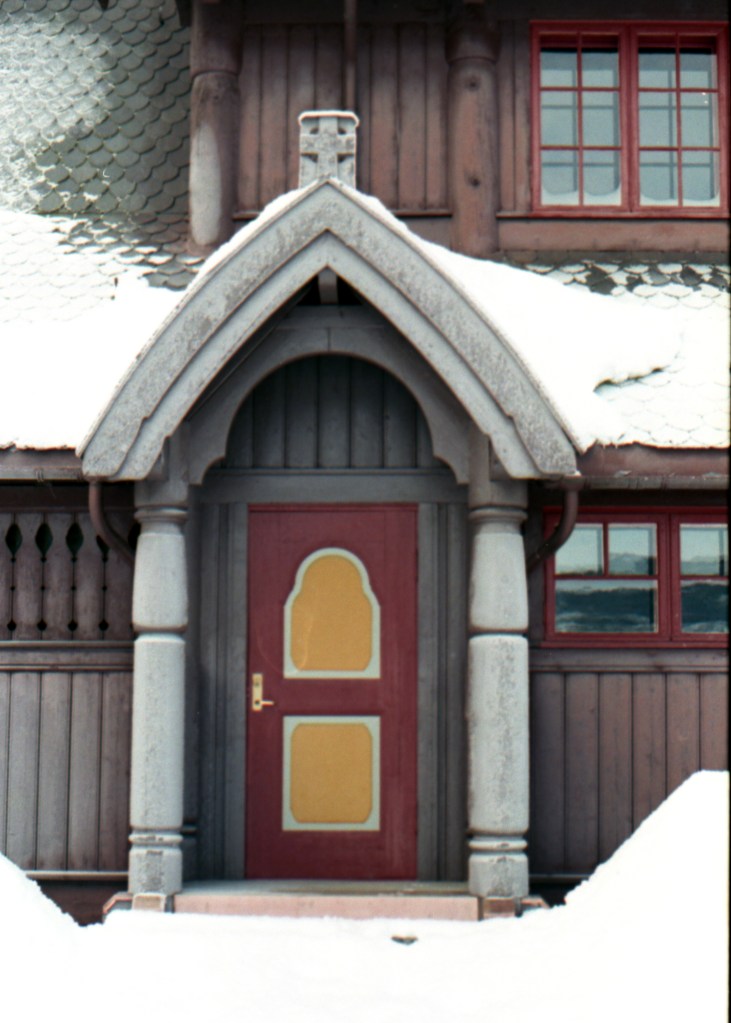
Side door at Skute church – Canon T70 w Canon 50mm f1,8 FD lens. Fujifilm C200@160
To me, Skute is one of the locations I always return to for church photography. It is such a beautiful and special building that I find to inspire my photography because of its beautiful lobster red colour and its colourful details in doors and ornaments. This is the first time I have been here in winter time, and if possible, the snow made it even more striking.
Their prominence and “standing out” of the environment is one of the reasons I like shooting churches. They are built to be proper landmarks and people tend to be very proud of their church and something they talk proudly of when asked. Often, when I am working around churches with my cameras, I get to speak to locals and employees and am often granted access to the inside as well. Sadly, I didn’t meet anyone at this trip to Skute, and was not able to photograph the incredible Neo-Baroque and Art Nouveau inspired interior, but I met a local lighting a candle on a grave, who welcomed me and was very happy to see someone photographing the church he was so proud of.
Reklamer
Another reason why I tend to shoot churches in winter time is accessibility. In the Norwegian winter, the amount of snow makes your options for locations limited to where it is in some way prepared for people to move about. The area around a church is always plowed and there are always some paths around the graveyards to walk on while taking your photos. Churches also provide some contrast and colour in an otherwise quite uninspiring and monochromatic winter landscape. Making them ideal for photography.
Scenes from Skute church – Canon T70 w Canon 50mm f1,8 FD lens. Fujifilm C200@160
Earlier on the day I visited the much older and more traditional Fluberg Kirke. About 25 minutes away from Skute, this is another church that I tend to revisit. Working around Fluberg is great for detail shots and the lovely aerial view over the lake Randsfjorden with its closest settlements Fluberg and Odnes. This is also just a few minutes walk from Meierilandet, where I did my Expired roll of Mitsubishi MX-III 400, and to get to Skute, you cross the bridge you see in that entry,
Reklamer
Fluberg Kirke was built consecrated in 1703, but its wind flag says 1699 indicating the year it the land was consecrated. At its time, Fluberg was built to be the main church of its are, and hence in the most exquisite way imaginably at the time including three galleries seating in total 450 people for a sermon.
Main gate from Fluberg church – Canon T70 w Canon 50mm f1,8 FD lens. Fujifilm C200@160
On this outing, I looked at shooting details around the church rather than aerial shots of a white church in white snow, and I must say that I am becoming very fond of the Canon T70 camera. This is definitely a camera I will be using more in the future. I will probably extend my collection of lenses suiting it to contain a wide-angle and a short tele-foto lens in addition to the 50mm.
Also, using the C200 again was a fun experience. This time I chose to set the camera light meter to ISO160, on third of a stop over exposure, to make sure the camera would bias that way if hesitating. I find that this works very well for what I wanted to achieve with this shoot. Even though there are better, sharper, finer grained and in general more flexible, but for its price, C200 is a very good choice and alternative.
Did you know that Mitsubishi, the manufacturer of cars, air conditioning units and heaters also at some point made film? At least, they had a line of film branded with their name on it at some point, and whether it is a rebranded Fujifilm or Konica film, is unknown to me. What I do know, is that the film I got in my hand is «Made in Japan» and has English writing on it. It also states that it was made at «Mitsubishi paper mills».
Roll with 24 frames of Mitsubishi MX-III 400 colour film.
Since the film was 15 years expired, I decided to shoot it at ISO 160 and use a camera that I trust. I therefore went for my Nikon F80 with a modern 85mm Sigma lens, that is substantially newer than this film was at the time it was exposed in January 2021. I chose to shoot mainly at aperture priority, because of very changing lighting conditions and the fact that I wanted to shoot with gloves in the cold weather.
Reklamer
All in all, I am very pleased with how well the film held up over the years in terms of colour representation. How this film was when it was new is unknown to me, but as it stands today, it gives very nice colours, really capturing the subtle greens and detail in the shadows, really showing the nice day it was when it was taken.
In some images, I saw a weird magenta cast in the images. This was only visible in some of the images, and not consistently over the whole roll. I developed a roll of Kodak Portra 160 in the same tank at the same time as I developed the Mitsubishi, and I could not find any of these colour shifts on this roll, leading me to think there might be unevenness in the emulsion of this film. The images with the colour shifts, were at the end of the roll. Scan settings were identical all over the roll, and should not be impacting the images in any way.
I do like the images and how this film looks 15 years in though, and I have another roll of the same roll in the freezer, that I will meter at ISO 125 to give it a little more exposure. This will be done sometime in the spring, when there is more colour around to play with.














 Cheap Camera Adventures