The derelict hut

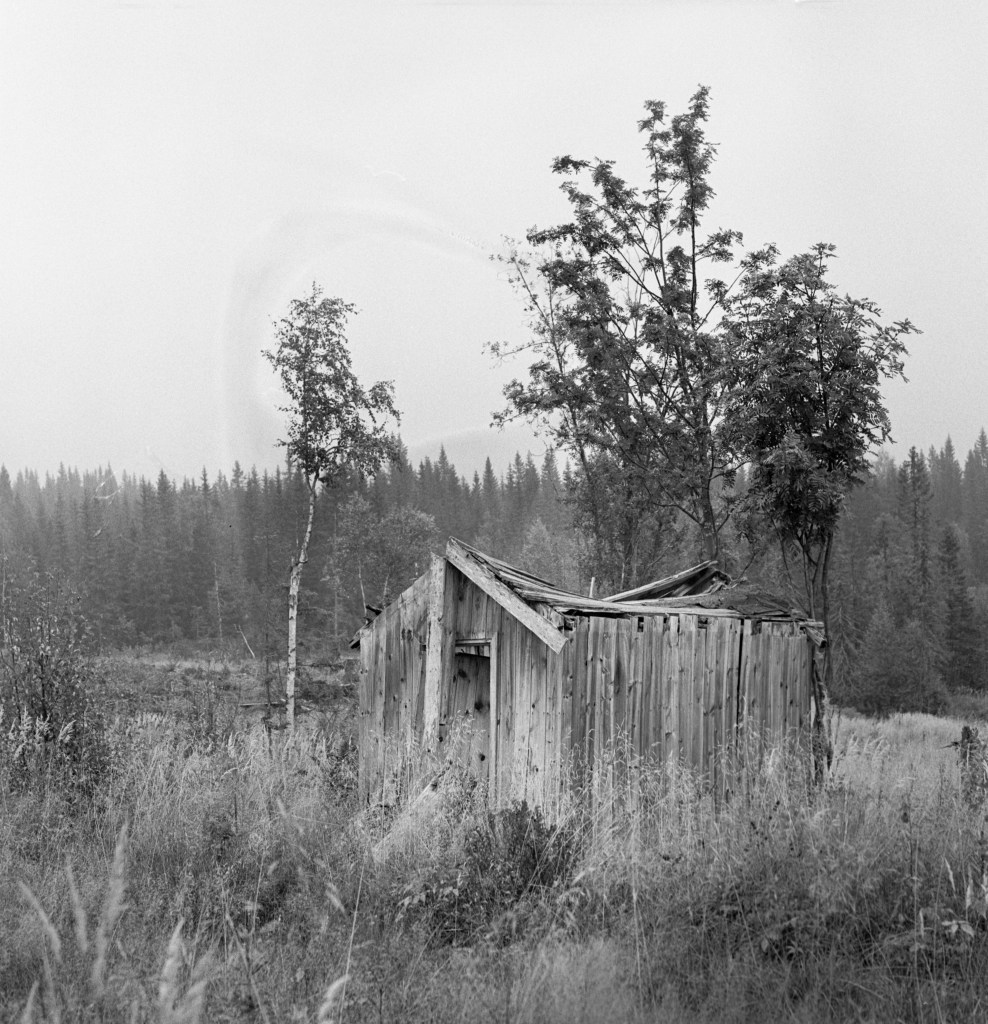
Over the last year, I have noticed an old wooden hut, standing on its own in a chopping-field a short distance from Gjøvik. The hut in itself is not really that beautiful to look at anymore. The roof has fallen down and the wood looks withered and dry. It would need significantly more than a lick of paint to make it shine once again. All the times I have driven past it or seen it when out walking, it has not worked because of the weather. I have pictured it to work well on a overcast and preferably misty day on black and white film. Today was the day that I would finally go for it and try this old hut, that I for my own amusement has named «Jabba». It is a bit amusing to tell yourself to go out shooting Jabba the Hut.

I rolled up the Hasselblad 500C with a roll of Kodak Tri-X 400 and brought with me a selection of filters, including yellow, orange and red, and I set off into the misty and drizzly morning. I found the hut in its usual condition, rather tatty and derelict, but this time, there was some mist in the background, creating a more interesting atmosphere around it. The scene itself is a bit messy and overgrown after a very lush summer, but the mist made it work.

My first frame of the day – Hasselblad 500C – Kodak Tri-X – No filters – Ilfotec ID-11 1+1

I decided to try the compositions in different ways with different filters, partly just to see what they would do to a scene like this. Especially, I was curious to what the red filter would do in conditions like these, and hence, I tried different approaches to learn a bit more about my filters. My pack of filters is rather inexpensive and are just plastic filters. At some point, I will upgrade my collection of filters, but not for this trip.

Trying again at Jabba – Hasselblad 500C – Kodak Tri-X – Orange filter – Ilfotec ID-11 1+1

Based on my rather limited access to the hut, as it stands in a rather difficult area to move around, I only made two different compositions this time. One straight on and one from the side. I did the latter without filter and with all three colors I brought – Yellow, Orange and red – and I must say that the results were a bit different than I thought. I expected that the red filter would give me deeper contrasts than the yellow, but actually, my results pointed in the different direction. That the yellow filter actually gave me much punchier images than the red, and the one without any filters gave me the best results.

What I see that the red filter does, and also to some extent the orange, is brightening up the greens and making the trees in the background brighter. For future reference, I will probably leave the two darkest filters at home for these days, but I do think it was worth the try.

Another reflection I have after this shoot is that I remember why I have stopped using Tri-X and other Kodak-films for my images. At least to some extent. Their tendency to curl when trying after development is very annoying and makes it very difficult tu both scan and print them in the darkroom. I have not had this issue with ILFORD-films and since I really do not see any difference between Tri-X and HP5 at box speed, I usually save the Tri-X for the difficult lighting conditions where I have to push the film, as I see Tri-X to be a better push-film.
Morning shooting at Næra

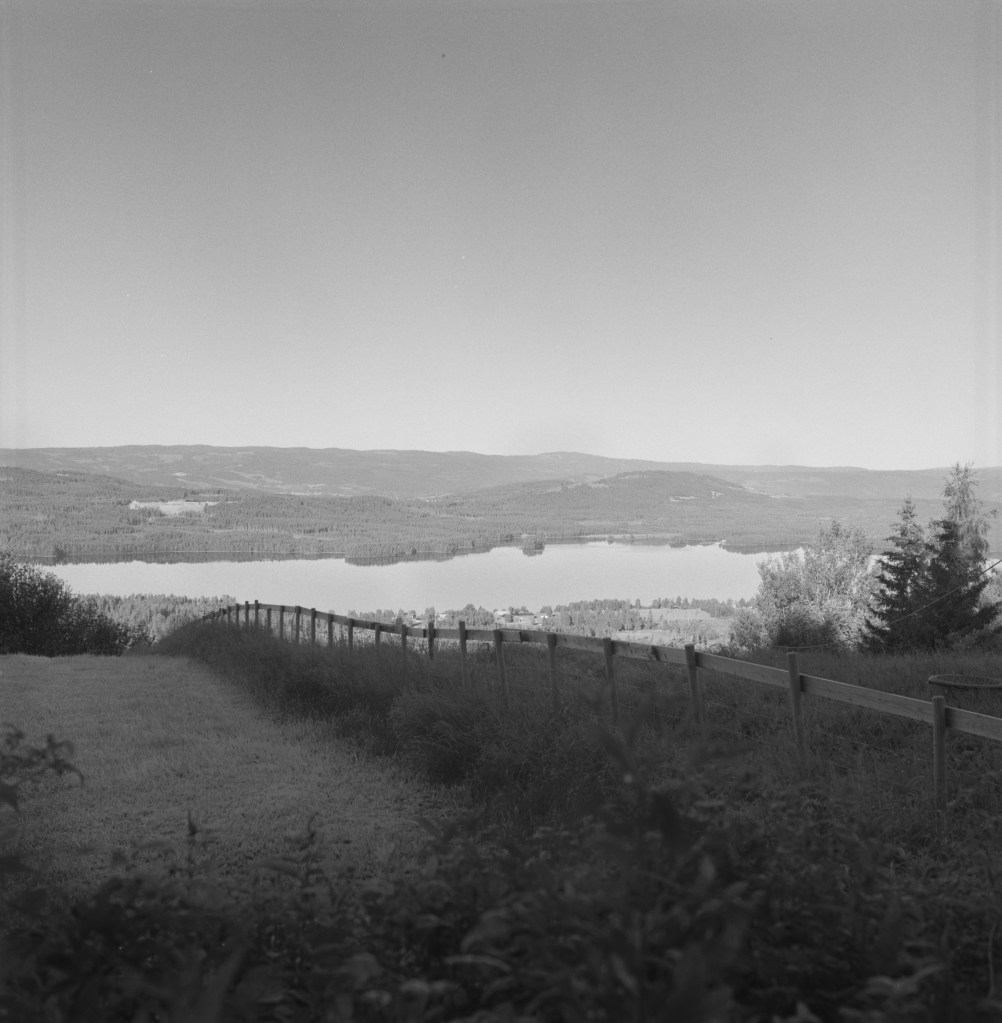
One of the most photogenic lakes around my area is bu far the lovely little lake named Næra. Situated a bit east of Moelv, it is the main bathing-water for places like Næroset, Åsmarka, Lismarka and Moelv and it is also an important area for leisure boating. A few weeks ago, as I was pondering around Åsmarka looking for an infrared-view of Næra, I came in contact with some locals. They told me about what was allegedly a much better viewing point over the lake, and I decided to take their word and go there in an early morning quest.

Armed with the Hasselblad and two rolls of film, Ektar and HP5 plus, my friend Cameron and I went for a morning stroll to the viewing point, and indeed, what a view.

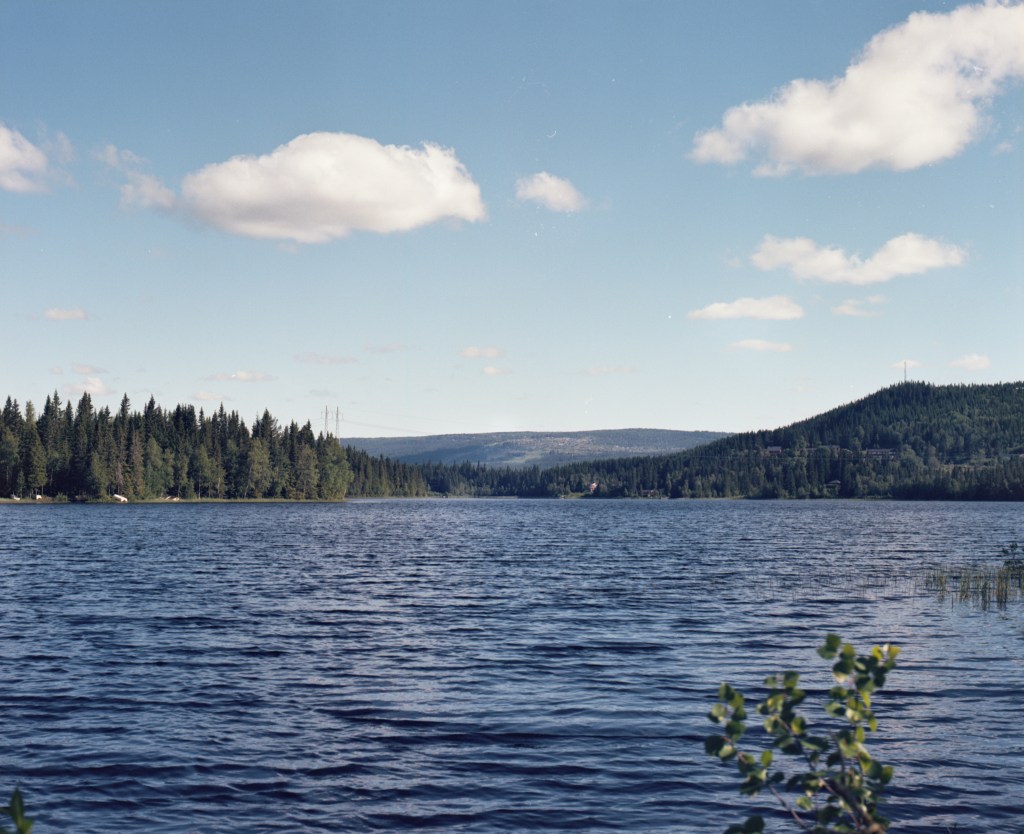
The lake Næra – Hasselblad 500C – Ilford HP5 plus @ 200 Yellow filter – Ilford ID-11

Realizing that I had misread the lighting conditions on this scene, I soon decided that the HP5 would most likely be the best film for the job. My total range within the scene pushed 9 stops, and I was afraid to blow out the skies or the water with the Ektar as I didn’t bring a polariser filter because I broke it a few days prior. I then settled for a yellow filter instead, and chose the approach of pull-processing to give me a flatter negative.

Along the path – Hasselblad 500C – Ilford HP5 plus @ 200 Yellow filter – Ilford ID-11

Our path went through some really lovely forest areas, and at one point, we had a row of telegraph-poles making their way towards the farm I believe is named Harabakken. I like the way that the poles made their way towards the farm and decided to attempt a composition with the HP5+. I would probably have gotten more out of this shot using an orange filter, but I decided to travel light, and only brought the yellow.

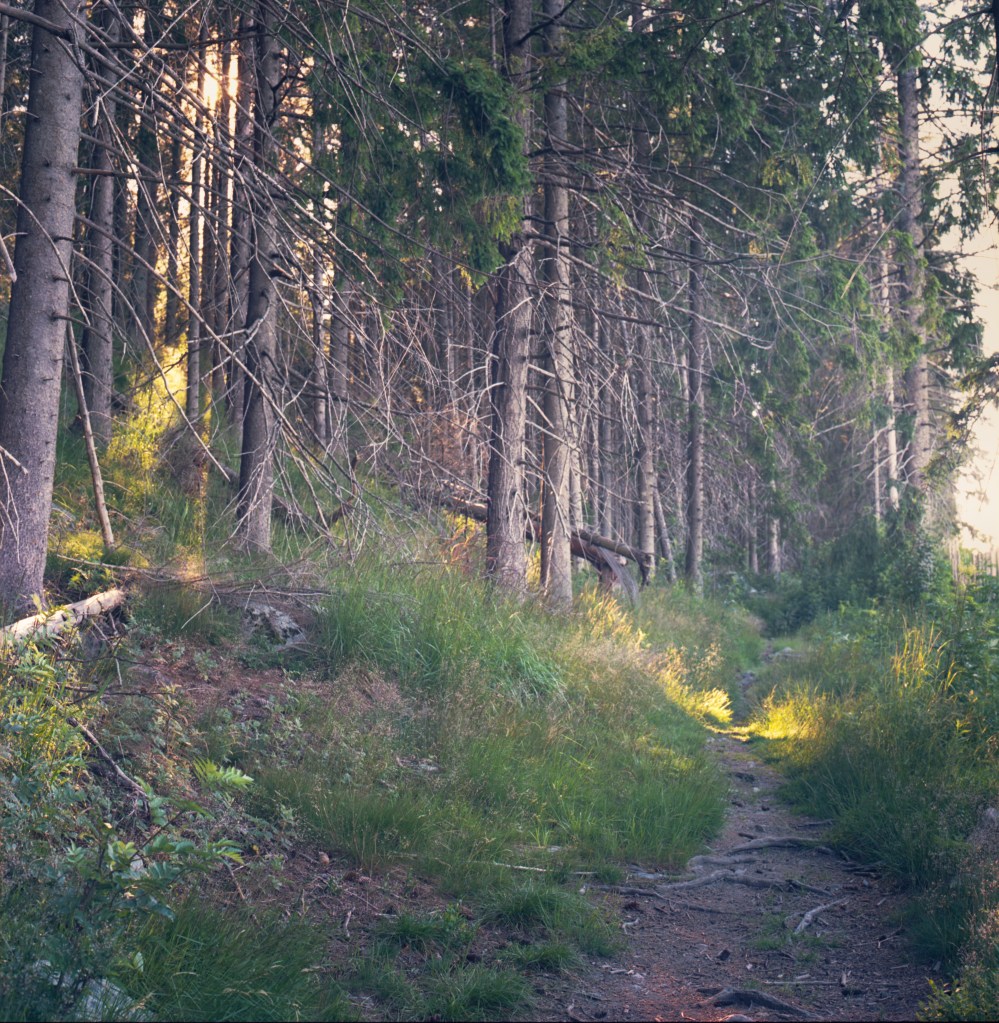
As we stopped to have out coffee, I spotted a really lovely trail of light coming through the forest, illuminating the path and some grass around. I decided to make an attempt with the Ektar-back, attempting to make a square- image.

Light on the path – Hasselblad 500C – Kodak Ektar – Tetenal C41

Our day concluded with a nice stop by another little pond that I am not going to name because it is more secluded and has a very fragile road going to it. We enjoyed another sip of coffee and had an absolutely lovely time out in nature this warm summers day.

I’ll include some more images in a gallery at the end, please enjoy

Frames of Norway 4

Finally, after a spring seeming never to produce any heat or greens in nature, summer temperatures have finally arrived. And what arrival it took on. Temperatures shot up 20 degrees in just a few hours and from dull and bland grey weather we suddenly saw blue skies without any noticeable clouds. Weather where one has to think about how to deal with the conditions. I decided to go to a local woodland-area called Sevalskogen. An area I just noticed for having really nice «old-forest» conditions and being relatively untouched for a while.

This is also an area that was heavily disputed in the 1920s and 30s. In these years this farm was owned by former Vardal Kommune, the municipality, until it was sold to a private farmer in 1932. At this time, the forest and the uncultivated fields were still owned by the municipality, and was broken up and sold out as so-called «bureisningsbruk». These were plots that people could buy and build their own farms on. This was a very unpopular decision and after just a few (I believe 4) plots were sold, the rest of the land was given back to Seval farm. This lot of land was obviously smaller than the original farm, both with forest and land. All the farms that were built in this time still stands today.

A fragment of the path – Hasselblad 500c w planar 80mm f2,8 – Fujifilm pro400h

To accompany me on this little outing, I chose the Hasselblad 500c. I have found myself to lean very much towards medium format lately, and I love using cameras with a waist-level viewfinder. I chose to roll the camera up with some Fujifilm pro 400h, a film that was sadly discontinued in January this year. I find this film to be a perfect mix of subtle colours and sharp green tones, and I find it to lean towards more of a water-color feel in the way it renders the images.

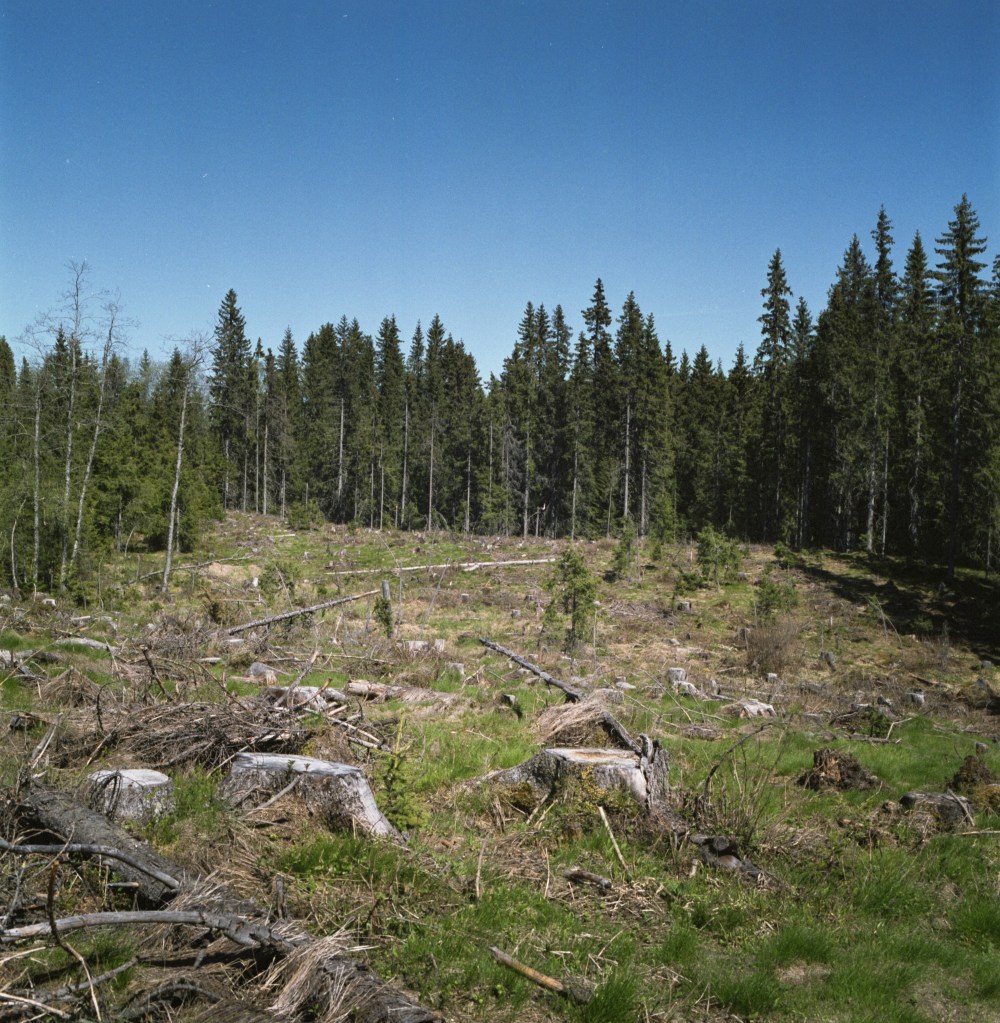
I went out with a happy spirit, but I found myself to really struggle with «getting going» this time. Just to get started, I made myself a very simple path-scene as you can see above. It is not under any circumstance a very strong composition, but it really helped me to get «into it» and get the right feel. I then progressed on and embarked into a felling-field. And here, the path mysteriously disappeared. My guess is that it has somehow been consumed by lack of use and new lush vegetation rising above the chopped down trees.

The felling field – Hasselblad 500c w planar 80mm f2,8 – Fujifilm pro400h

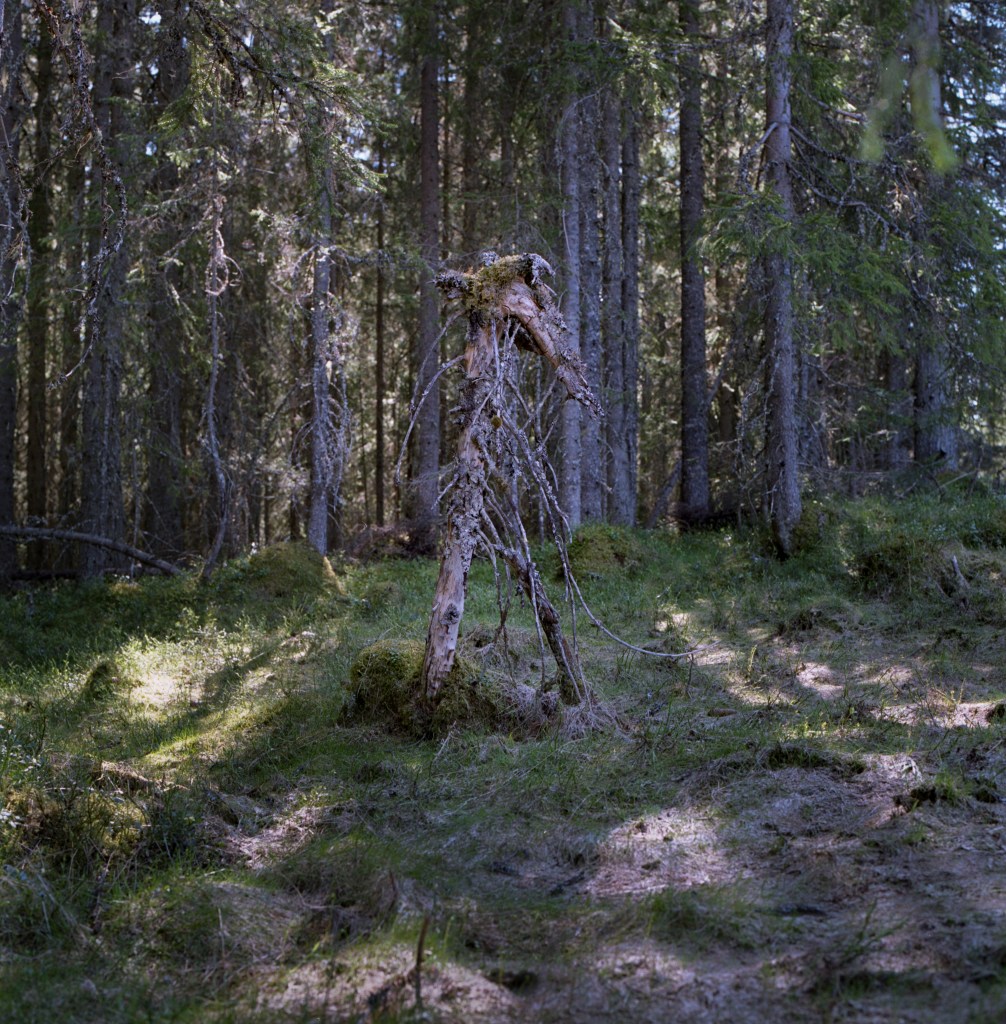
Although I couldn’t find the path, I saw a lot of small amphibians and I would guess there would be some adders lurking around the area, and since the path was a bit confusing, I decided to abandon the search for a path in the sunshine, and rather focus on the area I was already in. I turned my attention to a little tree-stub and attempted my luck there instead.

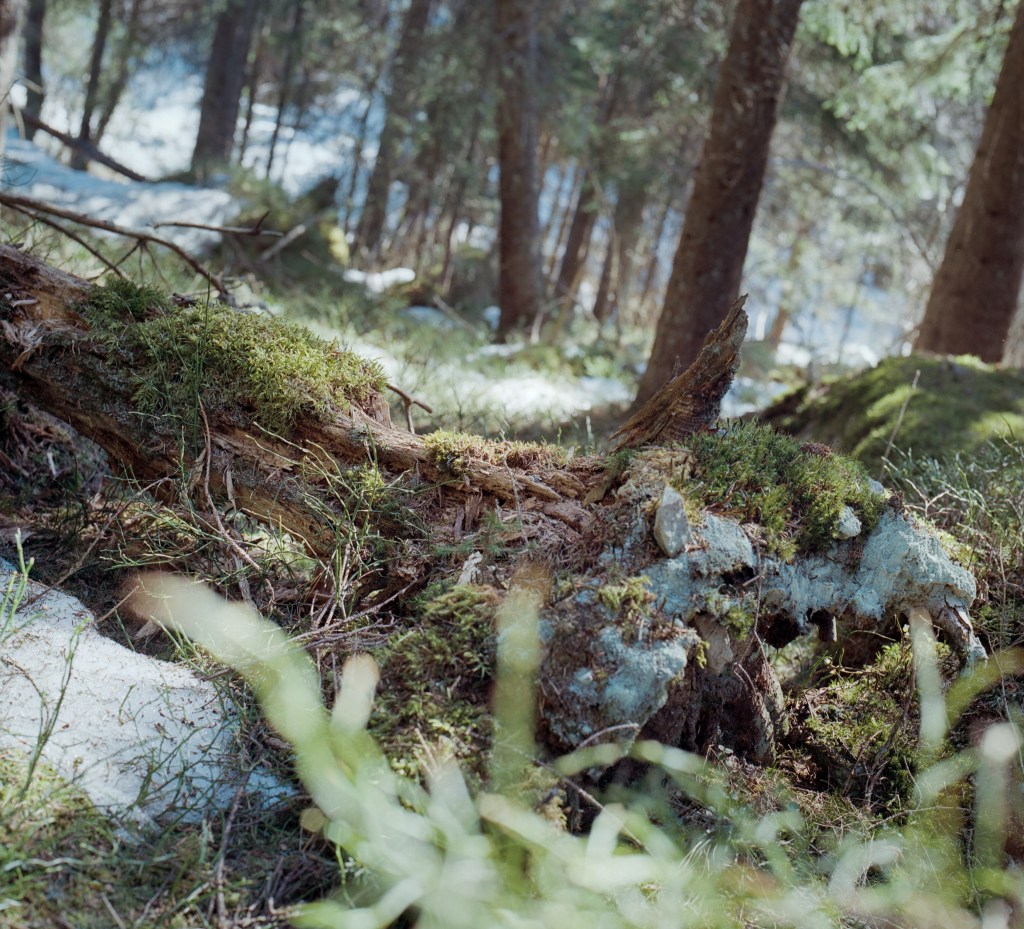
A tree-stump thingie – Hasselblad 500c w planar 80mm f2,8 – Fujifilm pro400h

I then started my walk back to the car, and I came across a scene with lovely windflowers and some forest in the background. I decided to capture it and I will share it with you here.

Windflowers sparkling in the green – Hasselblad 500c w planar 80mm f2,8 – Fujifilm pro400h

Frames of Norway pt3 – Redoing pt2

A few weeks ago, I went out to create a second episode of my new series «Frames of Norway», a series where I explore the landscapes of Norway with my analog cameras. I also dive somewhat into the history of the location and other interesting aspects of landscape and the characteristics of the area.

For this second part, I visited Amlisberget close to Moelv to enjoy the beautiful views over lake Mjøsa from high up. At the time, I was very excited about being out for that trip. It was my first real walk in nature for a while, and I got too trigger-happy and blew through a roll of FP4plus far too quickly. I think parts of my problem this day, was that I had the Canon T70 and shot aperture-priority, This made me not think well enough about my compositions to make proper photographs. I went into what I call the «digital trap» and just rattles off the shots and ended up with something that I am not happy with. At the time, when I looked at the images after development, I was very excited and felt they were nice, but after a while, I am not happy at all. So unhappy actually, that I decided to redo the trip.

For this round, I chose to go with medium format, I rolled up the Hasselblad with a roll of Kodak Ektar 100. I figured that most of my compositions in the last attempt were actually dependent on colour, and the weather was rather nice, and Ektar looks good when there is some light around. Also, the fact that I only have 12 shots and have to set them up manually using a light-meter, helps med focus and things closer about what I am doing.

Parts of the path – Hasselblad 500C w 80mm Planar – F11 1sec – Kodak Ektar 100

One of the greatest things about doing landscape-photography in Norway, is the culture of «friend associations». People sign up as «friends of the area» and spend their time and knowledge preparing and tidying good paths for everyone to use. These people work as volunteers and they are not even always reimbursed for their expenses. This path that I am following this time is marked and maintained by members of two different associations. The local sports-team and Moelvmarkas Venner. I don’t think we can measure the value of their work in money. Access to nature has been very important for the Norwegians during the difficult Pandemic-times.

Parts of the path – Hasselblad 500C w 80mm Planar – F5.6 1/8sec – Kodak Ektar 100

Much of the path towards Amlisberget goes through woodland, parts of it through copse-areas and some through your typical forest area. Most of the trees are spruces, as it is the most commonly grown tree in this area of Norway. One thing I learned very quickly at this path was to watch my steps. Not even a kilometer into my trip, I saw the first adder. Not that this snake possesses any threat to me at all, it is lightly venomous and not in any way aggressive. Most bites happen on hands and fingers when people try to pick them up or on feet when people step on them.But at the same time, I don’t want to upset my «host» when I am visiting their home. In all, I saw two adders (Vipera Berus) on this trip, and I heard the sound of five others creeping away in the grass as I was following the path. Sorry that I am not giving you any images of them here, I did not have the lens to photograph these images this time.

I walked out around noon this day because I wanted to have the mid-day lights and to use the blue sky and white clouds to my advantage. This gave me relatively short exposure times for most of my images that were not taken in the forest.

Lonely spruces in the view – Hasselblad 500C w 80mm Planar – F16 1/125sec – Kodak Ektar 100

As you can see in these coming images, this is one of the most important forestry-areas in Norway, and it is located on the outskirts of the huge Taiga – the boreal forest area that goes across the whole Northern part of the globe. It is said to start for real a few kilometers further east, but you can still see the same kind of landscape as you would see throughout the Taiga, from Løten to Vladivostok.

Much of the industry in this area is also based on forestry and wood-work, and in Norway the name «Moelven» is widely known to mean quality lumber. The lumber-industry in this area is still one of the strongest in Norway.

The View – Hasselblad 500C w 80mm Planar – F16 1/125sec – Kodak Ektar 100

The trip up to Amlisberget is recommended for everyone by me, the last 900 meters are quite steep and you should make sure to have enough water for this part when you are walking. There is also no guess-work where you need to go, as the path is well marked and easy to follow. If you walk in the morning or around noon, you will most likely have the place to yourself. The only person I met on my way up, was a local fireman who was out, putting up warning signs for forest fires. On my way back; however, I met more people. The trip is worth it, the view is magnificent.

The View – Hasselblad 500C w 80mm Planar – F16 1/125sec – Kodak Ektar 100 (The colours are a bit off in this one for some reason)

Frames of Norway 1

With this entry, I am opening a new series of entries and also Youtube-videos. In these entries, I don’t care too much about the camera or film, but rather focus on composition and my thoughts behind the choice of location or film in regards to what I wanted to achieve. Everything is allowed in these entries, regardless of price of camera. And yes, obviously I will still have some entries in the old manner too.

For the kick-off of my new series, I chose one of my favorite cameras. My Hasselblad 500c, which not by any means is a cheap camera. I love shooting square format, and the Hasselblad along with my Ikoflex are to me the most inspiring cameras I own. There could be something with the waist-level finder that just makes everything look very lively and nice and makes composition very easy.

My location for this outing is the site of an old derelict saw-mill just north of Gjøvik. Back in the day, this was a very active saw-mill with close proximity to the lake and easy access for boat-cargo on the lake. There are still a lot of poles and marks in the shallow water after extensive log-driving on Mjøsa.

Remains from the Log-driving on Mjøsa – Hasselblad 500C w 80mm Planar f2,8 -Bergger Pancro 400 – Adox Atomal 49 1+1

Log-driving was a dangerous job and many log drivers would drown while working on floating timber. Sometimes, workers had to do the dangerous maneuver of loosening up jammed logs using a pike-pole. To utilize this tool, they had to walk on the floating logs, and sometimes, they either were hurt when the jam broke up, i.e. being crushed, or they could stamp on a loose log and fall unto the water and get stuck in the water under the massive amount of logs.

In honor of the history of these brave workers, I decided to go with a somewhat gloomy look to these images. To me, gloom means additional grain and a rather «grey» palette. A film I have often had issues with being too grainy or gloomy for my taste is the Bergger Pancro 400. I have used this film just a few times, and I still have some lying around in the freezer. I thawed up one of them and went for this choice.

Remains from the Log-driving on Mjøsa – Hasselblad 500C w 80mm Planar f2,8 -Bergger Pancro 400 – Adox Atomal 49 1+1

It turned out better than I expected, and this film might just be perfect for this kind of shooting. A few pieces of reflection though are the following:

  1. Be very precise when exposing Pancro 400 as it handles underexposure extremely poorly and easily loses the highlights. I tries my best to nail my exposures dead on, and did reasonably well until my lightmeter decided to produce a flat battery. After that I had to rely on a simple app on my phone, which surprisingly worked rather well.
  2. Take your time with this film. I have tried different development cycles for this film, but this is by far my best results with it. I often shy away from very long development times of more than 12 minutes if possible, but to me, it seems like the results with Pancro400 gets better the longer you develop. This process in Adox Atomal 49 1+1 took 23 minutes.
  3. Fix for more than the double time of what you would normally do. As in the previous point. Time is gold with this film. I fixed this one in fresh fixer for 12 minutes, double the time recommended by Bergger, and that seems to give clean negatives. Anything gives harsher grain due to remaining emulsion I guess?
  4. Use it for its potential of making moody and gloomy shots. This is not an «everyday happy snappy film». You have to work with its strengths.
The remains of Biri Bruk – Hasselblad 500C w 80mm Planar f2,8 -Bergger Pancro 400 – Adox Atomal 49 1+1

From my research online, I find that the sawmill was active until the early eighties. I cannot guarantee my accuracy here, but it was defunct before the nineties. In 1994, Lillehammer hosted the Winter Olympics, and the old sawmill was being restored, the goal being it becoming a restaurant. Situated along the road between two venue-towns, Lillehammer and Gjøvik, the location was ideal.

During its restoration, something happened and the old sawmill house caught fire and burned to the ground on Friday the fourth of June 1993. The fire started in the old chip-silo and quickly spread resulting in devastating damage with fire-fighters unable to over-win the fire. Today, only the foundation walls are left, and is what you can see photographed in some of these images.

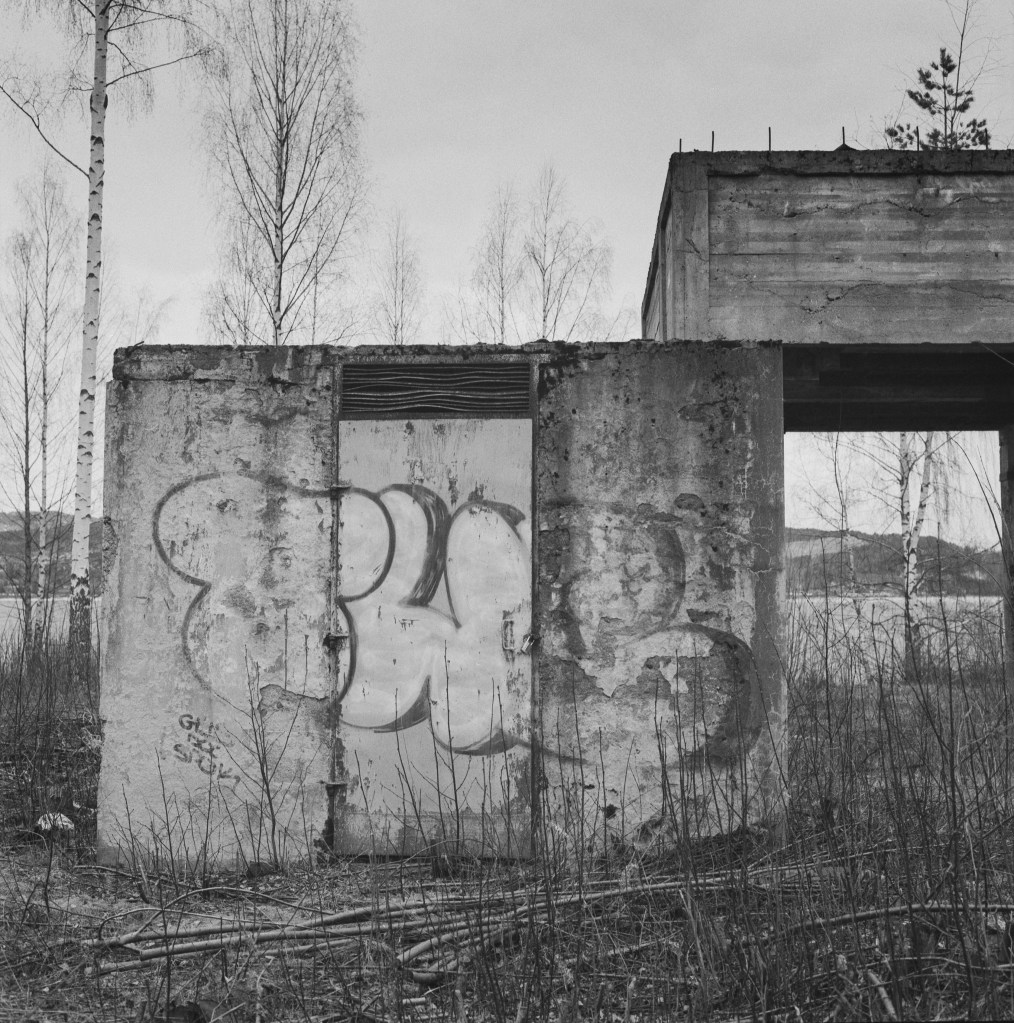
Ruins of Biri Bruk – Hasselblad 500C w 80mm Planar f2,8 -Bergger Pancro 400 – Adox Atomal 49 1+1

For me, this location has some personal value. My grandfather used to work in this place as a lorry-driver for many years, and when walking around, I can still hear his voice takling about all the interesting and struggle some days they had at work in this old sawmill. What was important for me in this outing, was to capture the mood of the place in regards to its history and how it is a symbol of a very decentralized way of structuring agriculture. And maybe most important, how we still have some remains of a very active workplace in a very smack little settlement.

Remains from the Log-driving on Mjøsa by Biri Bruk – Hasselblad 500C w 80mm Planar f2,8 -Bergger Pancro 400 – Adox Atomal 49 1+1

I hope you enjoyed reading this entry, and that you can catch the mood I am trying to convey through them. I would also love hearing your thoughts about Bergger Pancro400 and if you have different or supporting experiences.