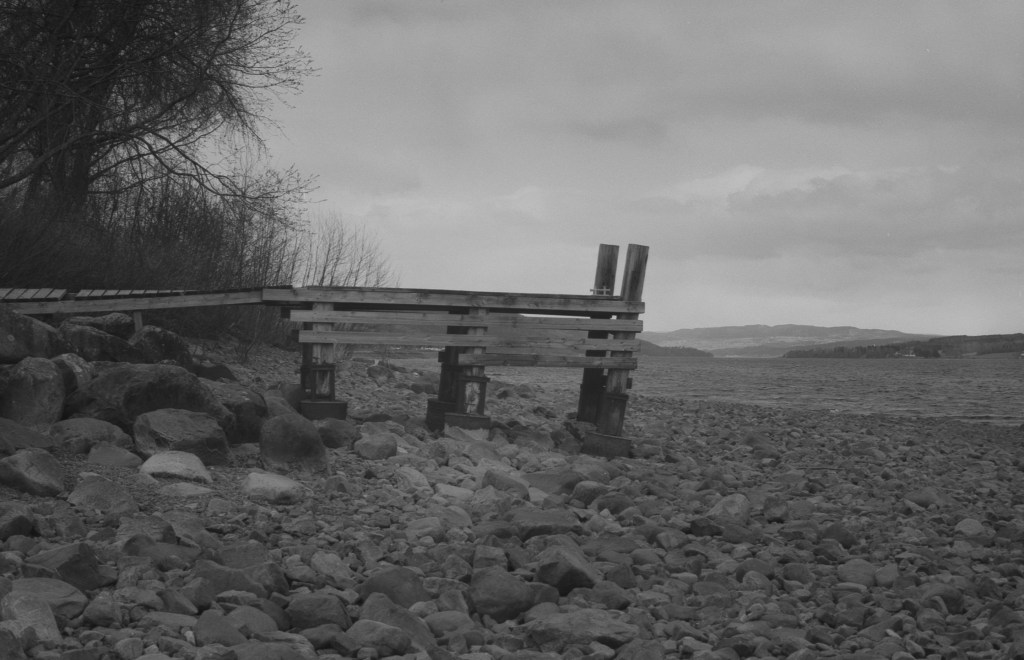
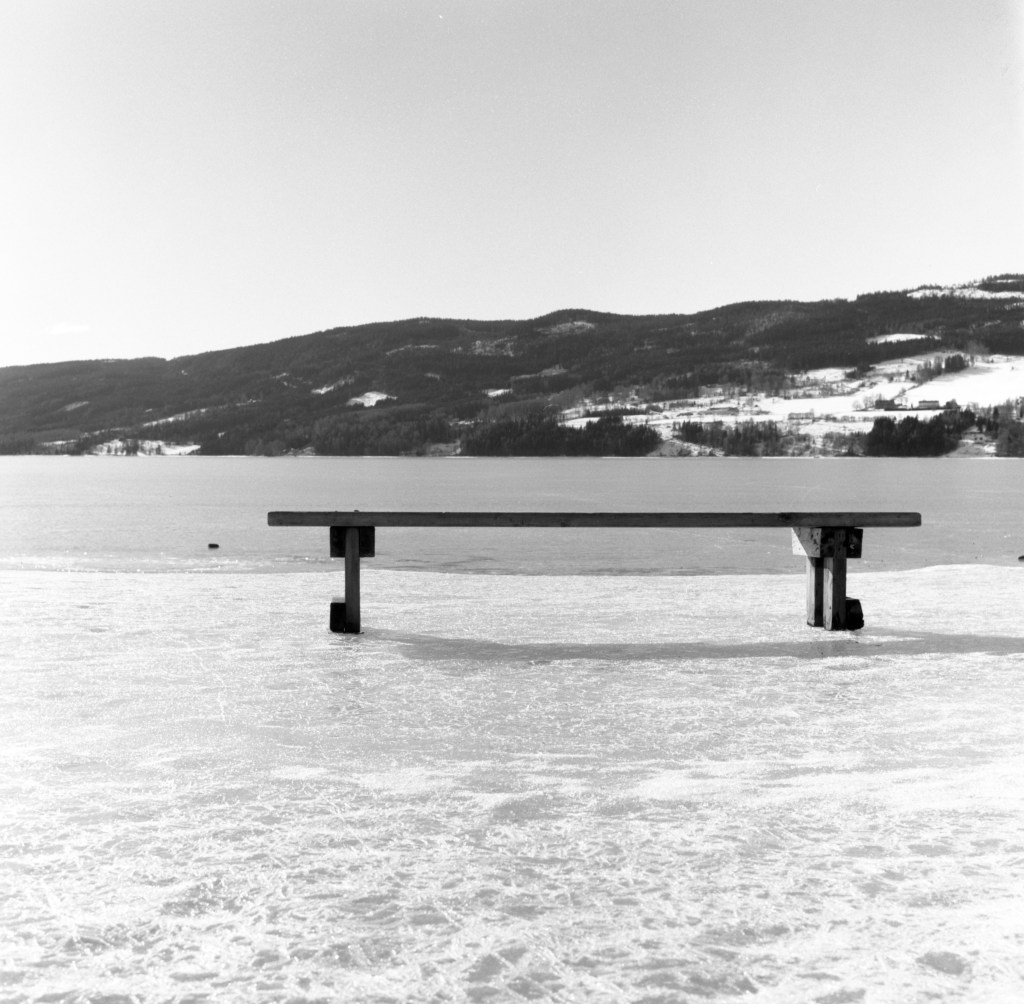
The other day, I went out for a little walk by the lake Mjøsa, biggest lake in Norway. Along me I brought the Canon T70 and a roll of Ilford FP4 Plus. It was a rather windy day and the weather was dull and overcast and with some threatening skies promising some downfall in some form. Whether it would come as snow or as rain was anyone’s guess at this point. Since the weather was rather unpredictable, I chose to not bring any video-equipment, so this is a blog-only post. For readers only.
At this time of year the lake is still low and one can walk on what most of the year is submerged by the lake. Once the snow-melting in the mountains picks up some time in the middle of may the water level in the lake will rise and the are I photographed this time will noe be accessible.
Frozen water motion – Canon T70 + Canon 50mm f1,8 FD lens – Ilford FP4 Plus – Adox Atomal 49
I snapped some shots on my way along the lake towards a little woodland area not far from the main path along the lake. I noticed a lot of motion in the water, and I tried to freeze it in action with the higher shutter speeds on the Canon, and even though some of the ended up slightly under-exposed I also got a few decent exposures.
Once again I chose to develop this film with Adox Atomal 49, a developer I know gives me very fine grain and is very good at keeping shadow-details without blowing out the whites. Whether this is considered a compensating developer or not, I am uncertain, but I find it to give me relatively flat negatives that are easy to scan and work with in post-processing. After using 10 liters of this developer I have found that the dilution 1+1 is the right one for my taste. I also like the way you get Perceptol-grain without having to sacrifice film speed. In these times when Kodak Xtol seems to be in shot supply, I have used Atomal instead. However, for my next big-batch I am mixing Ilford ID-11 instead of Adox Atomal 49.
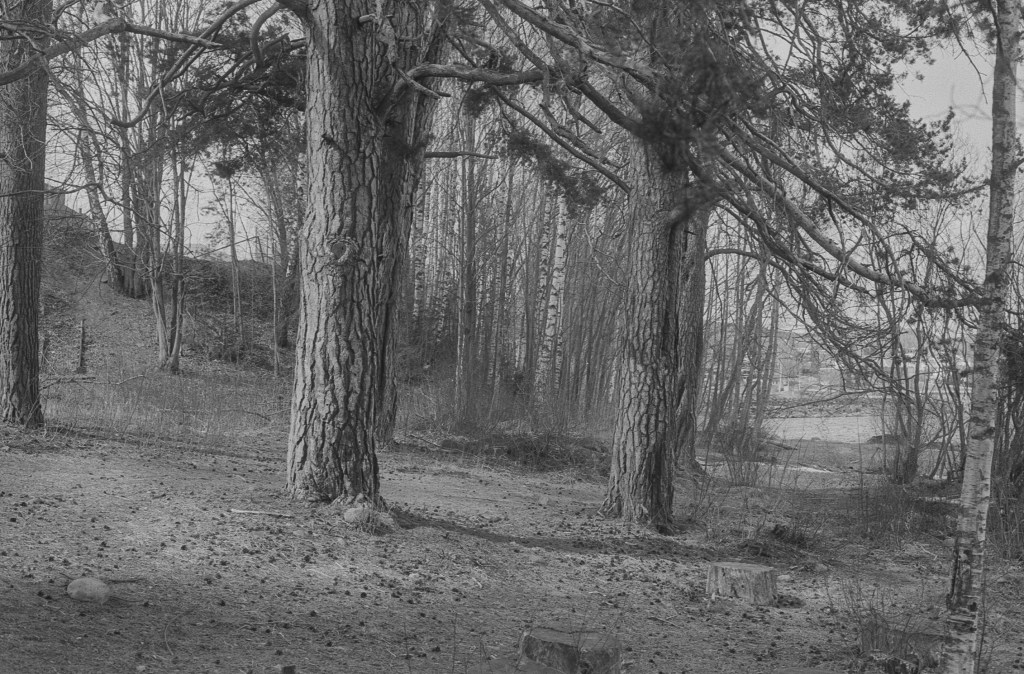
A bent tree – Canon T70 + Canon 50mm f1,8 FD lens – Ilford FP4 Plus – Adox Atomal 49
After a while I approached the trees and the little woodland-area which sadly has shrunk quite a bit over the last years due to construction of new residential areas closer to the lake, but some interesting trees are still left, and with the snow disappearing, it is once again accessible.
I find woodland-photography the most pleasant challenge for me as a photographer. Shooting a decent woodland composition can be very difficult, but at the same time, working in such an environment has a certain peace to it. The feeling you get from being in the woods is unlike anything else.
Better times ahead- Canon T70 + Canon 50mm f1,8 FD lens – Ilford FP4 Plus – Adox Atomal 49
In this second entry in the series “Frames of Norway” I am walking towards the viewing point “Amlisberget” to get the view over the little town Moelv and the lake Mjøsa in the east of Norway. This area of Norway has a very different landscape to it than what one often thinks of as Norwegian landscape. Rather than steep mountains and dramatic valleys and fjords, this area has a calmer, more rounded mood to it. The calm landscape forms were eroded during the last ice-age. There are a huge number of lakes and ponds, and the area has a lot of glacial till and in summer time, the area is one of the lushest farming areas of Norway.
The lake Mjøsa is the biggest lake in Norway and I will feature it in a number of entries in this series, focusing on different aspects or areas around it. Living and working in this area, it is a rather difficult to “forget” about it due to its size, and the landscape around the lake changes a lot from south to north, as well as its history.
A view over Mjøsa from Amlisberget – Canon T70 w Canon 50mm f1.8 – Ilford FP4 Plus Adox Atomal 49
The area around Moelv, has a long history for its industry and being one of the centers for trade and communication in its part of the lake. Being the “mid-point” between the bigger towns around the lake, Gjøvik, Lillehammer and Hamar, just about 20 minutes to each of the bigger towns, Moelv was an ideal loading-area for steamboats doing the so-called “across-trafic” indicating that they were crossing the lake, rather than doing longer trips along the lake. Boats doing this “across-trafic” were in general smaller boats owned by locals or smaller companies, and they would carry goods from smaller ports to the bigger port in Moelv where the bigger boats and ships would take over.
This is an interesting point, today, when we have the bridge over Mjøsa, we see the lake as an obstacle in our travels, but back then, the lake was the biggest and most efficient “highway” of the area with an incredible number of steam and motor boats sailing all over it. At some point, the church in Moelv served for a parish including farms and houses on both sides of the lake and having “church boats” to transport people across for sermons and so on. This connection between Moelv on the east-side of the lake and Redalen on the west side of the lake, is still strong today. This is also where the bridge is crossing the lake.
Woodland and farmland – Canon T70 w Canon 50mm f1.8 – Ilford FP4 Plus Adox Atomal 49
For this outing, I chose to go with a 35mm camera. I wanted to get a very “analog feel” to the images and I figured that being on a new location where I had never been before, I might get “shutter happy” and boom off a lot of shots. And I was right, I filled the whole roll in about half the trip.
A view towards Næroset – Canon T70 w Canon 50mm f1.8 – Ilford FP4 Plus Adox Atomal 49
I chose to go with the Canon T70, the revolutionizing first attempt from Canon on making a computerised camera. A camera loaded with different “safety features” such as sliders and buttons to make sure you don’t accidently open the camera mid-roll or accidentally rewind the film mid-roll. It also has a very good and accurate light-meter, and an apperture-priority setting that is working flawlessly. I also like the fact that this is a 100% Manual Focus camera and that you can focus manually without having to deal with the “sloppy” and “vague” feeling of an AF-lens. This is personal preference of course, but I prefer MF for this kind of use.
The Path – Canon T70 w Canon 50mm f1.8 – Ilford FP4 Plus Adox Atomal 49
I set out into a forest area where there are a lot of ski-tracks in the winter. I parked at Høgring, where the sports team Næroset IL has a little skiing cabin, and I walked from there. Forestry has meant a lot to this area, and previously Moelv had both a cellulose factory and a huge sawmill. The sawmill and its wood-workshop is still active and is one of Norways biggest providers of wood even today under the name of “MOELVEN”. The cellulose factory ceased operations in the late 1930’s due to the big depression in international trade.
A view over Mjøsa and Moelv – Canon T70 w Canon 50mm f1.8 – Ilford FP4 Plus Adox Atomal 49
Because the colours in the Norwegian nature is rather greyish and boring at this moment right after the snow melts, I decided to shoot black and white. I went for a traditional film, the Ilford FP4 plus, one of my absolute favourite films, and I used both yellow filter and a two-stop graduated orange filter. I was a but uncertain how the aperture-priority setting would deal with a soft-grad filter, but it seems to have correctly exposed the sky and overexposed the land-area, which was what I wanted it to do. Concidering the fact that the filter-thread on the lens is damaged, the images turned out rather well.
More forestry – Canon T70 w Canon 50mm f1.8 – Ilford FP4 Plus Adox Atomal 49
I chose to develop with Adox Atomal 49, a developer I have found myself to really like. Especially traditional films like FP4 and HP5 gives great results with this developer, and I find it to lift their abilities. It seems to be somewhat compensating and gives a rather flat negative and great shadow-detail even when the films are shot at box-speed. The down-side is its toxicity, and I find that even though I have loved my two first batches of it, I am hesitant to buy more of it because of this. I obviously collect the rest-developer and deliver it to a designated collection place where it is dealt with properly, but I still don’t like the thought of using something this toxic.
As you can see from many of the images, farming, as well as forestry is important for the area. Moelv was, and still is an important hub for the distribution and sale of grain and farming products in the area. Strand Brænneri was opened by the local farmers in the mid 1800s and was one of the first cooperative agricultural businesses in Norway, and became an important part of building Moelv and the surrounding area into the successful area it became in this time.
A lonely birch – Canon T70 w Canon 50mm f1.8 – Ilford FP4 Plus Adox Atomal 49
I am proud to live and have so easy access to an area with this amount of “cultural landscape”, and where you can really see how nature and man has lived together in peace over so many years.
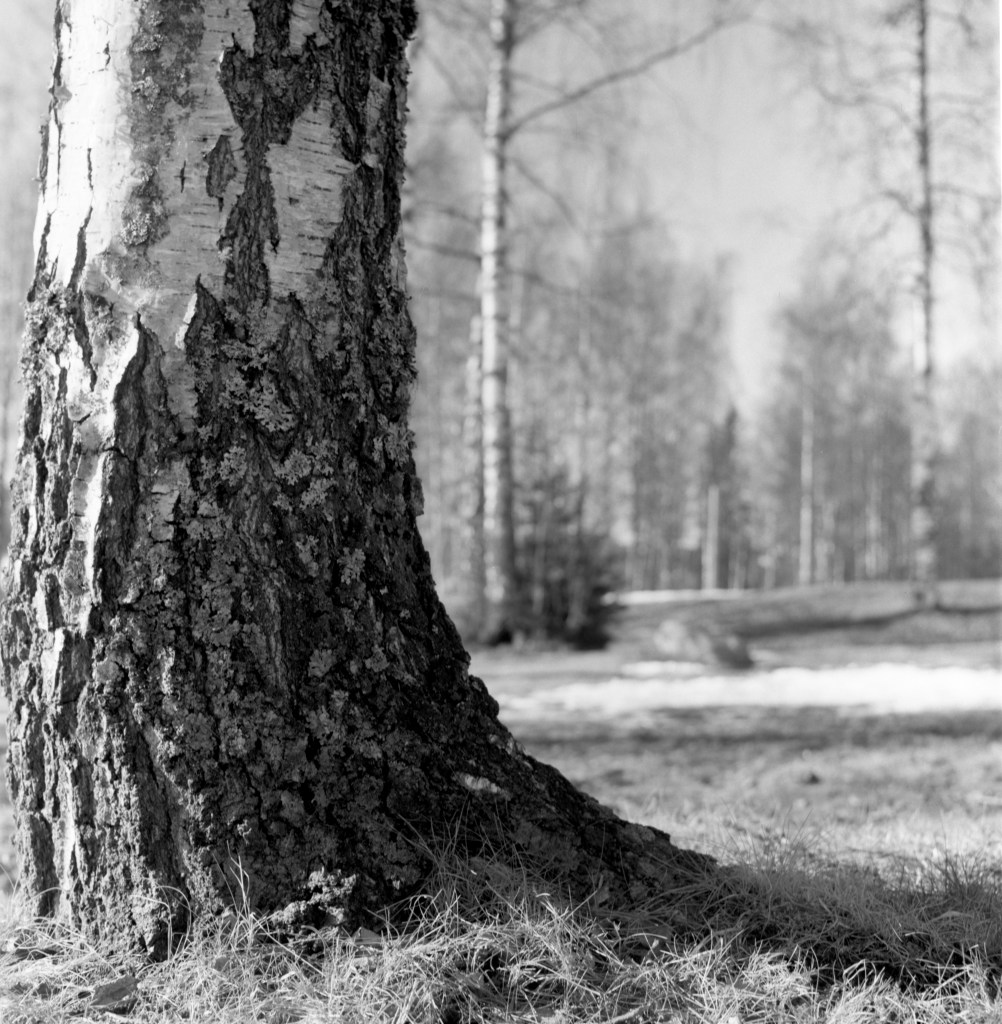
Nothing fills me with such joy and happiness as the day when I for the first time see grass being liberated from the firm fist of the winter-snow. Today was that day, and I immediately decided to go shooting. I loaded the Zeiss Ikon Ikoflex with a roll of Ilford FP4 plus, and went down to Kråkvika by Hov. A location where spring is often present early. And sure enough, there were a lot of spots and spaces where the snow was melted away, leaving the lifeless brownish colour of grass that has been buried for a while under the snowy carpet. The colours weren’t really spectacular, hence the choice of black and white-film.
To me, the Ikoflex is maybe one of the cameras that inspires me the most. There is something about the sensation of using something so brilliantly engineered and with a lens that sharp in a very light and beautiful box that appeals to me. I haven’t used it for a while because the winter was exceptionally cold this year, and I don’t think the Ikoflex would be too fond of the cold weather. Also, my Ikoflex has developed misfiring on lower shutter speeds, so I tend to keep it at 1/100th or 1/300th, which could be too short shutter speeds for winter-time. Whether I will have it repaired remains to be decided, but for my current use, the Ikoflex works well.
Spring landscape with melting snow – Zeiss Ikon Ikoflex – Ilford FP4plus – Adox Atomal 49
I find that filling the roll and finding the right compositions, is a very easy task with the Ikoflex. The inspiration comes naturally when using it, unlike the Zeiss Ikon Nettar, which I find that I can get bored when using. I have heard a lot said in negative ways about the Ikoflex and it being like an «over protective mother» or «insanely difficult and complicated to load», but I cannot understand how any of these can be true. If you read the manual, which I know is a very uncommon thing for people to do today, you will very easily understand that the advance wheel will turn freely when it reaches frame nr 12, and that you have to manually reset it for frame 1. Not at all difficult. I have a video on Youtube showing how it is done.
Reklamer
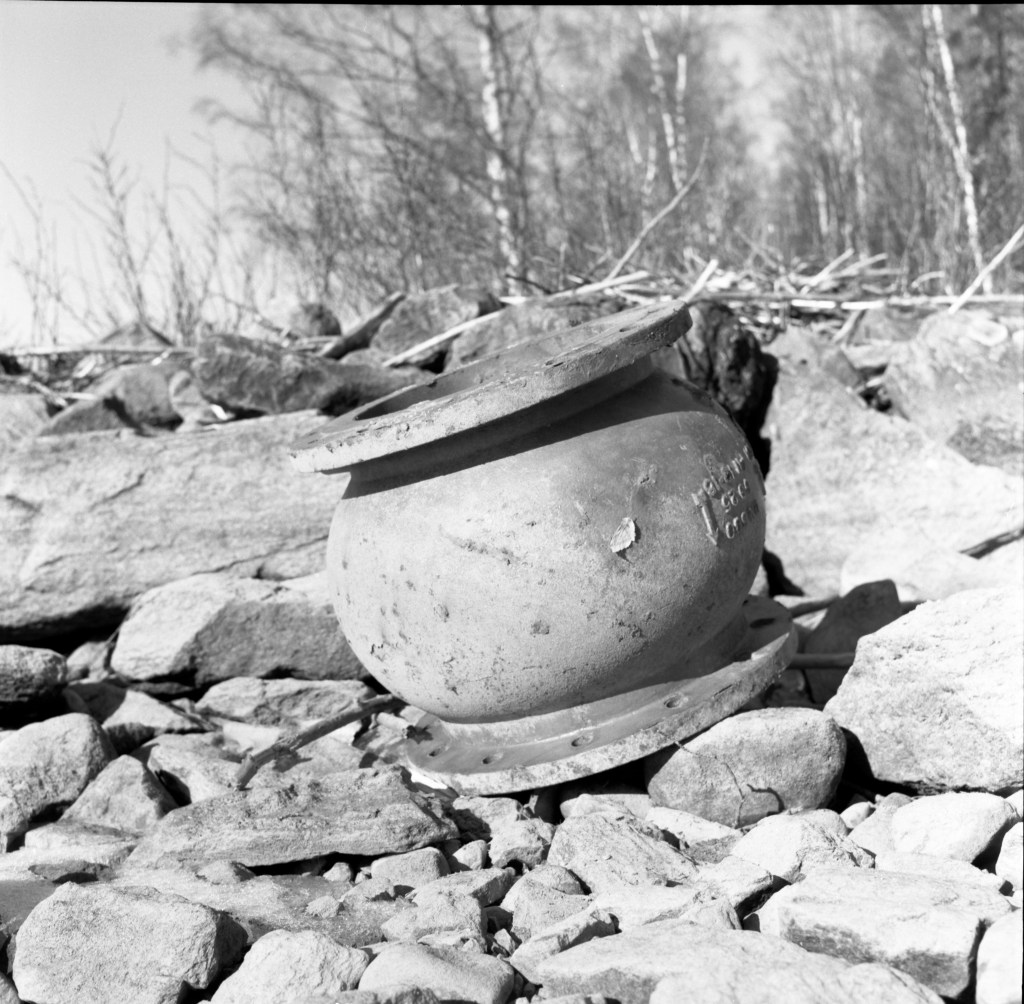
I am a rock – Zeiss Ikon Ikoflex – Ilford FP4plus – Adox Atomal 49
Walking around on a day where the snow is melting and the landscape comes back into sight, makes you notice objects or shapes that would normally either be removed or invisible in the greens and lush landscapes. There is something «rough and contrasty» about these snow-melting days that really appeals to my way of composing.
All in all, I had a very joyful little day out in the sun and I enjoyed every minute of shooting with the Ikoflex again. It is such an amazing little camera and the images really speak for themselves.
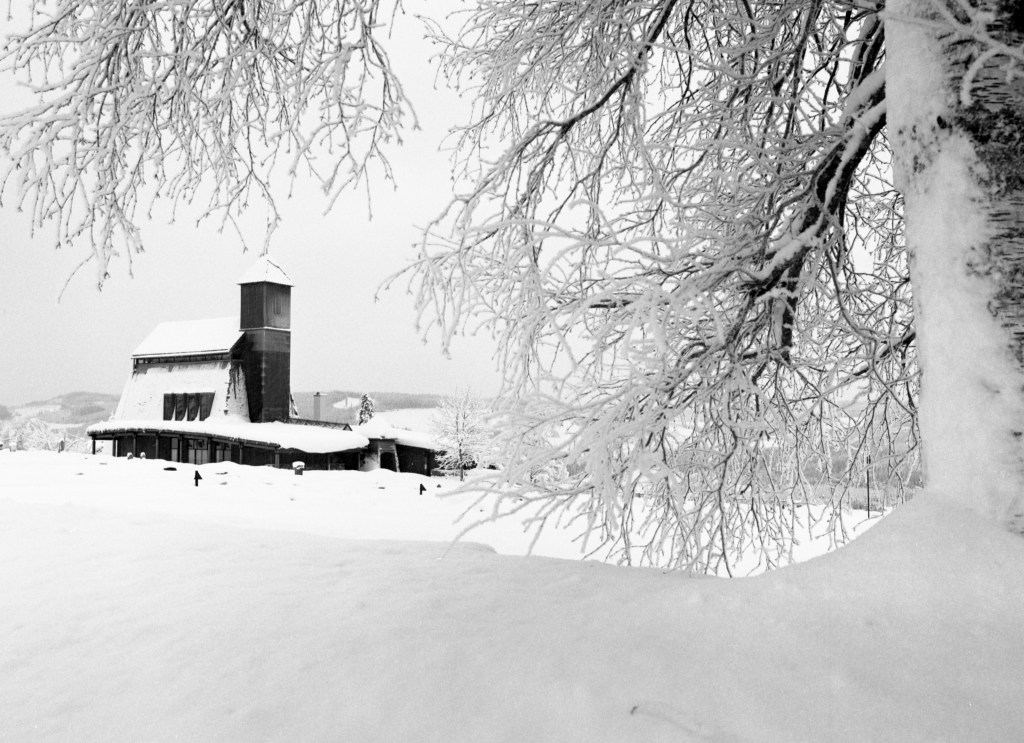
Not far from where I live, there is a modern, wooden church called Seegård. It was built in 1997, following the tragic fire in the old church during easter in 1994. The new church was raised in the same spot as the old one, and in an attempt to keep the cross structure of the old church and modernizing it, but at the same time make something that would suit its area. Not easy demands for an architect to meet, but I find that the architect Arne Thorsrud has pulled it off really well.
I have worked with this church on multiple occasions, mainly digital, but the other day, I decided to bring out my Bronica ETR, and make some black and white images of the church in winter time. I fitted the Bronica with the 50mm Zenzanon lens and a yellow filter to help balance the contrasts a bit.
Reklamer
To get the smooth results I wanted for this shoot, I decided to go with Ilford FP4 plus and combining it with Ilfotec Perceptol extremely fine grain developer. This is a combination I have found to work very well with winter conditions where snow and whites are prominent. However, you lose some film speed. In this instance, I shot the FP4 plus at ISO 50, and went for f11 which I find to be the sweet-spot of this lens. With a still standing subject like this church, which does not tend to move a lot, slower shutter speed is no real issue, and my shutter speeds were around 1/4th and 1/8th of a second with the correction for the yellow filter.
Seegård Church under the winter carpet. Zenza Bronica ETR w Zenzanon 50mm f2,8 and yellow filter. Ilford FP4 plus at 50 ISO – Ilfotec Perceptol 1+1
I did a few different angles and compositions, and a little bit of bracketing on a few of the compositions. After all, I ended with two images that I am very happy with, and they are the two I will share.
Seegård Church under the winter carpet. Zenza Bronica ETR w Zenzanon 50mm f2,8 and yellow filter. Ilford FP4 plus at 50 ISO – Ilfotec Perceptol 1+1
Sometimes my interest is sparked in some way when I watch Youtube videos. A few weeks ago, I watched a video called «Konica Autoreflex TC – The poor mans OM-1». To me, this title did not really make much sense. In my opinion, the Olympus OM-1 is extensive value for money and indeed very affordable both when it comes to lenses and camera bodies. They are also accurate like clockwork, and relatively hassle-free to service and maintain. I have shot a large number of rolls through my OM-1 and it has never given me any problems even in very cold winter days. So if there would be a cheaper camera that reliable, that had to be a gem for this blog indeed.
My lovely Konica Autoreflex TC with its marvelous Konica Hexanon AR 50mm f1,8 lens
I searched briefly online, and I actually found one incredibly cheap on a local Facebook sales page, and I got it for about 200 Norwegian Kroner (about 20 GBP) with shipping included. A real bargain there indeed. For the first tryout, I loaded it with a roll of Ilford FP4 plus that I shot at ISO50 and developed with Ilford Ilfotec Perceptol. I find that Perceptol really helps me get the winter tones I want for my shots, as well as a very fine grain.
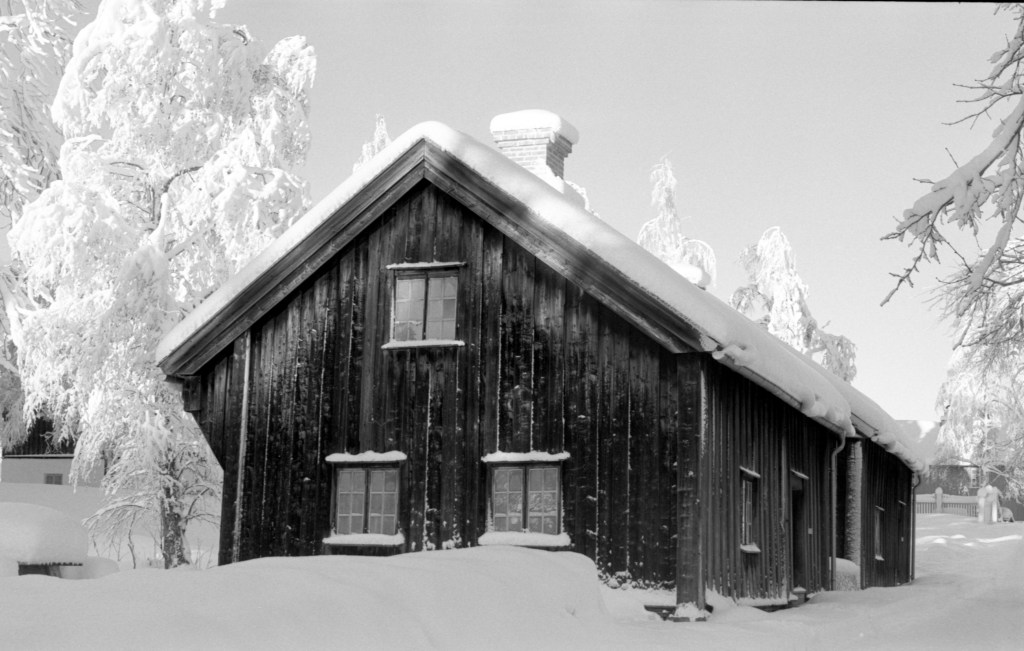
The Konica turned out to be a lovely camera to work with. It is indeed a bit heavier and more bulky than the OM-1 but it fits my hand very well and everything is where you expect it to be, and it all seems to work rather well. I did not try the Aperture priority setting on the camera, but shot it on a variety of shutter speeds and aperture settings with a wide range of filters I found to be helpful for me at this location, which is an old museum. However, I do not see this camera and the Olympus OM-1 to be comparable as equipment.
Reklamer
The Olympus OM-1 is a far more accurate camera with a broader selection of shutter speeds, all the way from a whole second to 1/1000th of a second plus BULB-mode. On the Konica, there is nothing between 1/8th and B, and the longer shutter speeds on my one «drags» a little bit. This could be the particular camera.
Also in the perceived build quality, the Konica is clearly a cheaper and less sophisticated camera than the OM-1. But if you forget about the irrelevant comparison to a clearly better camera, the little Konica is a very pleasant camera to work with, and the 50mm Hexanon Lens, is just outstanding. It gives a really nice sharpness, even at wide apertures and it is easy to focus.
Through my about 60 minutes photo-walk today, the Konica performed rather well for the first 20 minutes. After that, it coughed up a nice selection of issues and creative problems that I guess is it reacting with the cold weather. The temperature was about -12 degrees and some if these issues might be due to that.
Nr 1. Sticky shutter: After some shots the shutter started sticking every now and then. It did not matter which shutter speed the camera was set to. The only thing to do, was to tap the camera slightly so that the shutter would go off, and then shoot another frame to get one without immense camera shake.
Reklamer
Nr 2. Slowed focusing. After a while out in the cold, the focusing ring got very slow, almost as if the lubrication thickened and became a gooey syrup.
Nr 3. Camera refused to rewind the film back into the cassette and ripped it instead. When I manually retrieved the film, it actually broke on another place as well. Luckily, I did not lose more than four shots, and all of them were bad. (happy days)
All these issues aside, I like the Konica Autoreflex and the Hexanon lens. A ripped film could very well be my mistake and the other issues could be weather related. My next test out of this camera will be with a colour film, trying to capture some lovely, bleak winter colours.
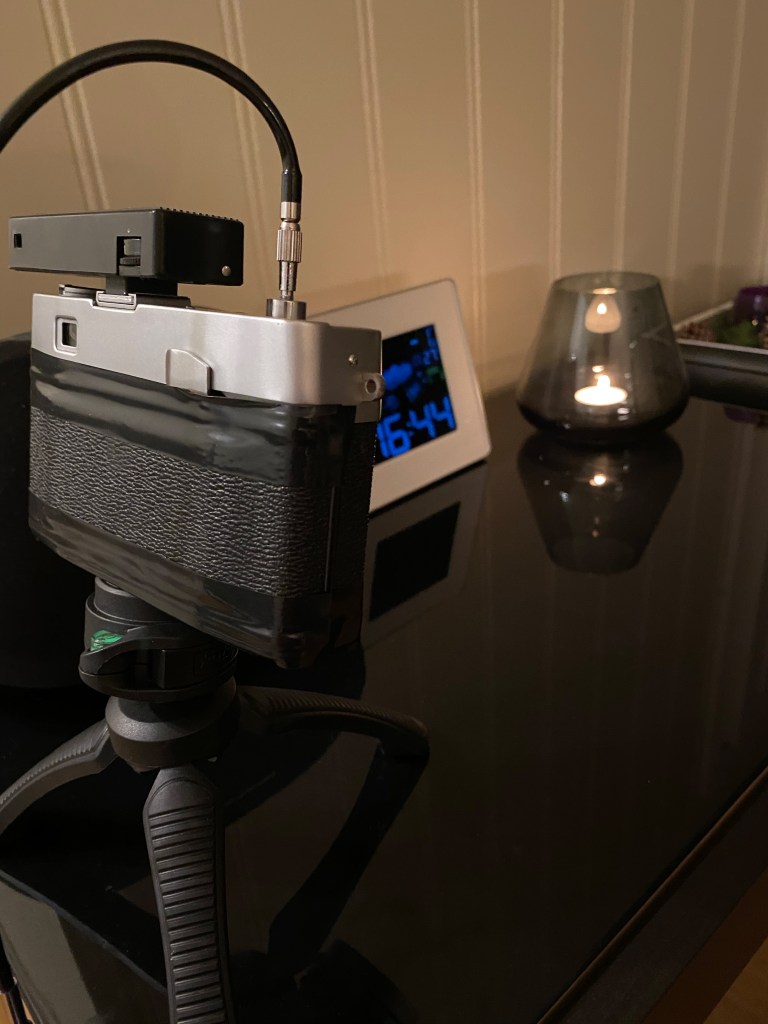
Playing with the Christmas decorations is not an activity reserved for cats. When I tested the Petri 7s for the first time in the beginning of December, I noticed how good the lens seemed to be. Even though my test then showed that the camera had seen better days, the f1,8 lens turned out to give very nice, details and I decided to shoot some frames to test it out. I decided to go with the Christmas, or actually Advent, decorations. I lit a candle in a glass candle holder, and let that work as a foreground, and I placed the rest of the decoration approximately 80cm away from the lens, which would be the closest focus length for this camera.
My setup. Petri 7s on a black glass plate with the decorations. I have taped the camera because the back has a tendency to «pop open» at any point.
I went with shots at f1,8, f4 and f16 to see how much difference there would be in sharpness and how they would turn out. I did not change the lighting conditions, but I adjusted my shutter speeds to compensate for the smaller aperture. for the f16 image, that was two and ha half minutes with compensation for the Schwarzschild effect.
Petri 7s – Ilford FP4 plus Xtol Stock. f1,8 1/8 seconds – f16 180 seconds – f4 1/2 seconds
All in all I think the lens gave me the results I anticipated. The f1,8 gives me a very nice bokeh, but the focus is a little bit off, so maybe the focus ring isn’t as accurate as I would hope for. The f4 image gives more sharpness and retains the nice bokeh feel, and the f16 gives a very sharp image.
The mood changes a lot between the images, and I am not sure which one is my favorite. You can make a judgement yourself, and I hope the images are to your liking.
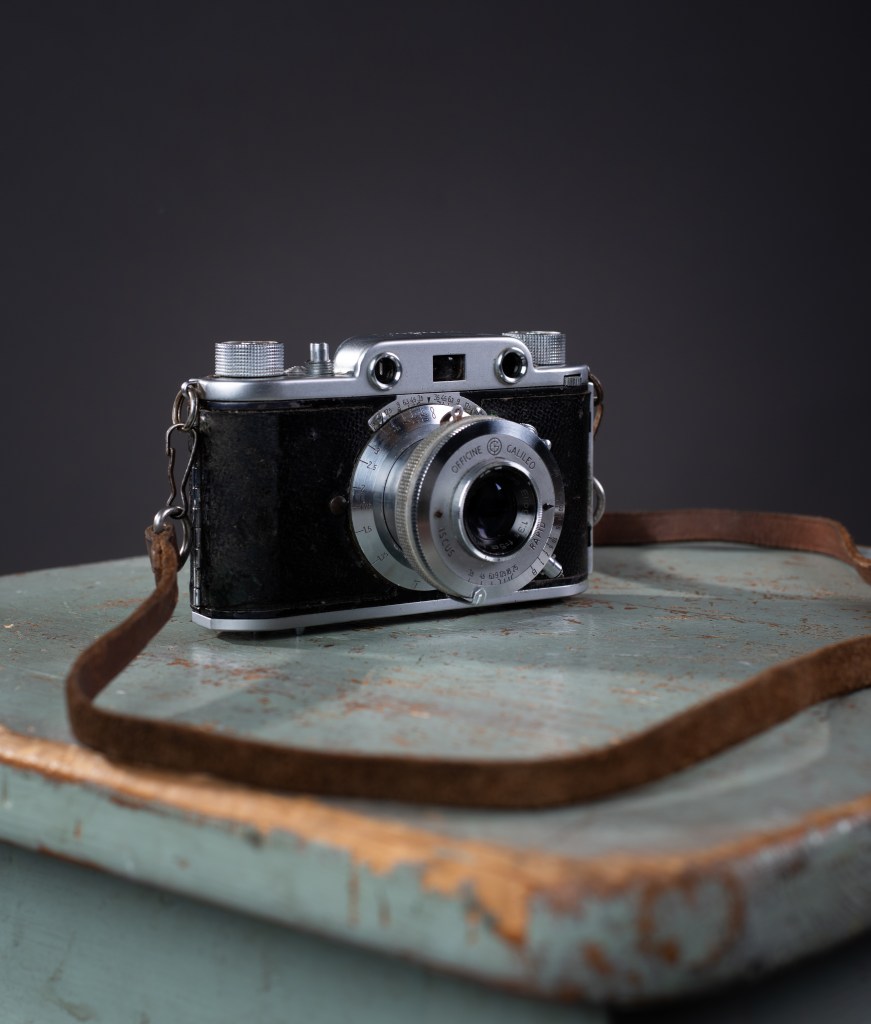
A few says ago, I wrote about my new camera. A 1947 Condor I. Mine was sold without the Ferrania logo, and from my research online, I see that these cameras were sold like this in 1947. This means that the camera is 73 years old, and was sold two years after WWII ended in Europe. In the early stages of the European healing time. In Italy, this is two years after Mussolini died, and Germany was still referred to as «Handelsschiffe» and completely divided into four sections by the allies. From Germany came the Leica IIc, a camera that is way above my budget, even today. And from Italy came Officine Galileo with their Condor I.
The Condor I is a relatively simple camera in many ways. 100% manual with shutter-speeds on a wheel around the lens, aperture settings on a lever and a coupled rangefinder with two viewfinders, one for sharp focussing with some magnification, and one for a preview of the whole Image. On mine, alas, the range finder is too dim to be of any help when focussing on my particular camera.
The beautiful Officine Gallileo Condor I
Operating the camera is a little fiddly, especially because of the very hard mechanics. It does not seem to have been used and looked after for some time, and it would not object to a little lubrication and a little clean. Other than that, it seems to work pretty well.
Reklamer
Walking around with a camera like this, makes you think more than if you walk around with a fully automatic digital camera, where you know that what you see is what you get. An old, vintage, piece of equipment seems also to put a smile on people’s faces. When shooting this today, I was asked by several elderly people about the film I used, what camera it was, and what I knew about it. I also had to tip some of them about my blog, where some of the images would be posted.
Another interesting thing with this camera is that it gives med 40 images on a 36-roll of film. This is because you stick the leader properly in place, and can close the back before you start advancing it. The lens is relatively sharp, sharper than I would expect from a camera this age, and way sharper than my Argus camera. On the down side, I am limited by having to «guess-focus» and I can’t really see its potential before I have some kind of rangefinder to help me. It also seems like the lens has a little hazing on it. Not that it is a dealbreaker for me, but it is something to consider then using it, as it gives very hazy results when there is some backlighting in the image.
Officine Gallileo Condir I, Ilford FP4 Plus, Kodak Xtol 1+1
Even so, the camera is fun to shoot, and I will probably use it for a few outings in the future. After all, it cost me close to nothing, and It is fun being so bound to your own skills.
Today was a wet, unpleasant and foggy day in Norway. No real need and point in going out, but there was some interesting fog, and a very white sky that lured me out anyway. The conditions were almost black and white anyway, so I chose to go with a Black and White film. Because of the verylow level of natural contrast, I went with a slow film. Ilford FP4 Plus. I also chose to stand-develop the film in Rodinal 1+100 for an hour, to get some extra contrast and find some beautiful grays.
I chose to use the Bronica ETR, because I wanted to do medium format and that it would give me 15 frames to a roll.
Bronica ETR w 50mm Zenzanon f2,8. Ilford FP4 Plus@125 Rodinal Stand-development 1hour. Scanned with Epson V600
I also got to test out my new scanner. Thank you for the friendly photographer who pointed out to me that my old scanner was probably shot. My new one is far better and gives me lovely scans.
Analog photography is has the loveliest tones imaginable for vintage style photography. The special look an old lens gives is an exquisite vibe to your photo that no digital preset can really copy, and the feeling of doing this with vintage equipment adds an extra element. Photography is not just about the picture, but the way to get there and the feeling of the process.
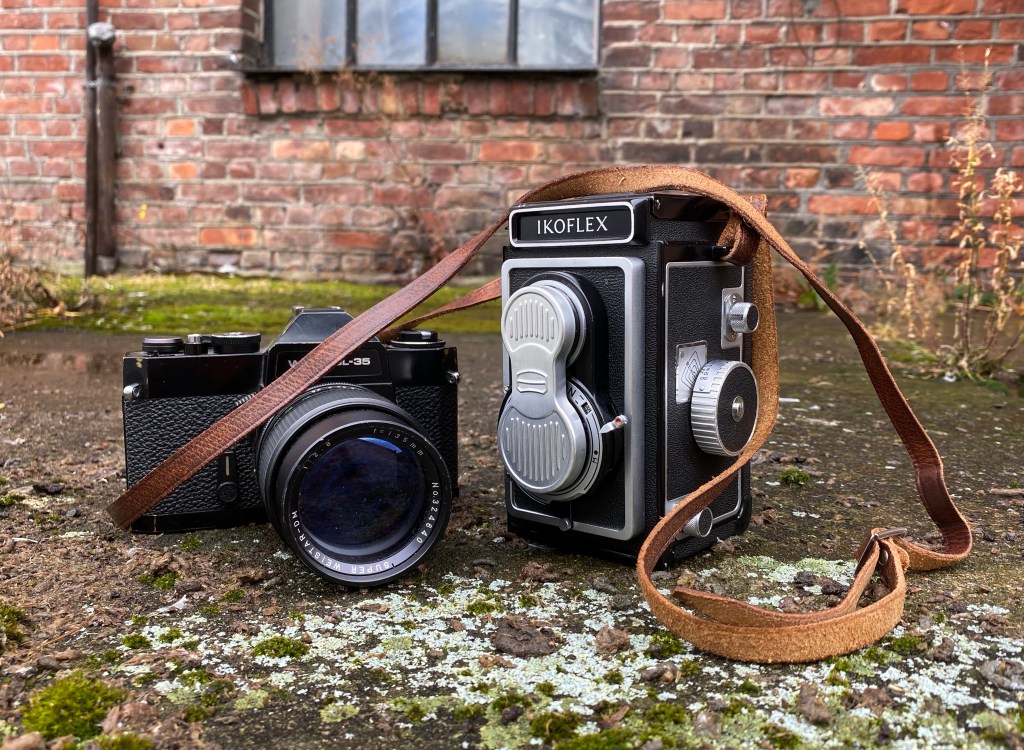
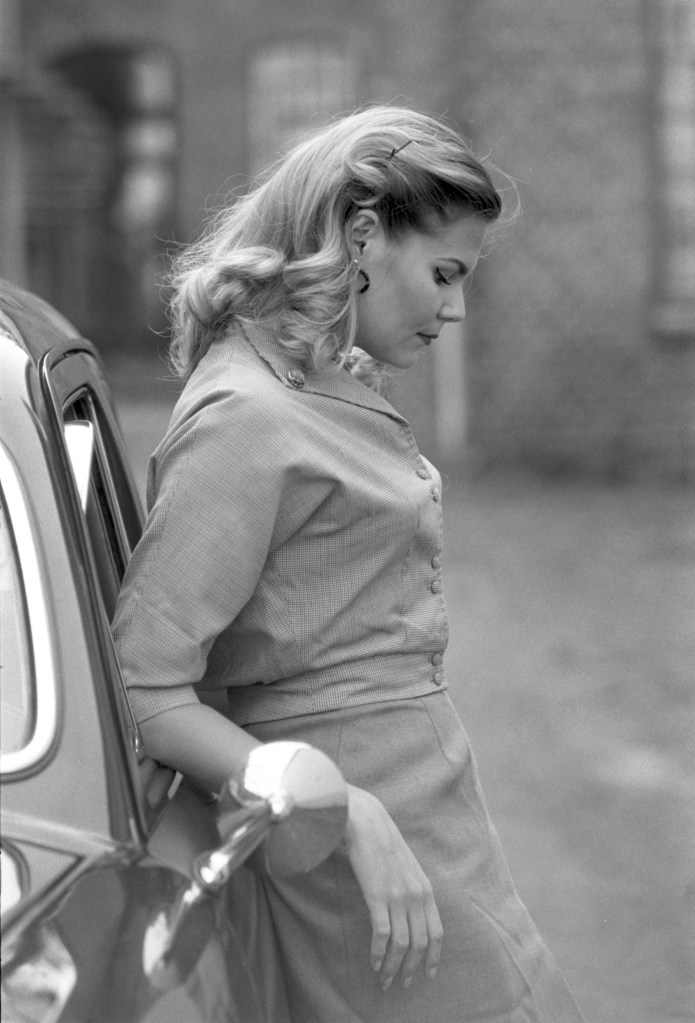
Yesterday I went out to photograph my friend Frida and her lovely 1950 Ford Shoebox. To go with me for this shoot, I chose two cameras. The Weist SL-35 and my lovely TLR, the Zeiss Ikon Ikoflex. Both these cameras are reasonably accurate and has sharp lenses that does really bring out that «vintage feel». I rolled up both cameras with Ilford FP4 Plus, A film that for me is my first choice when I want that «Vintage feel». This film has a really fine cubical grain structure, and has a more visible grain than other films around its speed, and I love how this grain structure affects the images.
My equipment for this shoot. Zeiss Ikon Ikoflex medium format TLR and the Weist SL-35, 35mm M42 SLR.
We met at a lovely location in Kapp just south of Gjøvik. This location used to be a condensed milk factory back in the days, but today it is used for cultural purposes among other things.
Reklamer
We first set off with the Ikoflex. I shot as close to f4 as I could get, and did some bracketing with f5,6 to be sure not to overexpose too wildly. I shot the Ikoflex at its highest shutter speed around 1/300th of a second, but my guess is that this shutter speed is a bit slower. Probably around 1/250th which is still very good for a 70 year old camera like this.
Zeiss Ikon Ikoflex. Shot at f5,6 shutter speed around 1/250th of a second. Ilford FP4 Plus, developed in Xtol 1+1 for 10 minutes.
I refer to the Ikoflex as «the bird box» and this is one of my absolute favorite camera in use. When I bought it, it came from a Swedish Zeiss collectors house, and the seller did not believe that it worked. Probably because he didn’t really understand how it works. These cameras have their specific way of use, and you will not be able to shoot this camera if you don’t know how to load film in it and how to set it up.
When we were done with the film in the IKOFLEX, I changed it for some Kodak Portra 160, but these images are not included in this entry.
Reklamer
We then set off with the Weist and its exquisite Weistar 135mm lens. I also shot this one as close to F4 as I could to get that lovely bokeh you get from this lens. This is the first time I tried this camera and lens for a shoot with a model, and I am very happy with how it performed.
Weist SL-35 with Weistar 135mm M42 lens. Ilford FP4 Plus shot at box speed. Kodak Xtol 1+1 – 10 minutes.
These are just quick scans of the negatives. This shoot will be finished as Darkroom prints. Whether the prints and the process of making them will be entered in this blog is yet to be decided.
All in all, I am very happy with how both cameras performed during this shoot and I feel humble and lucky for being allowed to with with people like Frida, who is on board with the analog nerdity.
Photographs open doors into the past, but they also alloq a look into the future
As you may remember from a previous post, I came across a strange, unknown camera and bought it cheaply at a thrift shop. The Camera is an M42 mount SLR, and I tried it out with a roll of StreetCandy ATM400 a few weeks back. The other day, I took this camera out once again with a roll of Ilford FP4 Plus in it, and my aim was to test the depth of field and the sharpness of the Weistar Lens.
I went for a shot walk this day, just a few kilometers, and I chose to look for opportunities for shooting at apertures bigger than f4. I did some nice shots around Elgsjøen, where I both tested the DOF on a little branch with leaves close to the water, and on some stumps that were spread around for people to sit on.
Reklamer
I was taken somewhat aback of the incredibly pleasant bokeh this lens produces. In addition to this, the subject is pin sharp and has a crisp tone to it. I must say that this lens surprises me, and I am looking forward to playing with this as a portrait lens at some point. (Stay tuned)
Weist SL35 and Super Weistar 135mm f2,8. Here with he beautiful grain provided by Ilford FP4 Plus at box speed in Xtol stock.
If you ever come across a package like this. Don’t hesitate. Don’t doubt. Don’t walk away. Buy this camera and lens and shoot happily ever after.






















 Cheap Camera Adventures