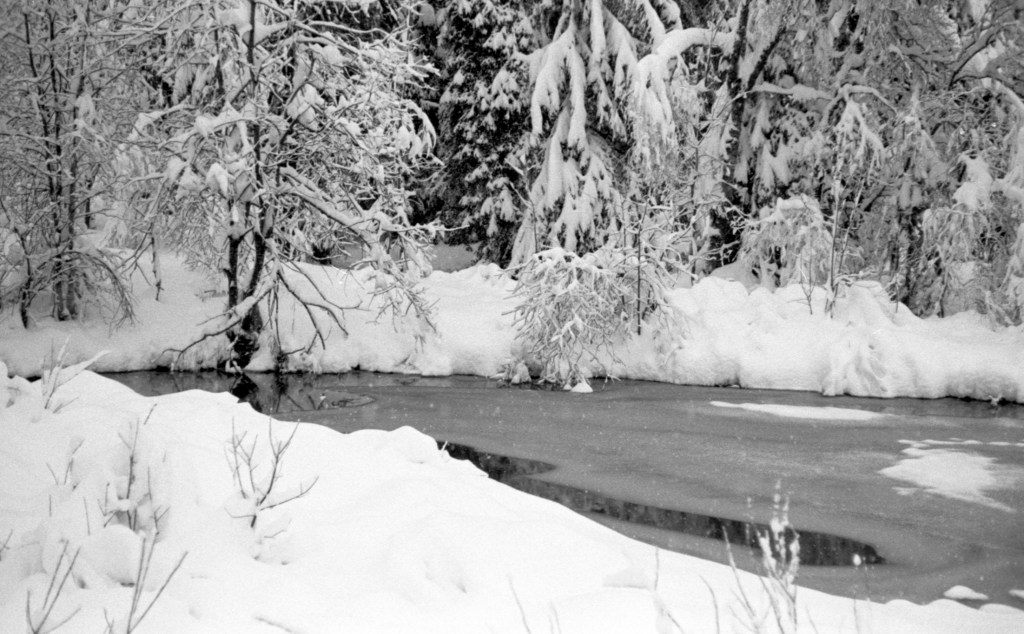
Sometimes, you shoot a roll of film, and you just put it in a drawer. Either you forget about it or you wait until you have shot more of them before you develop. The other day, I found a roll of Ilford Delta 100 35mm, that I couldn’t remember what I used for. I developed it in Adox Atomal 49, and it turned out to be a film I used at a trip during the summer of 2019 at a landscape photography trip to Veståsen in Nordre Land.
What camera I used, is completely blank to me, but based on the time the roll was exposed, and the quality of the exposures, I would imagine it was either done with my Nikon F80 or the Minolta Dynax SPXi. Here; a beautiful view over the little lake «Akksjøen»:
Summer mood at Akksjøen in Nordre Land – Ilford Delta 100 – Adox Atomal 49
This is one of my first rolls that I have developed with the Adox Atomal 49 developer, and I must say that I am very happy with how this developer makes the images look. The grain is very fine and I get the full film-speed without any issues. In comparison with my other Veryfinegraindeveloper Ilfotec Perceptol, where you have to shave off some of your film speed.
Reklamer
I just quickly wanted to share this picture with you, from a distant past without any Covid-regulations nor fear of a world pandemic.
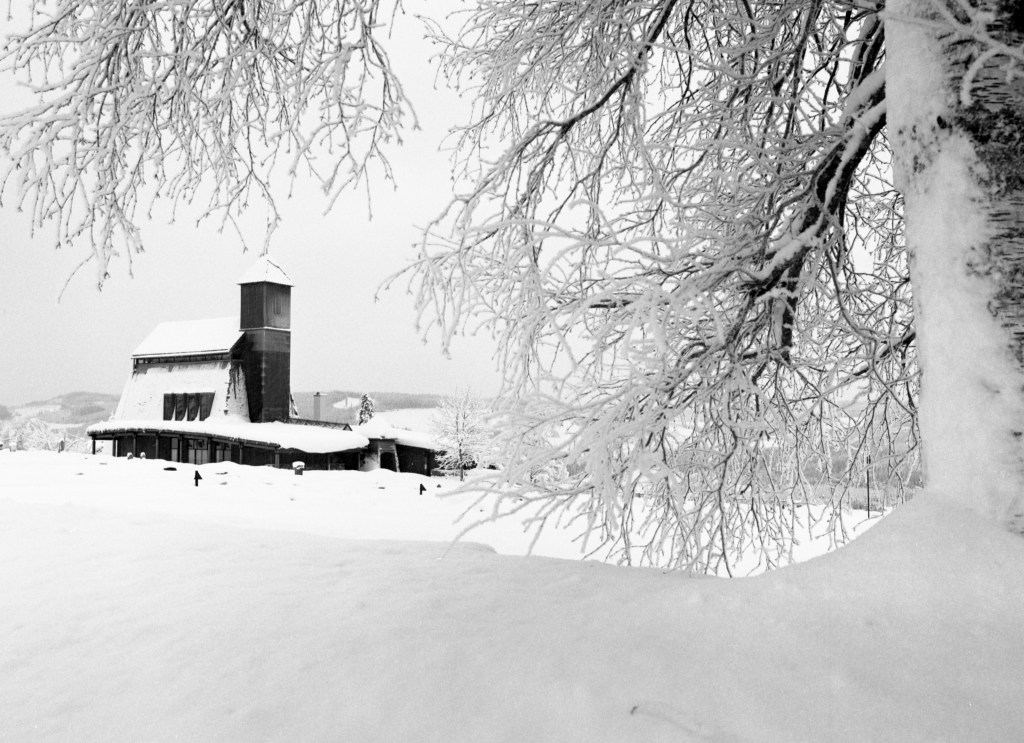
Not far from where I live, there is a modern, wooden church called Seegård. It was built in 1997, following the tragic fire in the old church during easter in 1994. The new church was raised in the same spot as the old one, and in an attempt to keep the cross structure of the old church and modernizing it, but at the same time make something that would suit its area. Not easy demands for an architect to meet, but I find that the architect Arne Thorsrud has pulled it off really well.
I have worked with this church on multiple occasions, mainly digital, but the other day, I decided to bring out my Bronica ETR, and make some black and white images of the church in winter time. I fitted the Bronica with the 50mm Zenzanon lens and a yellow filter to help balance the contrasts a bit.
Reklamer
To get the smooth results I wanted for this shoot, I decided to go with Ilford FP4 plus and combining it with Ilfotec Perceptol extremely fine grain developer. This is a combination I have found to work very well with winter conditions where snow and whites are prominent. However, you lose some film speed. In this instance, I shot the FP4 plus at ISO 50, and went for f11 which I find to be the sweet-spot of this lens. With a still standing subject like this church, which does not tend to move a lot, slower shutter speed is no real issue, and my shutter speeds were around 1/4th and 1/8th of a second with the correction for the yellow filter.
Seegård Church under the winter carpet. Zenza Bronica ETR w Zenzanon 50mm f2,8 and yellow filter. Ilford FP4 plus at 50 ISO – Ilfotec Perceptol 1+1
I did a few different angles and compositions, and a little bit of bracketing on a few of the compositions. After all, I ended with two images that I am very happy with, and they are the two I will share.
Seegård Church under the winter carpet. Zenza Bronica ETR w Zenzanon 50mm f2,8 and yellow filter. Ilford FP4 plus at 50 ISO – Ilfotec Perceptol 1+1
Sometimes my interest is sparked in some way when I watch Youtube videos. A few weeks ago, I watched a video called «Konica Autoreflex TC – The poor mans OM-1». To me, this title did not really make much sense. In my opinion, the Olympus OM-1 is extensive value for money and indeed very affordable both when it comes to lenses and camera bodies. They are also accurate like clockwork, and relatively hassle-free to service and maintain. I have shot a large number of rolls through my OM-1 and it has never given me any problems even in very cold winter days. So if there would be a cheaper camera that reliable, that had to be a gem for this blog indeed.
My lovely Konica Autoreflex TC with its marvelous Konica Hexanon AR 50mm f1,8 lens
I searched briefly online, and I actually found one incredibly cheap on a local Facebook sales page, and I got it for about 200 Norwegian Kroner (about 20 GBP) with shipping included. A real bargain there indeed. For the first tryout, I loaded it with a roll of Ilford FP4 plus that I shot at ISO50 and developed with Ilford Ilfotec Perceptol. I find that Perceptol really helps me get the winter tones I want for my shots, as well as a very fine grain.
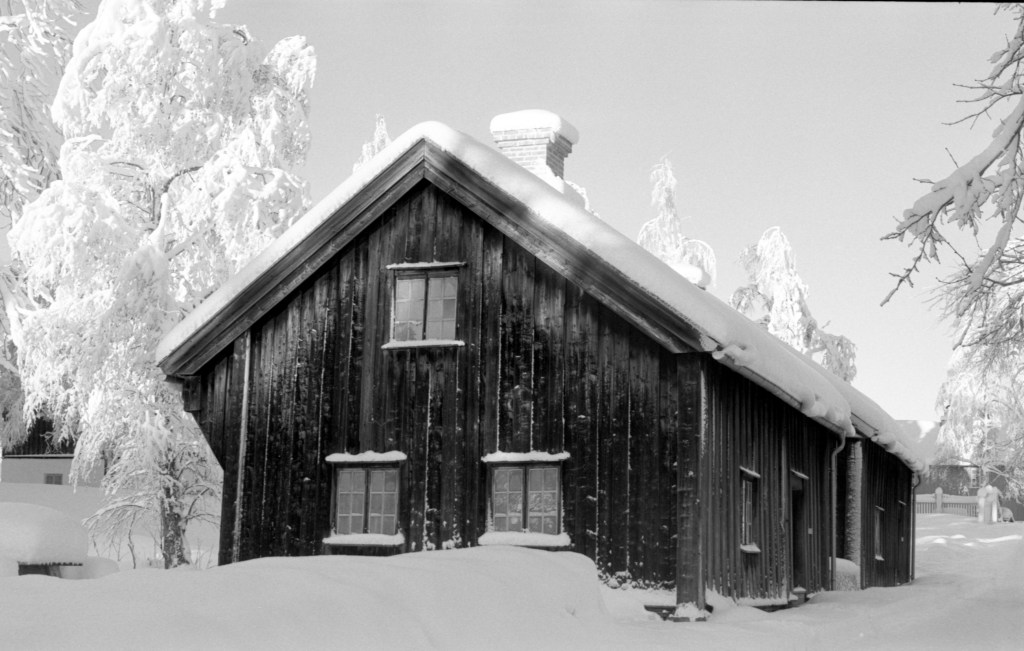
The Konica turned out to be a lovely camera to work with. It is indeed a bit heavier and more bulky than the OM-1 but it fits my hand very well and everything is where you expect it to be, and it all seems to work rather well. I did not try the Aperture priority setting on the camera, but shot it on a variety of shutter speeds and aperture settings with a wide range of filters I found to be helpful for me at this location, which is an old museum. However, I do not see this camera and the Olympus OM-1 to be comparable as equipment.
Reklamer
The Olympus OM-1 is a far more accurate camera with a broader selection of shutter speeds, all the way from a whole second to 1/1000th of a second plus BULB-mode. On the Konica, there is nothing between 1/8th and B, and the longer shutter speeds on my one «drags» a little bit. This could be the particular camera.
Also in the perceived build quality, the Konica is clearly a cheaper and less sophisticated camera than the OM-1. But if you forget about the irrelevant comparison to a clearly better camera, the little Konica is a very pleasant camera to work with, and the 50mm Hexanon Lens, is just outstanding. It gives a really nice sharpness, even at wide apertures and it is easy to focus.
Through my about 60 minutes photo-walk today, the Konica performed rather well for the first 20 minutes. After that, it coughed up a nice selection of issues and creative problems that I guess is it reacting with the cold weather. The temperature was about -12 degrees and some if these issues might be due to that.
Nr 1. Sticky shutter: After some shots the shutter started sticking every now and then. It did not matter which shutter speed the camera was set to. The only thing to do, was to tap the camera slightly so that the shutter would go off, and then shoot another frame to get one without immense camera shake.
Reklamer
Nr 2. Slowed focusing. After a while out in the cold, the focusing ring got very slow, almost as if the lubrication thickened and became a gooey syrup.
Nr 3. Camera refused to rewind the film back into the cassette and ripped it instead. When I manually retrieved the film, it actually broke on another place as well. Luckily, I did not lose more than four shots, and all of them were bad. (happy days)
All these issues aside, I like the Konica Autoreflex and the Hexanon lens. A ripped film could very well be my mistake and the other issues could be weather related. My next test out of this camera will be with a colour film, trying to capture some lovely, bleak winter colours.
When I first tried out Ilford HP5 plus, I completely fell in love with the film. I just loved the amazing latitude and the rich feel it gave my photos, and since then, I have mainly used HP5 plus whenever I needed a 400 or even a 200 speed film, which the occasional use of Tri-X-X when I want to push the film slightly, or just want to have a yellow cassette in my camera instead of a green one. At box-speed the two films are interchangeable in my humble opinion and I challenge you to spot which photo was shot with which of these two if I put up a selection.
A While back, before Covid and quarantines were an issue, I was in Aarhus in Denmark visiting a friend and enjoying the lovely Danish landscape and all the lovely pastries and coffee shops they have. I also visited Mimosa Photo shop in Aarhus city center, and picked up some rolls of film. Since I only had one roll of HP5 plus left, I needed a 400 speed film, and the only one they had in at that moment was Delta 400. I bought three rolls, and since then they have just been sitting around in the fridge, and not been tested. The other day, I went out for a little outing in the misty Norwegian winter-weather, and I decided to shoot with Ilford Delta 400.
Reklamer
I put one of the rolls in my Minolta Dynax SPxi, and screwed on the yellow filter and went for a spin, trying to find black and dark grey contrasts against the misty, white skies. I have often found the yellow filter to help me get the results I want in winter time, lifting the darks, while helping me retain detail in the very bright whites. I was curious how this film would be different from the HP5 plus, but after only one tryout, I can obviously not say that I have the knowledge to make a comparison nor a good enough photographic bank of results to base any personal judgement on. But I do know what I would expect from HP5 plus in these situations. An my prediction was more or less the same, but with finer grain.
Minolta Dynax SPxi w Minolta AF Zoom 35-70mm f4,5 Yellow filter – Ilford Delta 400 professional Ilford Ilfotec DD-X
The grain on this test-roll was actually finer than I expected, but I did not get the same contrast boost that I would have expected comparing FP4 plus and Delta 100 which I know both of very well. But all in all, I do rather like my results. The Minolta Zoom lens is not by any means the sharpest of lenses, but I tried out different aperture settings and even at some points used «Aperture priority» mode to get the most out the lens that I had on. The camera has a few functions that I find to be very helpful.
First of all, I like the two sensors on the right hand handle that will automatically focus when you touch them. In rainy weather; however, it turned out that these sensors were actually reacting to the rain touching it as well as my fingers, to the AF went berserk a few times. Also the AF tends to select different spots and, as visible in the images, it back focuses somewhat. It would be interesting to try this camera out with a different lens, to see whether this is a camera or lens-issue.
Reklamer
Second, I like the way you set the different parameters on different places on the camera. However, I do find it a bit fiddly and that you very easily forget which knob does what, and hence, shooting this in fully manual mode, is sometimes really exasperating. But the idea of having the controls on knobs and not on wheels, is something I really like. If Minolta only would have been friendly enough to mark these knobs with what they do.
Minolta Dynax SPxi w Minolta AF Zoom 35-70mm f4,5 Yellow filter – Ilford Delta 400 professional Ilford Ilfotec DD-X
Even with the AF on, as you can see, the focus gets very soft, and I suspect that there might be an issue with the AF system on this camera. But at the same time, I think that some of these photos gets some additional mood with that soft focus.
Minolta Dynax SPxi w Minolta AF Zoom 35-70mm f4,5 Yellow filter – Ilford Delta 400 professional Ilford Ilfotec DD-X
I chose to develop with Infotec DD-X which I know is made for the Delta series. I got the developer from Bjørn Joachimsen in November, and I would recommend you to look through his amazing catalogue of photos both here on WordPress and on Flickr.
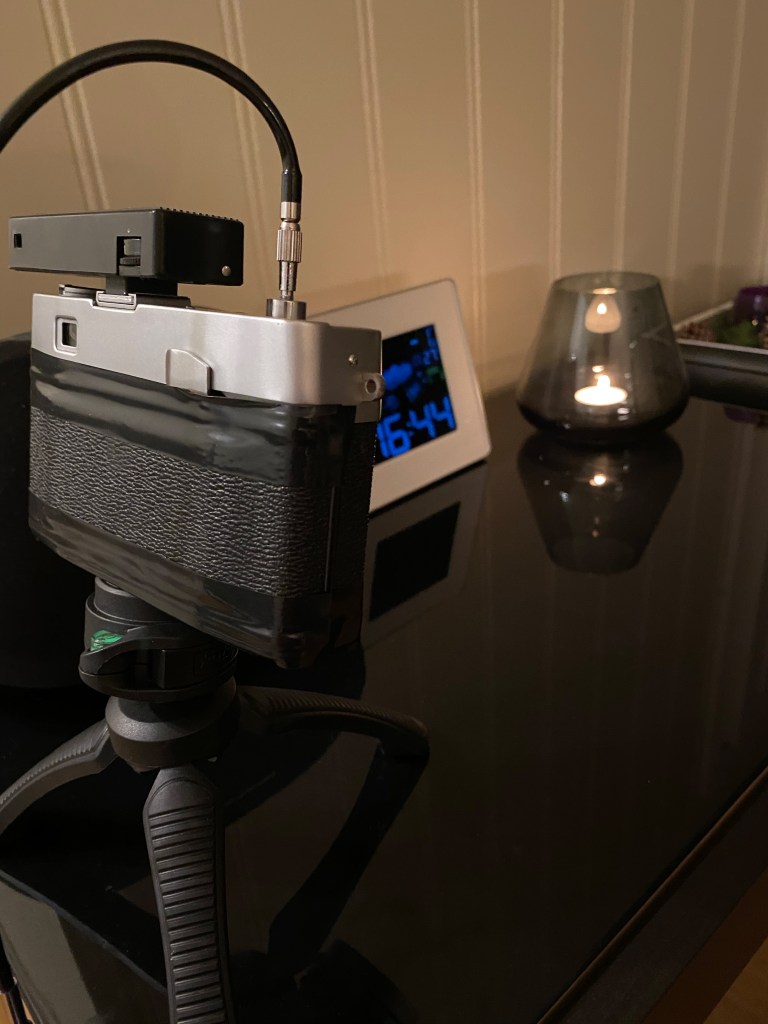
Playing with the Christmas decorations is not an activity reserved for cats. When I tested the Petri 7s for the first time in the beginning of December, I noticed how good the lens seemed to be. Even though my test then showed that the camera had seen better days, the f1,8 lens turned out to give very nice, details and I decided to shoot some frames to test it out. I decided to go with the Christmas, or actually Advent, decorations. I lit a candle in a glass candle holder, and let that work as a foreground, and I placed the rest of the decoration approximately 80cm away from the lens, which would be the closest focus length for this camera.
My setup. Petri 7s on a black glass plate with the decorations. I have taped the camera because the back has a tendency to «pop open» at any point.
I went with shots at f1,8, f4 and f16 to see how much difference there would be in sharpness and how they would turn out. I did not change the lighting conditions, but I adjusted my shutter speeds to compensate for the smaller aperture. for the f16 image, that was two and ha half minutes with compensation for the Schwarzschild effect.
Petri 7s – Ilford FP4 plus Xtol Stock. f1,8 1/8 seconds – f16 180 seconds – f4 1/2 seconds
All in all I think the lens gave me the results I anticipated. The f1,8 gives me a very nice bokeh, but the focus is a little bit off, so maybe the focus ring isn’t as accurate as I would hope for. The f4 image gives more sharpness and retains the nice bokeh feel, and the f16 gives a very sharp image.
The mood changes a lot between the images, and I am not sure which one is my favorite. You can make a judgement yourself, and I hope the images are to your liking.
Some days ago, I was tidying up my darkroom, and I found what I assume to be a previous test-roll. I assumed that the roll was around half, but it turned out to be around 24 exposures of HP5 plus. I then got the Idea of trying to capture the miserable weather we have had in the area lately. I figured HP5 plus would be brilliant at that, it has grain, but not too much and coarse. I also chose to go with Ilford’s Perceptol developer, to reduce the grain in the whites a bit, but not eradicate it.
My aim was not to get razor sharp images, but rather to capture the feeling and mood of this time of year. I am thinking more in the direction of a charcoal drawing than a crystal clear image of the mood. I know some photographers would have gone with a Holga or something similar to that on an outing like this, but I have never really befriended my Holga camera, and I prefer the effect the Petri Racer gives.
Snowy and wet December day – Petri Racer w Ilford HP5 plus@250. F8 1/60s – Ilford Perceptol stock
For that reason, I chose to bring along the Petri Racer. For long term readers of this blog, you know the Petri Racer camera very well. It was the first camera I bought for this blog, and the camera that inspired me to make a blog about cheap cameras, hence CCadventures – Cheap Camera Adventures. Not that all cameras featured on this blog is «Cheap», but they are reasonable and affordable alternatives that in some way sparks my interest.
Reklamer
The day was very snowy and it was unpleasant walking around in the snowy weather. I also had to wipe and dry the Petri a few times during the outing, to make sure it was not soaking or that the lens got fogged up. The camera had been in the car for a few hours before the shoot to «climatize» somewhat, but the wet snow and humidity made it fog up slightly anyway. I therefore let the film reach room-temperature before developing it. I often do this when the weather is cold to avoid swift temperature changes during the process. Not that the weather this day was very cold, only around -2 degrees, but it never hurts to be on the safe side.
Even capturing the snow falling – Petri Racer w Ilford HP5 plus@250 f8, 1/4 sec – Ilford Perceptol stock
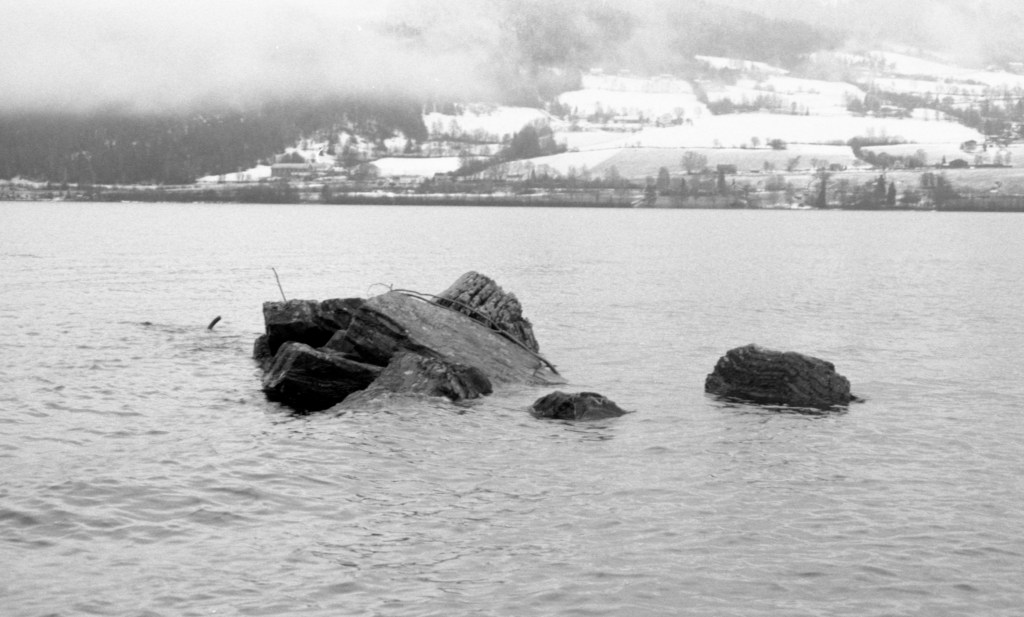
The whole outing took me around half an hour, and I was soaked afterwards after wading in deep snow to reach a dam with view over the little lake Skumsjøen close to Gjøvik.
For the images, I am quite satisfied with the images as I find that they convey the mood and feeling I was aiming at conveying. These are not my strongest photographic moment by any means, but in terms of conveying the unpleasant Norwegian December-wet snow, I think I did a decent job.
Petri Racer. -Ilford HP5 plus@250 f8 – 1/60 sec. Ilford Perceptol stock.
Today as I was relaxing, enjoying a cup of coffee, I looked out the window. The first fall of snow has just blessed us with its arrival, and this always brings new objects to my attention. Things that I maybe haven’t noticed because it is hidden in the November-browns.
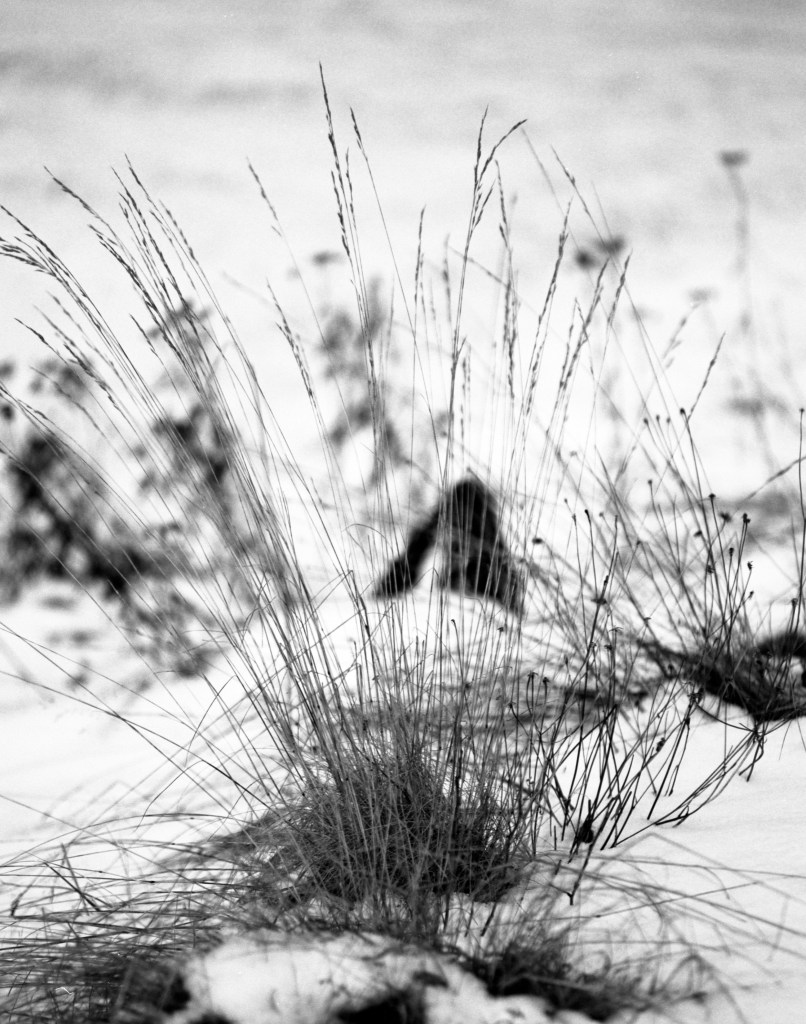
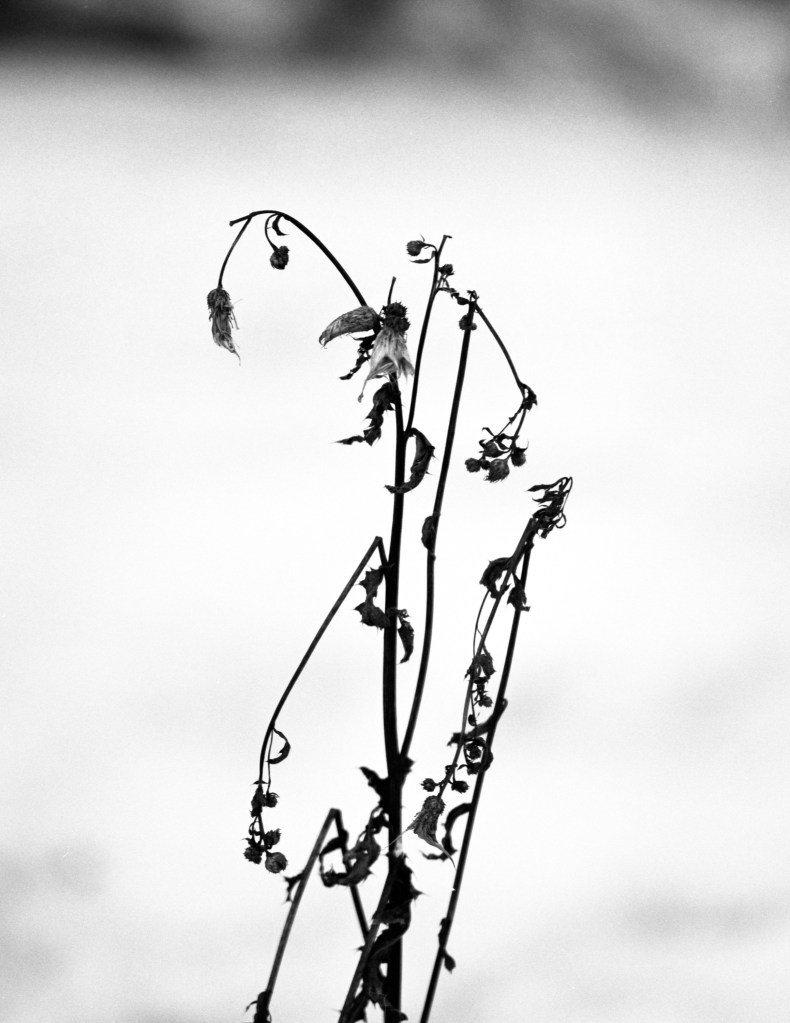
Today my attention was drawn towards some wilted plants. Their very dark brownish colors made a nice, almost minimalistic, tone towards the snowy background. I immediately ran to put a roll of Ilford Delta 100 into my Bronica ETR. I also fitted it with a lens I just bought. a Zenzanon 150mm f3,5. Equivalent to around 90mm at a 35mm camera, and used a yellow filter to get the minimalistic contrast that I was looking for.
I aimed to keep the snowy areas around zone 8-9, to not completely blow it out, and my dark areas around zone 3-4 to retain some shadow detail. I got fairly good negatives, but I would have loved to have retained some more detail, especially in the most contrasty images.
Reklamer
Once again I chose to develop Delta 100 in DD-X developer, and this time as well, it gave me fabulous negatives. I am really looking forward to working with some of these images in the darkroom, and I expect to use lower grade filters, or maybe some split grading to get the most out of the negatives. A spot on my wall is already prepared for one of these images.
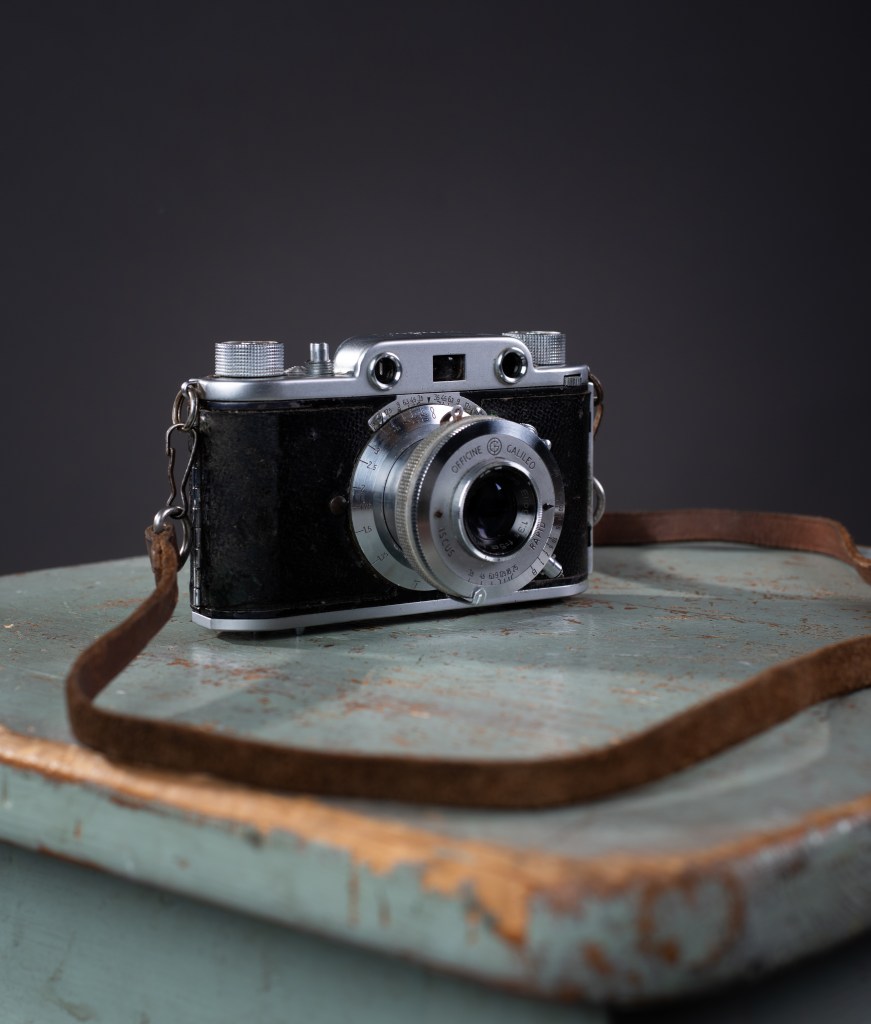
A few says ago, I wrote about my new camera. A 1947 Condor I. Mine was sold without the Ferrania logo, and from my research online, I see that these cameras were sold like this in 1947. This means that the camera is 73 years old, and was sold two years after WWII ended in Europe. In the early stages of the European healing time. In Italy, this is two years after Mussolini died, and Germany was still referred to as «Handelsschiffe» and completely divided into four sections by the allies. From Germany came the Leica IIc, a camera that is way above my budget, even today. And from Italy came Officine Galileo with their Condor I.
The Condor I is a relatively simple camera in many ways. 100% manual with shutter-speeds on a wheel around the lens, aperture settings on a lever and a coupled rangefinder with two viewfinders, one for sharp focussing with some magnification, and one for a preview of the whole Image. On mine, alas, the range finder is too dim to be of any help when focussing on my particular camera.
The beautiful Officine Gallileo Condor I
Operating the camera is a little fiddly, especially because of the very hard mechanics. It does not seem to have been used and looked after for some time, and it would not object to a little lubrication and a little clean. Other than that, it seems to work pretty well.
Reklamer
Walking around with a camera like this, makes you think more than if you walk around with a fully automatic digital camera, where you know that what you see is what you get. An old, vintage, piece of equipment seems also to put a smile on people’s faces. When shooting this today, I was asked by several elderly people about the film I used, what camera it was, and what I knew about it. I also had to tip some of them about my blog, where some of the images would be posted.
Another interesting thing with this camera is that it gives med 40 images on a 36-roll of film. This is because you stick the leader properly in place, and can close the back before you start advancing it. The lens is relatively sharp, sharper than I would expect from a camera this age, and way sharper than my Argus camera. On the down side, I am limited by having to «guess-focus» and I can’t really see its potential before I have some kind of rangefinder to help me. It also seems like the lens has a little hazing on it. Not that it is a dealbreaker for me, but it is something to consider then using it, as it gives very hazy results when there is some backlighting in the image.
Officine Gallileo Condir I, Ilford FP4 Plus, Kodak Xtol 1+1
Even so, the camera is fun to shoot, and I will probably use it for a few outings in the future. After all, it cost me close to nothing, and It is fun being so bound to your own skills.
In my previous entry, I went out in the grey, misty Norwegian November to take some calm and pleasant pictures with my Bronica ETR and a roll of Ilford Delta 100. I also tested a new developer, Ilford DD-X, and I was very pleased with one of the images. So pleased in fact, that I decided to take a trip into the darkroom to make myself a print for my own wall at home.
The picture I chose to work with.
I brought along my GoPro and made a very basic and amateur video coverage of the darkroom session. My video skills are not good, and this is actually the first time I have tried to mount together a video in this way. I might do more of these.
Some days ago, I was contacted by another Norwegian photographer who has a collaboration with Ilford Photo. He kindly sent med some rolls of Ilford Delta100, some DD-X developer, Fixer and Wetting agent to try out. Today I went out with my Bronica ETR to try it out. Before I go any further, visit his amazing gallery on Flickr and read his posts here.
When I heard that I would be sent Delta100, I was thrilled. When I took up analog photography again some years ago, Delta 100 was one of the films that really rekindled my interest in film-photography and I find it to be one of the best films I know about. The smooth and soft T-grain structure gives pleasant results. even when developed in Rodinal. In most cases I shoot Delta 100 at 50, but today I chose to go at box speed, because of the lighting conditions.
Reklamer
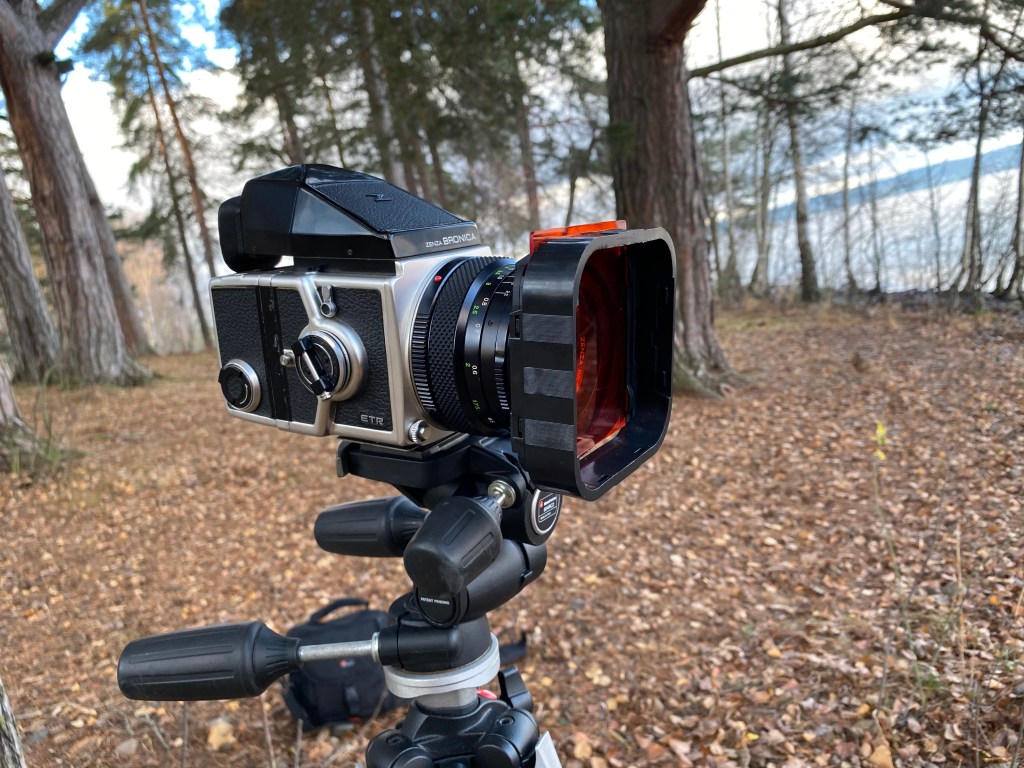
My location for this outing was Tallodden. A beautiful little place not too far from where I live, and I brought my Bronica ETR, some square filters and a tripod. I always mount the Bronica on a tripod. It is too heavy to shoot steadily by hand, especially at shallow apertures or longer shutter speeds.
My setup at the location.
There is something about walking around with a proper MF SLR like this. It makes people interested, and I had a shot chat with a nice elderly man who was out for a little stroll along the lake. He told me that he had not seen anyone with such equipment around that area for years, and asked me all sorts of questions about the camera, my lens, film, plans and where I would post my images for him to see.
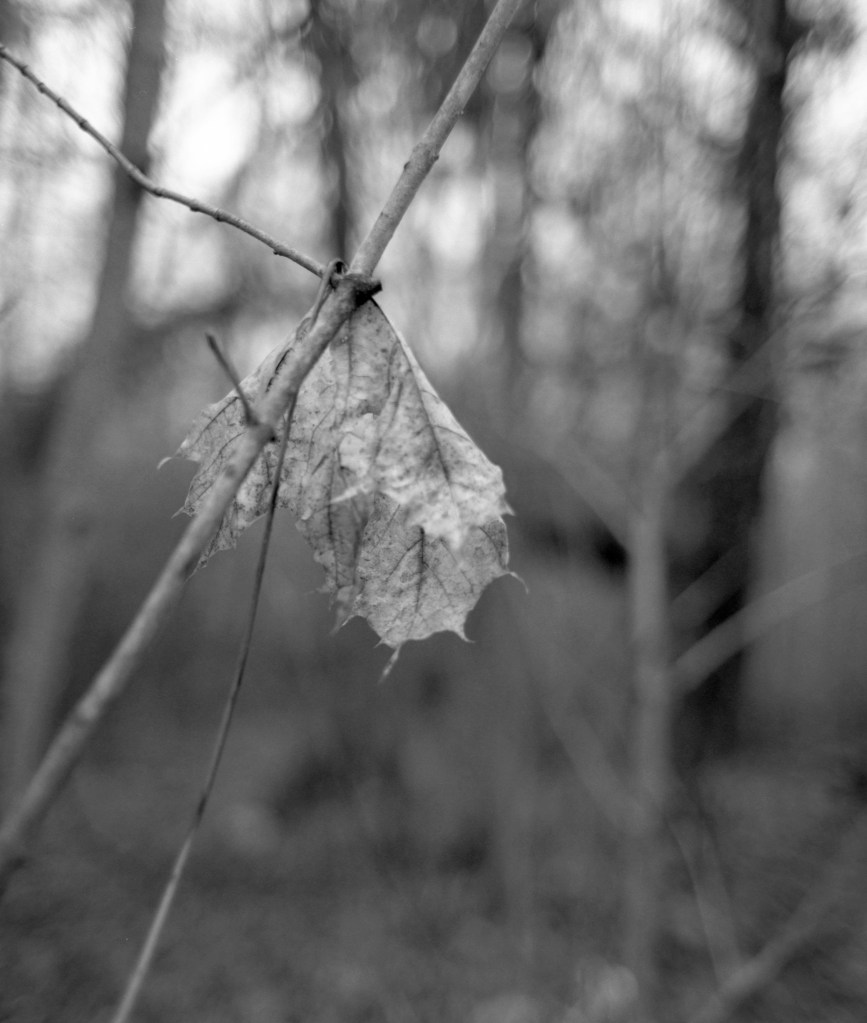
A lonely autumn leaf. Bronica ETR w 50mm Zenzanon f2,8. Shot at f2,8 1/30th with yellow filter. Developed in Ilford Ilfotec DD-X 1+4
I spent some time scouting around for interesting subjects that would give me a smooth and calm mood to my images. I wanted the fine grain the Delta100 gives to be one of the main focus on my shots. I chose to use a yellow filter for most of the images to boost some contrast, and get the most out of the range. But I swapped for an orange filter for shots where I wanted the «silky water» effect, and more depth in the range.
I then went home and developed.
Reklamer
This is the first time I have ever used DD-X. Actually I have never used Ilford Developers before, so I was very excited to see what the grain structure and the range would be like. This is a shoot where I would normally have gone for Kodak Xtol, and I am comparing a bit to what I would have expected from Xtol.
I am very happy with my results, and I am happy to see the smooth and lovely grain in this shoot, and I think the DD-X brought it out beautifully. I still have more rolls to shoot and develop in this developer, so I will not come with any analysis of any kind based on my limited knowledge, but so far I am very happy.
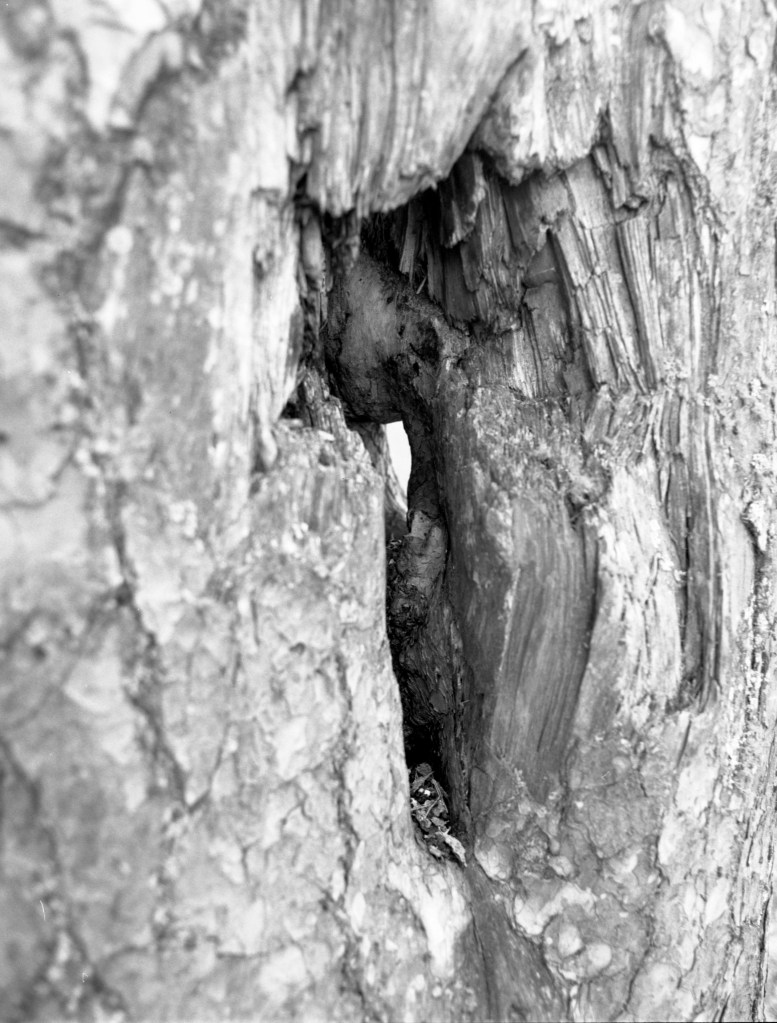
Bronica ETR w 50mm Zenzanon lens. yellow and orange filter. Ilford Delta 100, DD-X 1+4
Once again, thank you for sending me films and chemistry to try out. More entries with this film and developer will come. Also a video of me making darkroom prints of some of these images.


















 Cheap Camera Adventures