Testing out some cheap film

I am not usually bulk-rolling film, but not long ago, I got hold of a 100ft roll of Agfa APX100 for very cheap money. I decided to give it a go, as I have previously been very fond of affordable films like the Fomapan 100 which I also tend to bulk-load, as it is relatively inexpensive to do. I have found my way of exposing and developing Fomapan 100 that gives me the results I want. This method includes exposing at EL 50 and shave 20% off the recommended development time with Kodak Xtol 1+0.

As the Agfa APX100 is a brand new film for me, I decided to shoot it at box-speed and develop as the massive development chart suggests. As Kodak Xtol have been out of stock in Norway for a very long time now, I decided to use Ilford ID-11 to develop this film. I chose the dilution 1+1.

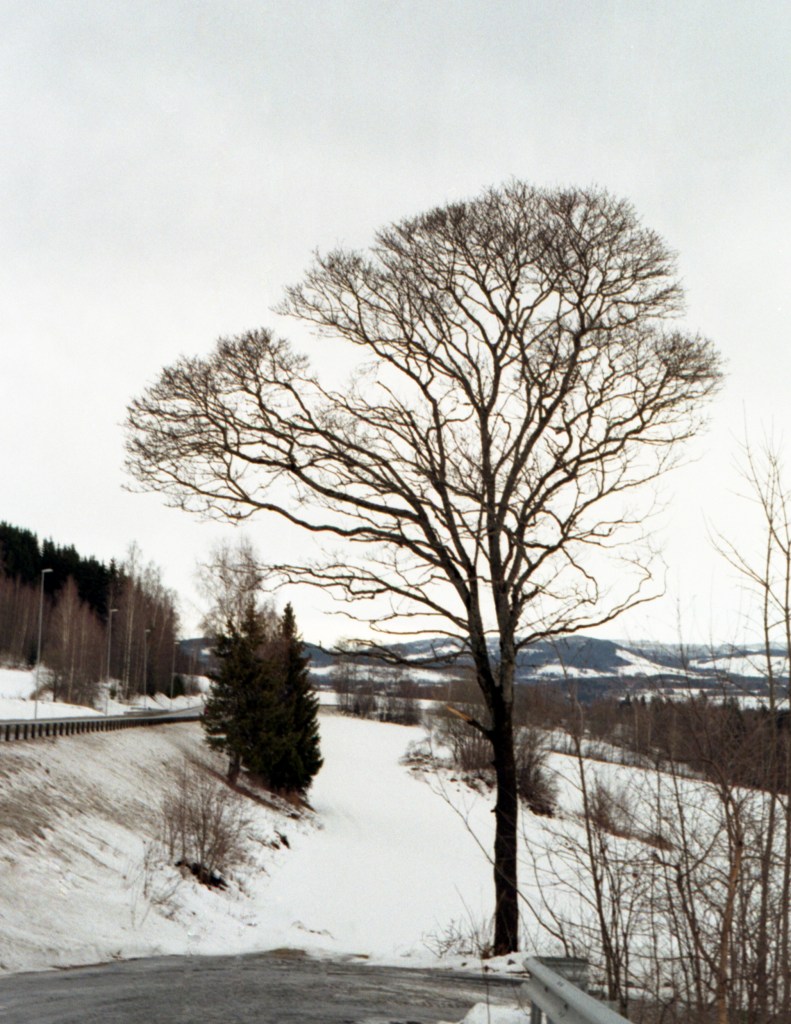
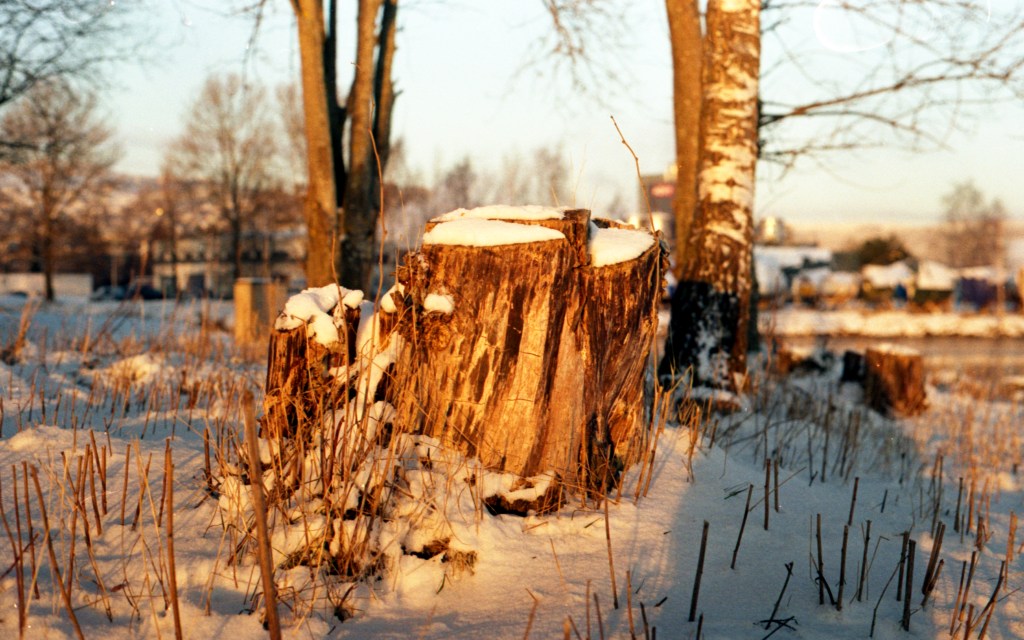
Winter leaves as Spring emerges – Konica Autoreflex TC – 50mm Hexanon f1.8 – Agfa APX100 Ilford ID-11 1+1

Immediately, when looking at the negatives and their scans, they appear slightly under-exposed, and it is clear to me that this film needs more exposure than I gave it at this first tryout. Especially definition in the darker areas is easily lost, and I think that a slight pull could give me a flatter negative that will be easier to work with in post-processing. My next roll will be tested with the method I use for Fomapan 100, and I will evaluate those results as well.

Spring by a frozen lake – Konica Autoreflex TC – 50mm Hexanon f1.8 – Agfa APX100 Ilford ID-11 1+1

For this test, I chose to go with the Konica Autoreflex TC. A camera I bought this autumn and that I have found to work very well and be reasonably accurate at shutter speeds faster than 1/60, which is the area in which I chose to shoot this time. The lens is a very standard Hexanon 50mm f1.8, a lens that is reasonably sharp and is easy to focus. Some of the images were shot using a yellow filter and some without the yellow filter.

The film has the amount of grain that I would expect from a 100 ISO traditional film and it seems to me as it behaves very much like the Fomapan 100 in its sensitivity. The lighting conditions on the day were quite contrasty, and I find that to be very clear from the negatives. They seem more contrasty than I would expect from these conditions with my standard go-to slow film, FP4 plus. That said though, it is important to clarify that I am basing this on just one outing and one roll of film, and that I by no means am a film-expert. I will use this film some more over the coming weeks, and find out how well it works for me and how I can get it to work for my style and preference.
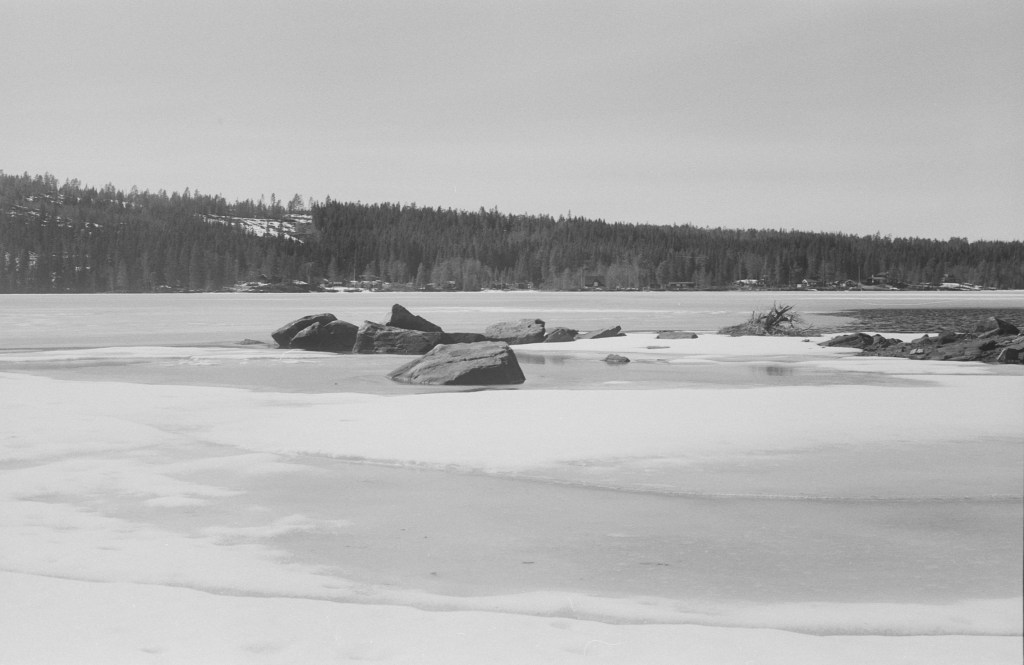
Rocks in the ice – Konica Autoreflex TC – 50mm Hexanon f1.8 – Agfa APX100 Ilford ID-11 1+1

What I found when working with these scans in Lightroom, was that getting the correct contrast-levels was tricky. You cannot go to far before you lose your shadows and you easily blow out the whites. The images taken with the yellow filter in general give a better balance in the contrasts.
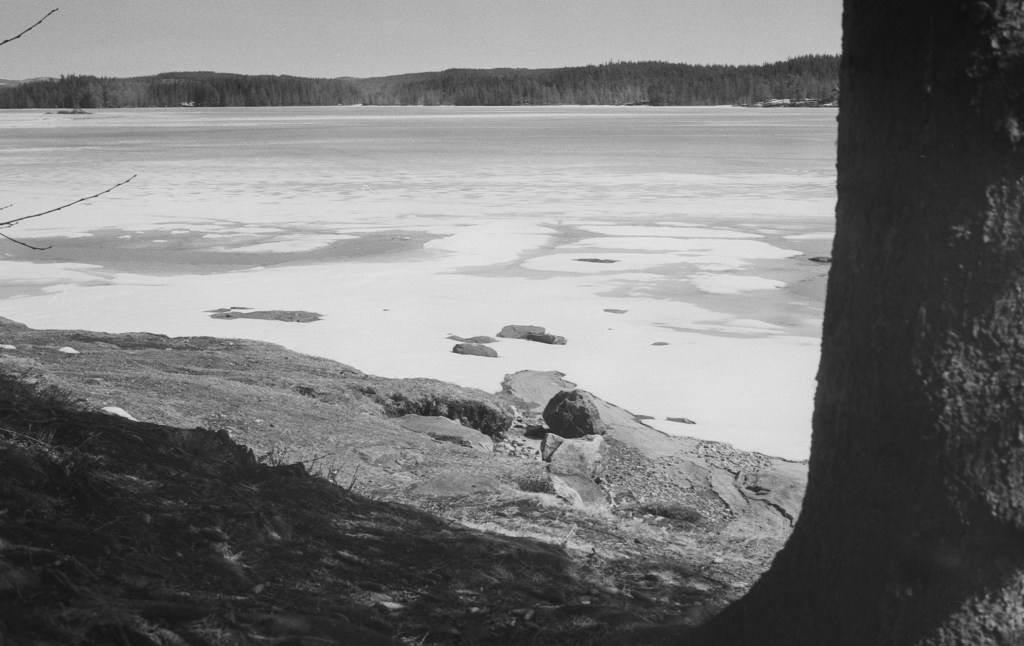
Darker areas are easily lost – Konica Autoreflex TC – 50mm Hexanon f1.8 – Agfa APX100 Ilford ID-11 1+1

Capturing bleak winter colours

As I have previously written on my blog, I like shooting Kodak ProImage 100 in the winter. There is something about the colours and the subtlety of it, that I find to be exactly the right media for my style of winter-shooting. Some days ago, I gave the Konica a roll of ProImage and went for a little outing to some different locations where I could access the lake. The day were one of those days where it was clearing up after some dull and grey days, and there were very bleak, oranges and purples in the landscape.

Lith Print feel – Konica Autoreflex TC – Hexanon 50mm f1,8 – Kodak ProImage 100

I have also found myself to be very fond of the little Konica camera. Yes, it has a bit fewer shutter speeds than the OM-1 that inspired me to buy it, and indeed it hates cold weather. But the camera, and its lens is in mint conditions and takes beautiful images. The lens is very sharp and produces beautiful bokeh. It also feels very sturdy in the hand. From what I gather this is because mine is an early model where the whole body is a metal construction. It does not produce any light leaks at this point and I guess the light meter would work if I gave it a battery.

Tree root in snow – Konica Autoreflex TC – Hexanon 50mm f1,8 – Kodak ProImage 100

Based on the fact that this was marketed as an «entry level» SLR camera in its time, I must say that its performance is incredible. If I was to recommend an entry level SLR to anyone at this point, I would be very tempted to say Konica Autoreflex TC and just smile. I am very happy that I purchased this camera and I will probably keep it as one of my regular users over some time, along side with the Olympus OM-1.

Testing a Konica Autoreflex TC (Part 2)

This entry is a sequel of a previous entry where I shot a roll of Ilford FP4 plus trying out my new Konica Autoreflex TC camera, and where I, somewhat irrelevantly compared it to the Olympus OM-1 because I saw a video about it on Youtube. In retrospect, I regret that comparison because I find the cameras to be very different and not too comparable. I therefore cleared my mind, and I rolled the Konica up with a roll of Kodak ProImage 100, which is my preferred colour film for 35mm winter photography, and I went for a little walk.

My car needed to visit the garage that morning, and I had some time to walk around shooting the Konica handheld to get a good feeling about how it performed. Since the morning weather (The lovely thing about Winter-Norway around 10.00) was bright, colourful and vibrant I chose to go with Colour Shooting

A short time-lapse of the beautiful weather conditions this day.

Even though the Konica really dislikes the cold weather and can start to play up in different ways, I learnt from this last time, and this time, I chose to consider where it had issues last time before I started working. Fist of all, when the shutter gets cold, it tends to stick a little bit, therefore I tried to keep the cameras as close to my body, under my jacket, most of the time. This probably looked a bit strange, but it worked. I also avoided the lens fogging up due to this.

Another issue I found last time, was that the rewind button under the camera sticked and would not operate properly outside and the film ripped. I tried this button on multiple occasions indoors later, and it always worked. So this time, I did not rewind the film before I came home, and I did not have any issues with ripped film. That said, though. The take-up spool did in fact cut off the tip of the film leader in some weird way.

Konica Autoreflex TC w 50mm Hexanon f1,8 lens – f11 1/60th Kodak ProImage 100. Tetenal C41
Reklamer

I shot without filters this time, but I would probably have chosen to use a two stop polarizer if I had one for the ø55 filter tread. But when looking at the images, that was not really necessary after all. Working with the Konica camera is very pleasant, and it lies very well in the hand and has easy controls to operate. It also seems to be quite accurate in the normal shutter speeds that I have tried out, but then again, it doesn’t have shutter speeds between 1/8th and B.

What I really like, is that lovely Hexanon-lens. It has a very nice sharpness and it helps me render really vibrant colours and grey tones very well. I am looking forward to trying this one out with some Bokeh-shots with wide apertures at some stage. Stay tuned.