Shooting the beast

Sometimes you are really lucky. A few weeks ago, I signed up for the news-letter from a Youtube-channel run by a Canadian photographer named Azreal Knight. If you have not heard about his channel, you should really check it out. A lot of interesting content about analog photography. By signing up to this news letter, I also entered into a little «lottery» or whatever you would call it, and I won. When the price arrived, the box was rather big and I was curious what was in the box.

The content of the box was: One roll of Ilford HP5 plus, one roll of Kodak Gold 200, a selection of stickers, a really cool box-set of darkroom prints of the best Azreal Knight images of 2020… AND… A weird and huge BEAST of a 35mm camera. An Olympus iS-1.

This camera did not make sense to me at all when I first held it in my hand. It was huge and bulky, heavier than my Hasselblad 500C, has a plastic feel to it and the design is best described with the word hideous. At the same time, I am a big fan of Olympus and their lenses never let me down, so I was curious to try it out.

Loading the camera was actually rather fiddly. The take up spool is in the back-door of the camera, in a purpose built box on the back making up most of the bulky design of the back side of the camera. This sounds like a great idea as you would not ruin your whole roll if you should be unlucky and open the back door mid-roll. At the same time, getting the film to load properly is difficult because the motion of closing the door makes the film curl up and away from the take-up spool.

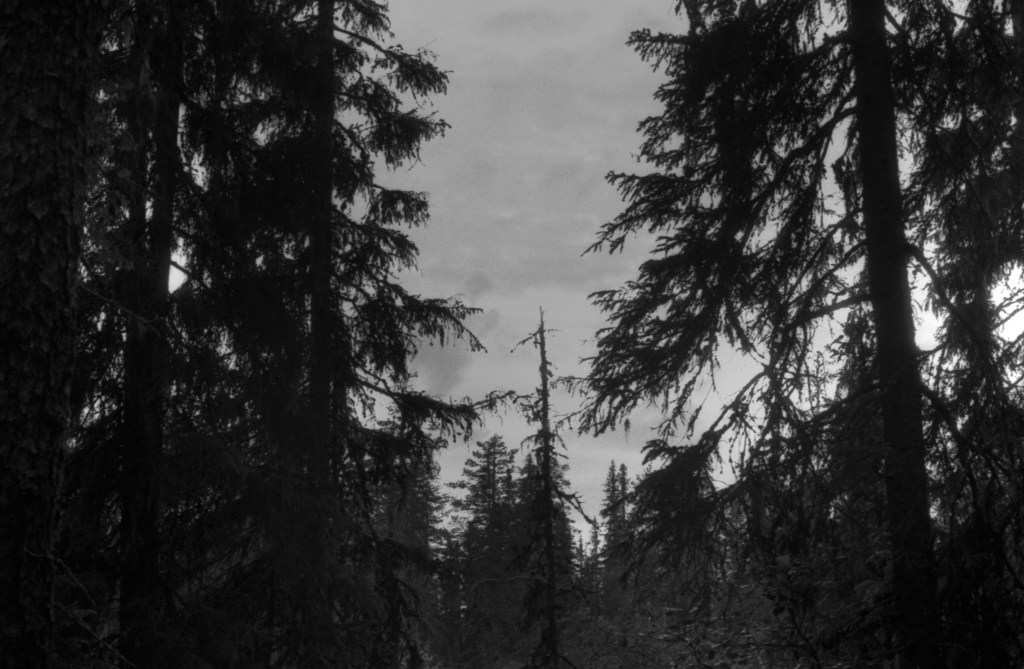
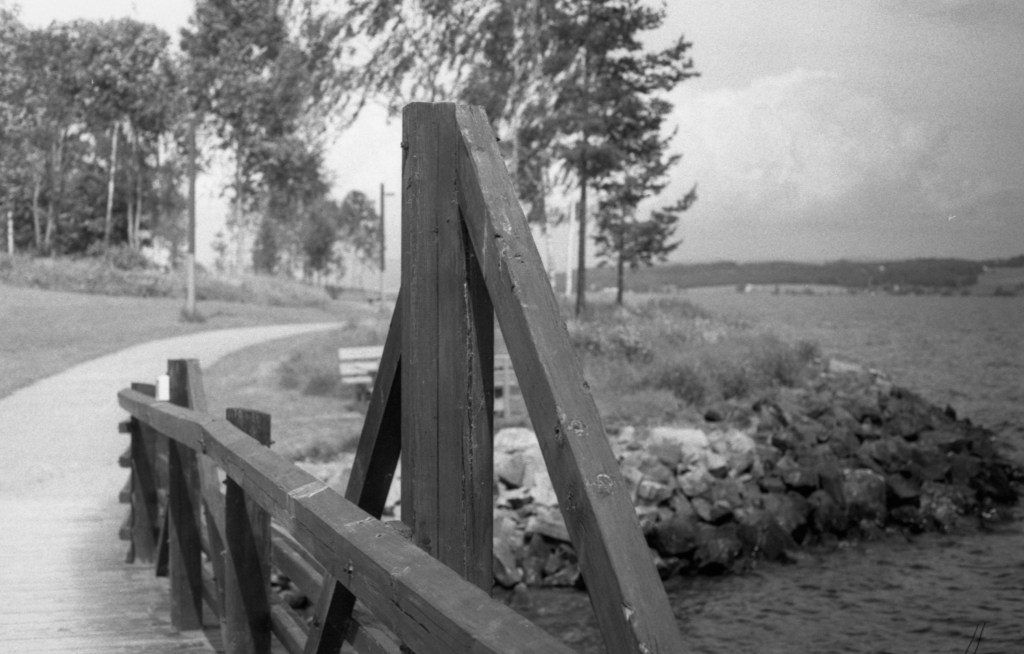
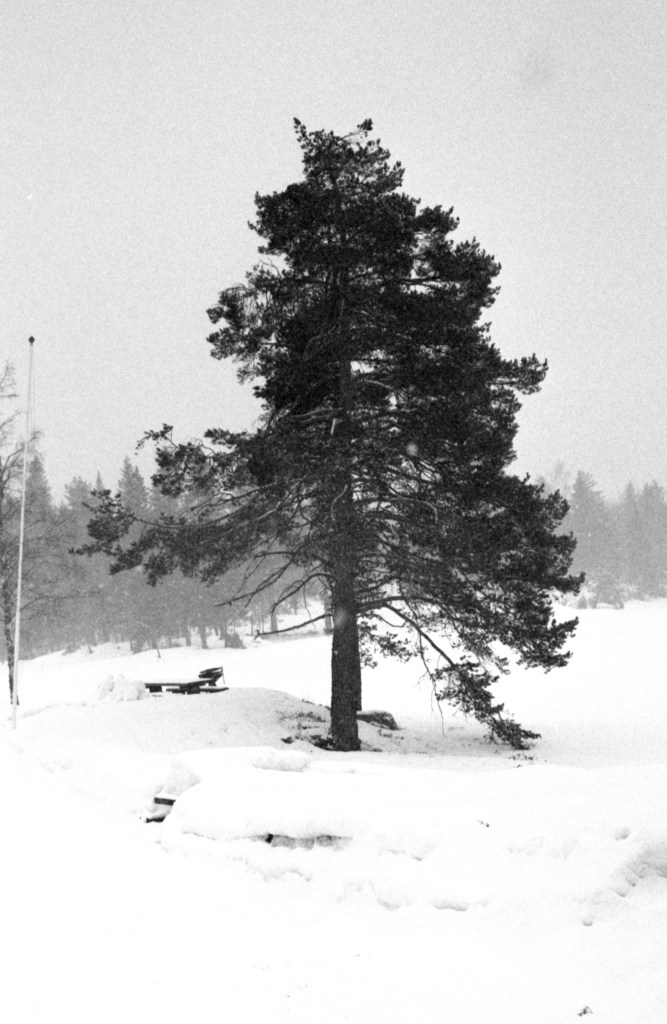
A tree – Olympus iS-1 – Ilford HP5 plus – Ilford ID-11 1+1

In use, the camera is an interesting experience. Even though I don’t really feel that this is a camera for me, I did enjoy using it. Not to be mistaken, there are a lot of small problems with this camera that I find to be very annoying, but using it is very different from using any kind of SLR og PaS-camera I have ever used. This belongs somewhere in the middle from my understanding.

First of all, the camera is heavy and bulky and does not really fit my hand very well. Especially the part about the ergonomics I fear would make me not bring the camera along.

Second, the camera has one of the slowest and least precise AF-systems I have used in a long time, and focusing it manually is fiddly and difficult as well. I ended up doubling and sometimes tripling the shots on many occasions to be sure I had something usable at least.

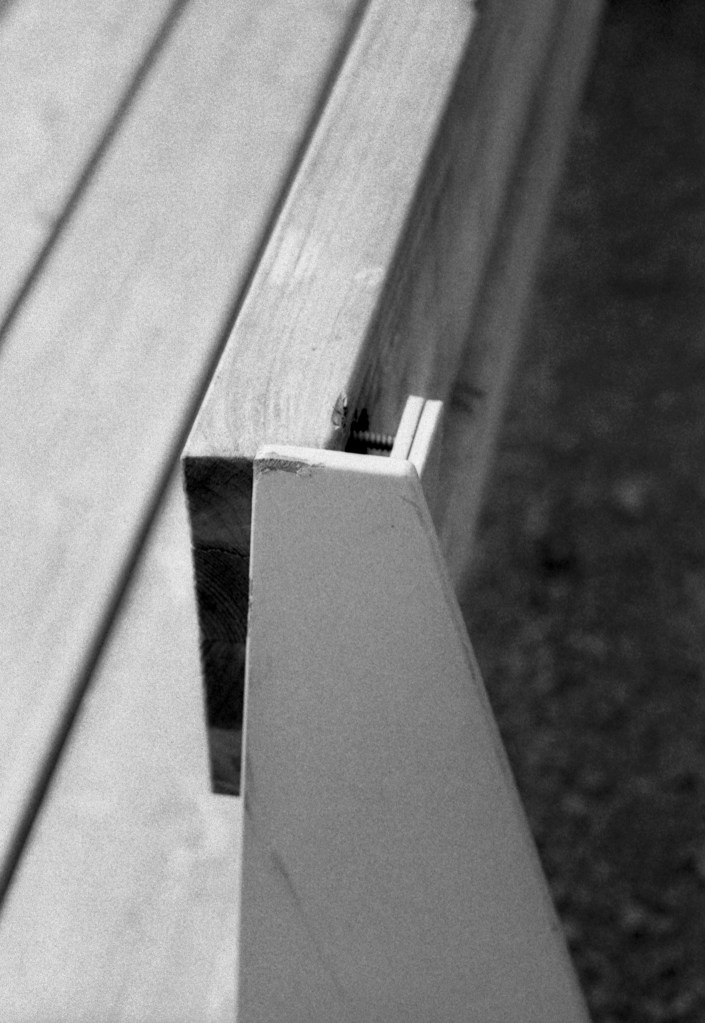
Third, due to its size and weight, this camera is difficult to hand-hold even at shutter speeds around 1/100, and many of my images shows severe camera shake. Even images I know were shot at 1/100 and above.
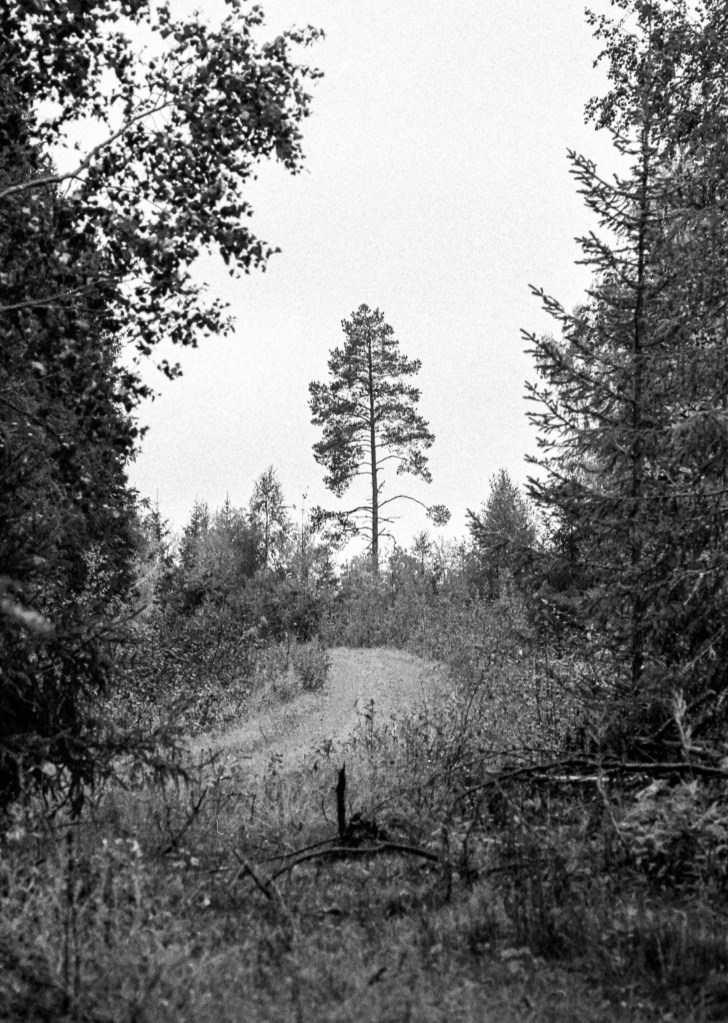
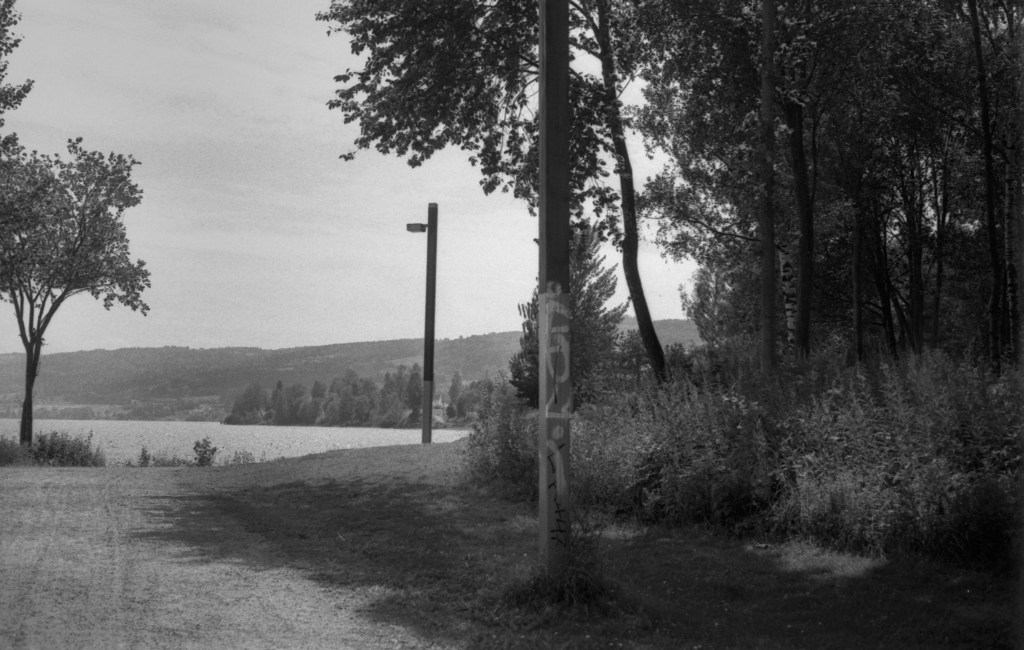
A tree – Olympus iS-1 – Ilford HP5 plus – Ilford ID-11 1+1

On the positive side, I must say that the lens is its Olympus name worthy. It performs very well both on its widest and longest settings and the when the AF hits it seems to be a very sharp lens.

As you can see through the images and their captions, I went for Ilford HP5-plus for my test this time. I actually used the roll that came with the camera. This is a film I use often and that I find works very well with the conditions like what I had on this day. Overcast with a bit of rain. I find that this film adds an extra element of texture to the images in a very nice way with its grain-structure which is visible, but pleasing. Even in 35mm shooting.

Morning mist and APX100

This last week has had really beautiful mornings and the other day, I decided to go for another tryout with the bulk of Agfa APX100. I bought this bulk a while back as I found that it was the cheapest bulk-film on the market and I was curious about its performance and capabilities. So far, I have not been really sold on this film. I find it grainy, slow and to lack latitude. I also find that, even with a very sharp lens and a very accurate camera, I get very inconsistent results. In this entry, I paired it up with my Olympus OM-1 and the 50mm Zuiko f1,8 lens.

From my previous experience with this film, I have found that metering it at 50 – a whole stop over-exposure – and developing for box-speed typically gives me the best results. Also, the yellow filter usually gives me a bit more contrast and definition in my negatives. This was also my tactic for this outing, and my results were just as inconsistent as they have been previously.

Since it was very early in the morning, and I wanted to travel very light, I chose to leave the light meter at home and rely on the light metering app I have on my phone. This is a very simple light meter, but I can easily meter at different places in the scene to get a decent exposure. I have done this in many instances before and never had any issues with poor exposures. If hesitant, I double up with an additional exposure just to be sure that I have at least one usable one. I’ll honestly say, that I only got one out of my 15 exposures this time to be anything that I would refer to as a decent image and what I had in mind while composing.

Over the misty hill. Olympus OM-1 w 50mm Zuiko f1.8 & yellow filter – Agfa APX100@50 Ilford ID-11 1+1

In this first image, which is the only one that I am actually happy with, the film manages the masterpiece of being both over and underexposed at the same time when the range was within about 4 stops. Even so, I find this image to really convey the mood of this morning very well and I like its dark gloominess. However, I know that this image would have looked far better on both Fomapan 100 and FP4 plus, which both are very affordable alternatives to the Agfa APX100, and that gives me more consistent results.

For my second composition, I wandered into the woods looking for a slow-flowing river passing under a very simple bridge. This image did not turn out in any way the way I thought it would. To me, this image is just a grey mesh with a lot of grain and lacking definition on what the real subject was. Even with heavy dodging and burning, I still am not convinced with this result. I also made three bracketed images of this, and all of them are severely lacking on definition.

Crossing the river – Olympus OM-1 w 50mm Zuiko f1.8 & yellow filter – Agfa APX100@50 Ilford ID-11 1+1

In the two upcoming images, you see the main issue with this film, completely lost shadow-detail even with a full stop over-exposure and metered for the shadows. I will keep trying this film for different purposes, but I must say, that it does not look like this film is for me and my use. I’ve read about people using this film for one or two stop push-processes, but I cannot for the life of me figure out why, when I have these issues when overexposing it.

Checking the bulk

Around a week ago, I went out shooting with the Canon T70 and a bulk-loaded Agfa APX 100 film. When I pulled the negatives out of the tank, I realized that it had somehow gotten exposed to light at some point and that there were a lot of different light leaks that could not have come from the camera. After inquiring around online, I found that the most likely explanation would be that the bulk-loader itself was not light tight and that it might have impacted the film either when stored inside the bulk-loader, or when rolled. I therefore decided to take the bulk loader into the darkroom, and I rolled up one little roll of film (approximately 12 frames) just to check whether there was a problem with the whole bulk, indicating a problem with the light seals on the loader.

To make sure there were no other differences, I used the same cassette when rolling, and I used the same techniques, only that I did everything in the dark. I then put the roll of film into my Olympus OM-1, which I know have good light seals, and set off to make some test shots.

A bench and a field – Olympus OM-1 Agfa APX 100 – Rodinal 1+100 1 hour

I spotted some light leaks on this roll as well, especially on the last shots on the roll, the one that had been closest to the previous loaded film, but the frames from «deeper in the bulk» seemed untouched by the light leaks. The light leaks were also consistent to one end of the frames vertically, so it cannot be anything with the shutter or light seals on the camera. I guess my experiment showed me that the bulk-loader is not 100% light tight, and I will apply black tape to it next time I fill it with a new roll.

For the film itself. I have found that what works for me, is shooting this film at 50 (or even lower) and using a yellow filter. This gives me the shadow details and a decent spread of greys. However, I will probably not buy this film again. To me, it is grainier than Kentmere 400 and I expect finer grain and more shadow-details at box-speed for a 100 speed film than what I get from the Agfa APX100.

Windy summers day – Olympus OM-1 Agfa APX 100 – Rodinal 1+100 1 hour

I also this time shot the Agfa at 50, but since I used a yellow filter, I set my light meter to ISO 25, giving an additional stop of compensation for the filter. I chose to go with Rodnial stand development on this particular test, because I wanted to see how the Agfa film would look with this kind of «lazy» development process. I think the process got some grain out of the film, and that if used on a rainy og foggy day, that this combination could work really well. It does really set the «moody» tone in the images. I would, however, get a rather similar result with pushing Tri-X, and this is a film with far broader applications.

Old Wood

One of my favorite subjects for my photography is driftwood and other types of old wood, such as dry tree-roots or fallen branches that has been lying around for a while and gotten touched and greyed by the elements. To me, this represents a strength and a a token of persistence shown by nature. Yesterday, I was out very early in the morning, before sunrise with just the colours trying to capture them with my Hasselblad. Once my roll of KODAK Ektar was filled, I broke out my Olympus OM-1 with its incredible 50mm Zuiko lens and a roll of Kodak Tri-X in search of some driftwood.

Just a little sneak-in from the Hasselblad because I absolutely love this image – Hasselblad 500C – Planar 80mm f2,8 – KODAK Ektar

My location for the morning was Husodden in Søndre Land. A secluded little headland in the lake Randsfjorden, home to amazing sunrise-light and a wide selection of birds and forest colours in the summer. It is also the home of a little air-strip used by the local flying enthusiasts. I didn’t meet any of them this morning, but I made sure not to be in their way if they were coming.

Reklamer

After sunrise, but when the light was still rather bleak, I got soft and nice contrasts, but seeing the conditions become more and more contrasty, I decided to shoot tie Tri-X at 200 instead of 400. The only filter on the lens was a Hoya UV-filter, that I find to be helpful on this lens. Although it is supposed to be Multi-coated, I have found it to react somewhat with haze if used without. (Could be anything else as well, I am no lens expert)

Details in the old bark – Olympus OM-1 – 50mm Zuiko f1,8 – Kodak Tri-X @ 200 – Adox Atomal 49 1+1

It never ceases to fascinate me how incredibly nice the textures in old wood can be. The image above here was taken of a very small detail on a bigger log, but really shows the worn details in that old bark and how incredibly beautiful that is if you isolate it like this. I also thin that pulling the film a stop was the correct choice for this occasion, as it gave me the opportunities to shoot wider apertures such as this f2,8 with the shutter speed 1/250th. I don’t trust the Olympus at 1/1000th after having some uneven exposures with that shutter-speed. Also, I do appreciate the extra shadow detail, but I don’t think that would have been an issue with Tri-X at this shot anyway.

For development, I chose to go with Adox Atomal 49. A developer I have used a lot the last months. I bought it after having some «bad» experiences with my usual Kodak X-tol where it didn’t mix properly (two batches) and I was curious about trying something new. Ive found Atomal to be a brilliant match with many of the films I use, especially Tri-X and FP4 plus, but also HP5 plus and Fomapan 100. It gives me very fine grain and seems to give very nice grey-tones and full film speed. Trouble is, it is somewhat cumbersome to mix and consists of three bags of powder rather than two. It has also «coloured» my 5L-container red and I will have to get a new jug for the next batch.

This old log – Olympus OM-1 – 50mm Zuiko f1,8 – Kodak Tri-X @ 200 – Adox Atomal 49 1+1

The image above is taken at f 5,6 and shutter speed 1/125. I just love the lines and how it almost seems charred in the dark-area to the right bottom. The balance in this image is very soothing I find, and it really shows why I find the Olympus to be my favorite 35mm Camera.

Since I was at an airfield – Olympus OM-1 – 50mm Zuiko f1,8 – Kodak Tri-X @ 200 – Adox Atomal 49 1+1

I shot 36 images of drift-wood in different ways and I only included my top-picks here. However, on my way back to the car, I spotted the wind-indicatorthingie (whatever it is called) and decided that I would attempt a 37th frame. I find that the «last image» don’t always come out, but I figured it was worth giving it a shot. I think this was f8, but it did not take any notes about this shot.

Scouting a location and shooting slow film

Today I was out and about with one of my lovely analog cameras again looking for locations for some early-morning sunrise photo trips. I came across this lovely location called «Husodden» not too far away from where I live. Being sensible and staying local is an important part of the world we currently live in. While I was walking around Husodden to shout for possible locations, I did some photographs with the Olympus OM-1 and a roll of Rollei RPX25. I metered it at around ISO 18 (My light meter goes to ISO25, so I opened the aperture slightly more) and shot with an orange filter to get the popping effect in the sky and boost the contrasts a bit.

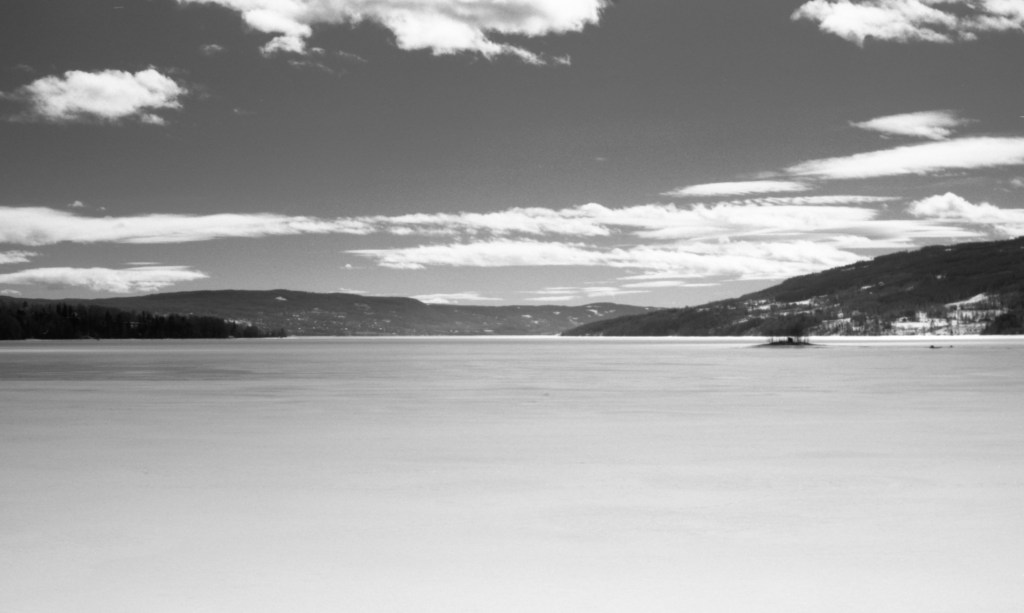
Randsfjorden, the lake, was still frozen and it became a white carpet in many of my images, and gave some extra contrast as well.

Sky-pop over Randsfjorden – Olympus OM-1 Rollei RPX25@18 Kodak HC110 Dil-B

I tried to use the remainders of the snow as a lead-in line in many of my images, and I aimed for a very large separation between snow and sky. In retrospect, some of these images would have benefited more from being shot with a graduated filter rather than a fill orange one.

Sky-pop over Randsfjorden – Olympus OM-1 Rollei RPX25@18 Kodak HC110 Dil-B
Reklamer

I decided to develop the film with «an old friend». Kodak HC110. I have not used this developer for a very long time, but there was something about the shots I took today, that made me bring out the golden syrup and mix Dilution B. HC110 used to be my favorite developer and, it is very economical and gives really nice greys. Also, there is something about it that I just like. I don’t really know what it is, but there is something about using that thick concentrate and stirring it properly that really wakes the «geek» in me.

A quick and pleasant day out for me today, and I am really looking forward to visiting this location again at some point in the near future. Both for woodland detail work and for early morning sunrise-shots.

Capturing snow and fog

Yet again, the persistent winter of 2021 struck  back at us with all its wreath. After a few weeks of impeccable weather and a really pleasant spring mood, we were once again confronted with the face of King Winter. When I went out yesterday, it was blowing a gale and the snow flew thick in the air. Thicker than horse-flies at a swamp in the summer. The weather was bland and uninspiring  and being out there was nasty and uncomfortable. Yet, I had something in mind.

I wanted to capture the foggy and snowy day with a gritty and grainy mood. I chose to go for a BW film. The Rollei Retro 400s, which is a film I have used a bit before and that I find to suit my way of shooting very well. My thinking was that the 400 ISO film would give me just the right amount of grain and contrast, as well as giving me the opportunity to shoot hand-held, which is very handy in windy conditions, where camera-shake due to wind is a real danger, even with  a sturdy tripod.

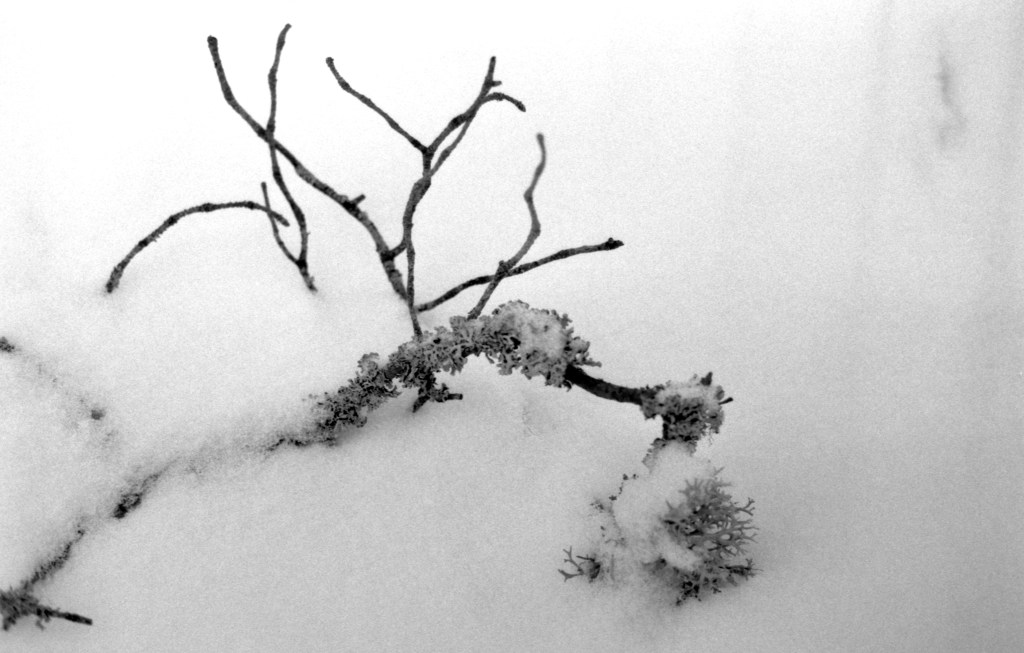
A fallen branch – Olympus OM-1 w 50mm Zuiko f1,8 – Rollei Retro 400s – Rodinal 1+100

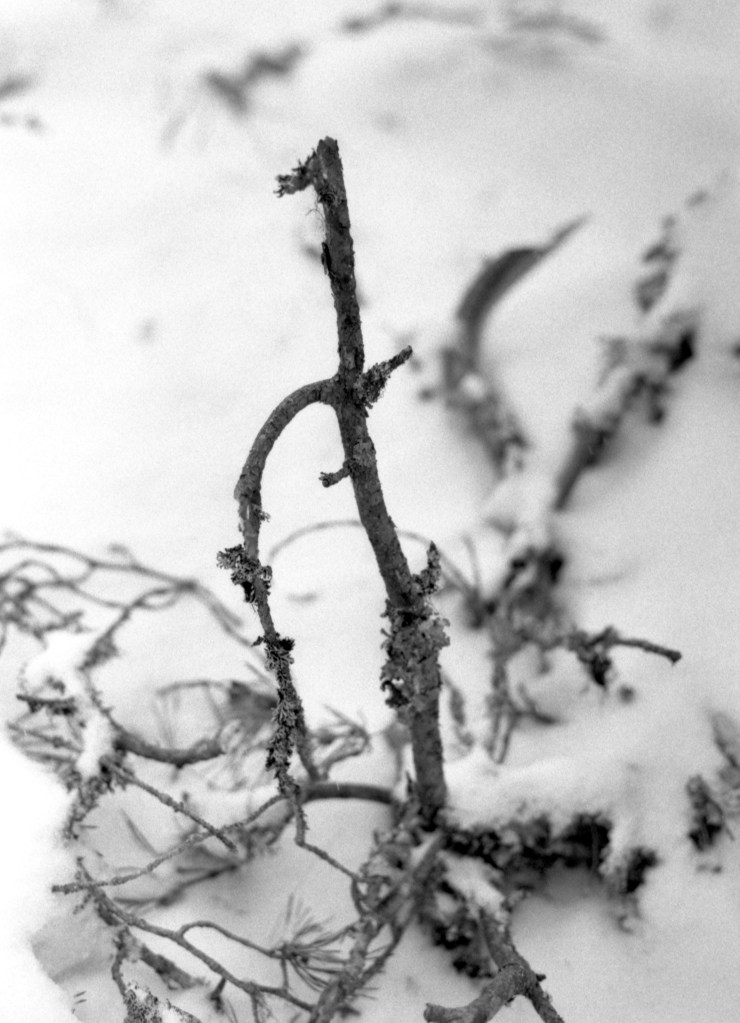
I shot about half a roll of film, focussing on making quick compositions around branches that, over the winter with heavy snow, has broken off bigger trees. The foggy and snowy conditions makes these branches stand out as interesting shapes, and shows them for the beauty they are. WIth the added grain from the film and the additional grain and contrast from the use of Rodinal 1+100 Semi-Stand gave that somewhat “raw” look I was going for.

Reklamer

The camera I chose to use, was my brilliant Olympus OM-1. This is a camera I trust at all shutter-speeds and that I know will work regardless of conditions. However, I noticed two issues on this particular outing. first and foremost, there was a little piece of dust that obstructed my view through the viewfinder. I used it as it was when out shooting, because I did not want to take the lens off in the middle of the show-storm. When I took the lens off, there was a little piece of dust on the focussing glass. How this ended up there is unknown to me, I have not taken the lens off this camera for months, and it has not been there before.

A fallen branch – Olympus OM-1 w 50mm Zuiko f1,8 – Rollei Retro 400s – Rodinal 1+100

It also seems to give uneven exposures at the highest shutter-speed 1/1000th, I even got a blank frame that I know was shot with this shutter-speed. This has also never happened to me before, and I will keep an eye on this in better conditions. 

All in all, I got the images I wanted, and all in the matter of around 15 minutes in the snowy gale. Thank you for following and reading, I hope you enjoy my images.

More Christmas decorations

This entry is a sequel of the FP4 shoot with the Advent decorations. If you haven’t seen that entry, please scroll down and find it. In this entry, I have once again done like a cat, playing with the Christmas decorations. This time, I played with the Christmas tree and a roll of Kodak ProImage 100 and I used the Olympus OM-1 with the same 50mm lens that I often use it with. Originally my plan was to shoot this with the Praktica MTL5 B and the Helios 44-2 lens, but it turned out that the lovely Praktica didn’t really appreciate being hooked up with the shutter release cable, and it therefore decided to jam. Not the kind of jammed that you can easily fix yourself, the properly jammed jam. Therefore, I had to restart the shoot with the Olympus, which handled the cable just fine.

I shot the Zuiko Lens fully open at its maximum aperture of f1,8, but I chose to let the Christmas tree lights be my only light source and ended up using longer shutter speeds, such as 1/2, 1/4 and even one and three seconds.

Christmas tree angel – Olympus OM-1 w 50mm Zuiko f1,8 lens. f1,8 shutter 1/2 seconds. Kodak Proimage 100

I know that there are many opinions on the Kodak ProImage 100 out and about. For my style and preference of photography, I find the ProImage to be brilliant for capturing winter colours where I often find Ektar too vibrant. Also, for indoor photography like this, I find this film to work perfectly, as I would often have to de-saturate Ektar in these situations. But again, this is personal preference. Personally, I like the «level between» Ektar and Portra as I see this film to be.

Reklamer

These images are slightly colour corrected in Photoshop after scanning, there were no colour shifts, but I found that the images got scanned with slightly different white balance. Not a big deal though, as it was easily correctable with Photoshop. The film was developed using the Tetenal Colortec C41 kit, which I find to work very well and be easily controllable. When using this kit, I cannot understand why it took me so long before I dared to try developing colour myself.

Thank you for reading and following me through 2020. Let us all hope for a better and less troublesome and pandemic 2021.

Emptying the roll of RPX25

In my last entry, and video, I tried out the very slow Rollei RPX25 film. I shot it with my Olympus OM-1 and I used a yellow filter because of the lightning conditions that I found to be ideal for yellow filter. Also, I must say that I got images that I am very pleased with. I only shot half a roll of the film, and cut it out of the camera, much because I was not sure what to expect in terms of contrast and metering.
Today, I rolled up the rest of the RPX25 in the OM-1, and went for a little outing to shoot the rest of the roll. The weather was absolutely horrendously nasty, with snow/rain blend and temperatures around 0. A typical nasty early winter day in Norway, and I went to a location I know very well. A little lake close to where I live, Skumsjøen, and looked for something that would allow me to shoot wide-open, at f1,8 with the 50mm Zuiko lens.

Tree root abstraction – Olympus OM-1 w Olympus Zuiko 50mm f1,8. Shot wide open f1,8 with Rollei RPX25. Semi-stand development Rodinal 1+100 70 minutes, agitated beginning and midle of cycle.

I went for some very abstract close-ups of tree roots near the frozen water. I even took the risk of walking on the newly formed ice, as it felt safe, to get the best angles. Luckily I did not fall through.

From my last outing with this film, I remembered that I got very hard contrasts in the negatives, and I gave it a whole stop of over exposure to retain more grey-tones in the details. Another measure I chose to reduce some of the contrast while retaining the sharpness, was a cycle of stand-development with Rodnial 1+100. This is not a type of process I often use, but for slower films, I have found it to work well with my style. It also gives a certain «character» to the shots, that I find to suit my eye.

Reklamer

I am not in anyway competent to comment on the performance of this film, nor its abilities. I have not used it enough to know how to handle it properly yet, and I am no film expert. However, I find it rather enjoyable to play with this filming trying to rethink my exposures to get the results I want. Also, I have only shot the film in dull, overcast weather, but I find that the Rollei RPX25 gives me a fun challenge to work with. In short, this film is fun to work with.

A video will be available on Youtube soon. Search for Ccadventures.

Working with a slow film

I have shot some slow films before, especially PanF 50 and I love the way a slow film looks. Smooth, calm, invisible grain and deep contrast. I also love how they allow me to shoot with very open apertures and longer shutter-speeds without having to compensate using ND-filters.

A film I have tried some times before without success is the «Rollei RPX25». I bought some rolls of this film for my medium format cameras, and my experience was not that great. One of the films turned out to be incorrectly cut and was more or less impossible to reel for development, and when I finally got it reeled and developed, it had the nastiest mottling I have ever seen. From some research online, I understood that this problem could be down to lack of prewash. Wiser and happier, I went on to try another roll, but on this one, I got nasty camera-shake even though the camera was mounted on a tripod and triggered using a release cable.

Some weeks ago, I bought a few rolls of RPX25 for my 35mm cameras, and today I set out to try it.

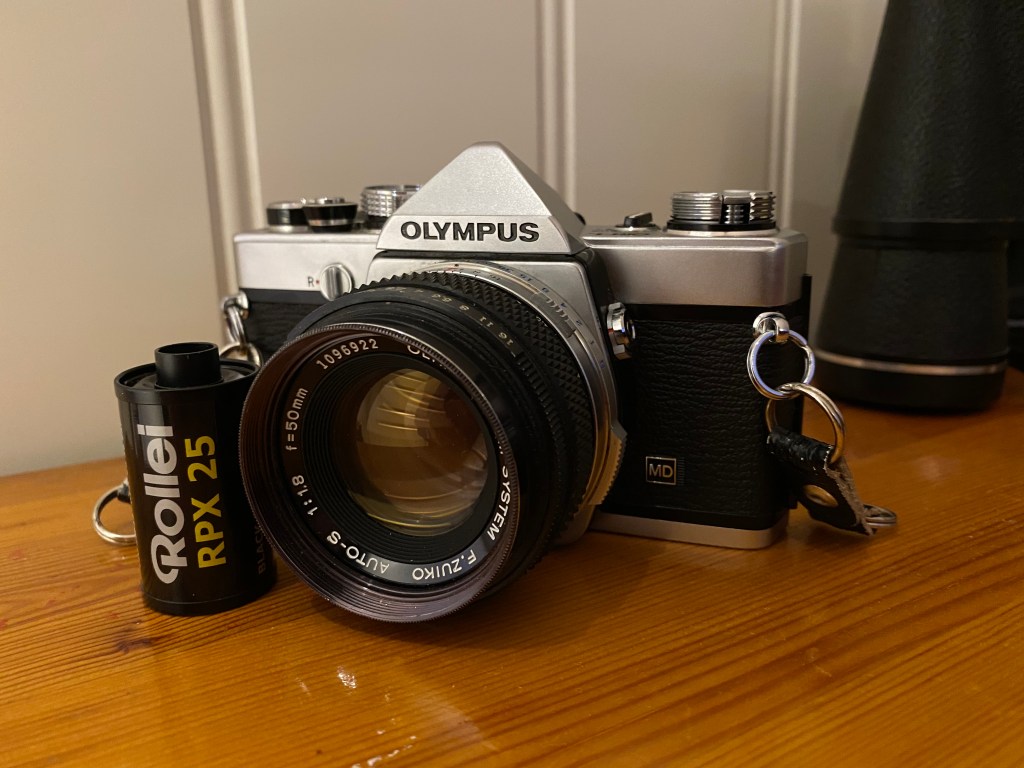
My equipment for the day. Olympus OM-1 w 50mm Zuiko f1,8 and the Rollei RPX25 canister.

I wanted to try this film out in a snowy winter environment, to see if I could tame the contrasts the film gives and end up with a contrasty, but nice winter shot. I chose to shoot at f8 with a yellow filter, to have some aperture to go on, as well as not shooting very long shutter speeds. The yellow filter is also very helpful to shape the contrasts. To be on the safe side, I bracketed the shots to be sure I get something.

Reklamer

So why did I chose the OM-1? I chose this camera because I wanted a reliable camera that I know is fairly accurate both at aperture-settings and shutter speeds. I don’t worry too much about this when I have films I know and that has some latitude, but I was very unsure how this film would handle potential under-exposure, and chose to play it safe. I exposed the film at 20 ISO, which is the lowest my light-meter would go, and developed as shot at 25. My negatives were contrasty but actually rather good looking.
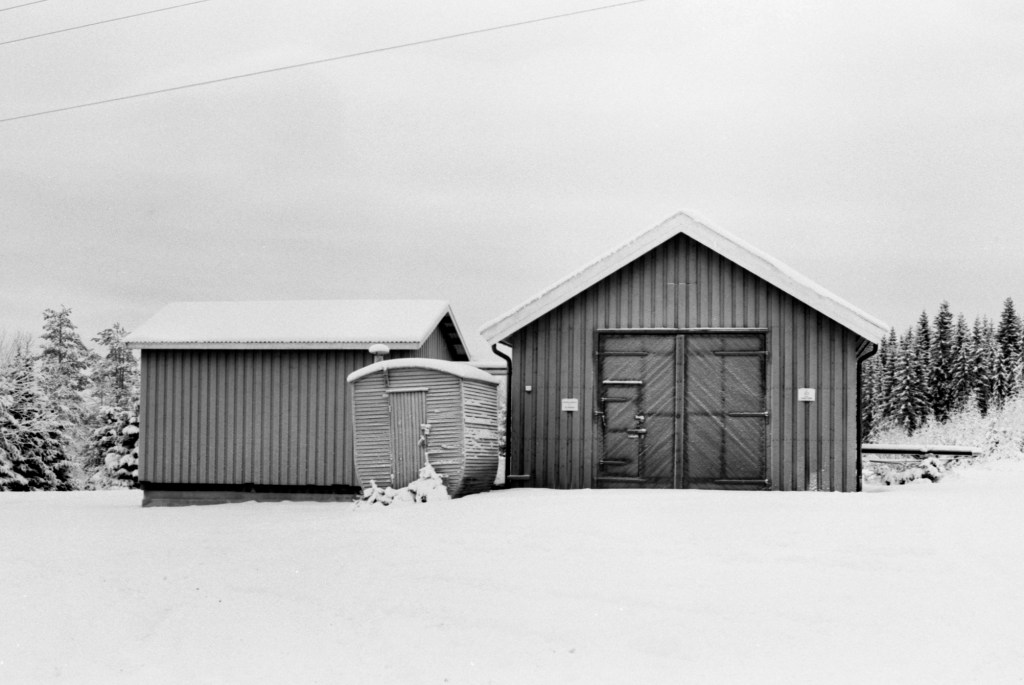
Here are some shots.

I am very happy that my shots didn’t completely blow out the white snow, and the yellow filter helped me keep the detail in the overcast sky, without adding too much extra contrast to the already dark buildings. I am happy with this try-out, and I will finish the roll at another time.

If you want to join the shooting and hear some Camera-babble, a video will be available on YouTube shortly.

Derelict train station

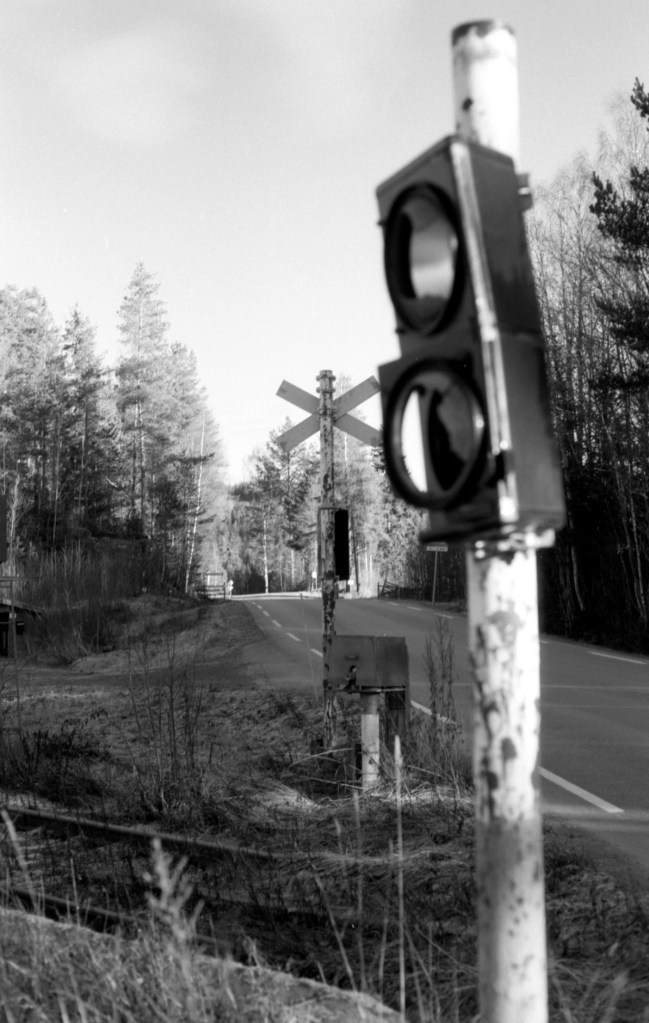
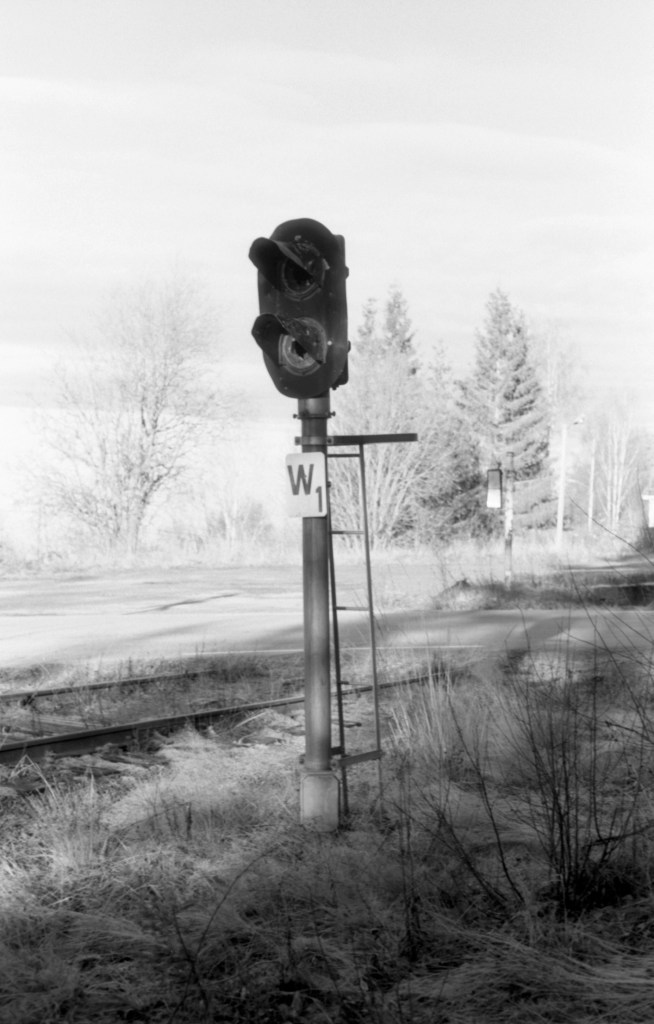
I’ve always had a fascination for derelict buildings and other traces of human civilization that is let aside and forgotten. Today, I brought out one of my good friends, the Olympus OM-1, to an old, derelict train station a short drive from where I live. I equipped the Olympus with a roll of Fomapan 100 and the razor sharp 50mm Zukio 1,8 lens. I brought with me a selection of colored filters to boost contrast and play with the light in the lifting sun and shifting blue skies.

Valdresbanen, the railway I worked by, was closed for passenger traffic in 1988. Some freight trains were ran there later, but the old station buildings have been untouched since this time. Quite sad to think about the number of shut down railways in Norway really. Nevertheless, the old buildings are still characteristic and beautiful in their own way.

Today, I went to Fall station which is very close to Hov in Søndre Land municipality. This was never a big and populous station, and the only building there is a little shed where people would wait for their train to arrive. The main station building was burned down in 1982 by the Norwegian railway company and the shed was built after that. I have shot portraits at and around this location multiple times, but I have never before gone there to explore the location as a subject of its own.

Reklamer

I have never tested out the filters I used today, so I did a lot of bracketing to understand how they work and see how to best compensate for their function. I only got to use the yellow and the orange filters, as they were what I found to match the lighting and location the best.

I did some playing around with different items left aside by the old railway, and did heavy bracketing. I figured that the Orange filter needs two stops of compensation, while the yellow needs a bit more than one from how I interpret my negatives.

Working with dark colored filters can be a bit challenging due to the light loss, and hence difficulties to focus. With the Olympus, however, I found that working with colored filters were a dream. The viewfinder is wide and bright, and there was never any difficulties getting the focus where I wanted it with either the yellow or the orange filter.

The foggy train station lies up a steep hill, and at the bottom of this hill it was a hazy and relatively thick fog, removing pretty much all background scenery from many of my images. The station itself, however, was above the fog, and was shining for itself in the misty and cold morning light.

Reklamer

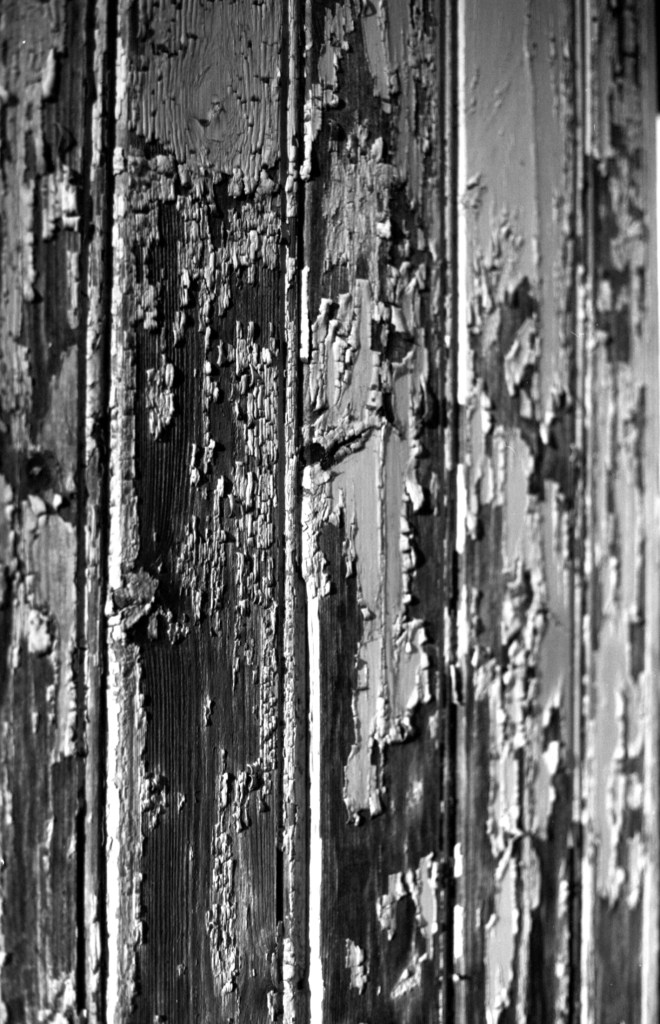
I also shot an image of some crackled paint on the station building. I chose to shoot this with the yellow filter and I went all the way down to f2,8 to get a very shallow depth of field, but retain some sharpness. I haven’t tried this lens at f1,8, and even though I guess it would work very well, I did not want to risk a too shallow depth on this one. I forgot to note down my shutter speed for this image, so that information is not provided.

Crackled paint – Olympus OM-1, Zukio 50mm f1,8 – f2.8. Fomapan 100, Xtol 1+0. yellow filter

All in all, I enjoyed this little shoot, and I once again remembered why I love to shoot the Olympus. This is such a pleasant camera to use and its handy size and bright viewfinder makes it a great choice for all kinds of shoots.

All images are unedited scans from my Epson V600.