Eight frames of Retro 400s

On a foggy, snowy day a short while ago, I shot about half a roll of Rollei Retro 400s with my Olympus OM-1, aiming at capturing the hard contrasts of the really nasty weathered day. I cut the outing short because it got very difficult and nasty to work in the wet and snowy gale. I cut the film out of the camera, and saved the rest for another day. That day came, and I put it into my Canon T70 and went to a local church that I find very interesting to shoot.

Because of the conditions on this particular day, I chose to overexpose the film by one stop to 200, and shave off 20% of the development time. Basically a one stop pull. This would give me more shadow-detail and give me more to play on with the apertures on a bright afternoon in the snow. I never got to use that last point, as it turned out that the total number of frames left on the film was EIGHT.

Aas church on a bright afternoon – Canon T70 – Rollei Retro 400s – Foma Fomadon Excel 1+0 7m30s

My negatives were more contrasty than I thought they would be, so I am very happy that I pulled the film one stop for this shoot. I mainly shot at f11 and f8 for this outing, and I have to say that I think the little 50mm Canon Lens performs rather well. For a standard kit-lens it is decently sharp and helps me capture the moods I want. I have, however, seen some diffraction on f22, and I avoid that aperture when using this camera.

Reklamer

The aperture-priority setting on the Canon seems to work very well. Even on these shots, where the sky was very bright, I managed to retain decent detail in the sky, showing the cloud-formations etc, without using any filters.

A naked graveyard tree – Canon T70 – Rollei Retro 400s – Foma Fomadon Excel 1+0 7m30s

I also have a hard time walking past an interesting looking trees, and I saw one at this grave yard by the fence by some graves. Because of the deep snow, I was not able to study the tree and identify what type of tree it was, but it made for a really lovely composition. I shot it from two different distances because I was uncertain which one that would be the most efficient. I will include both here.
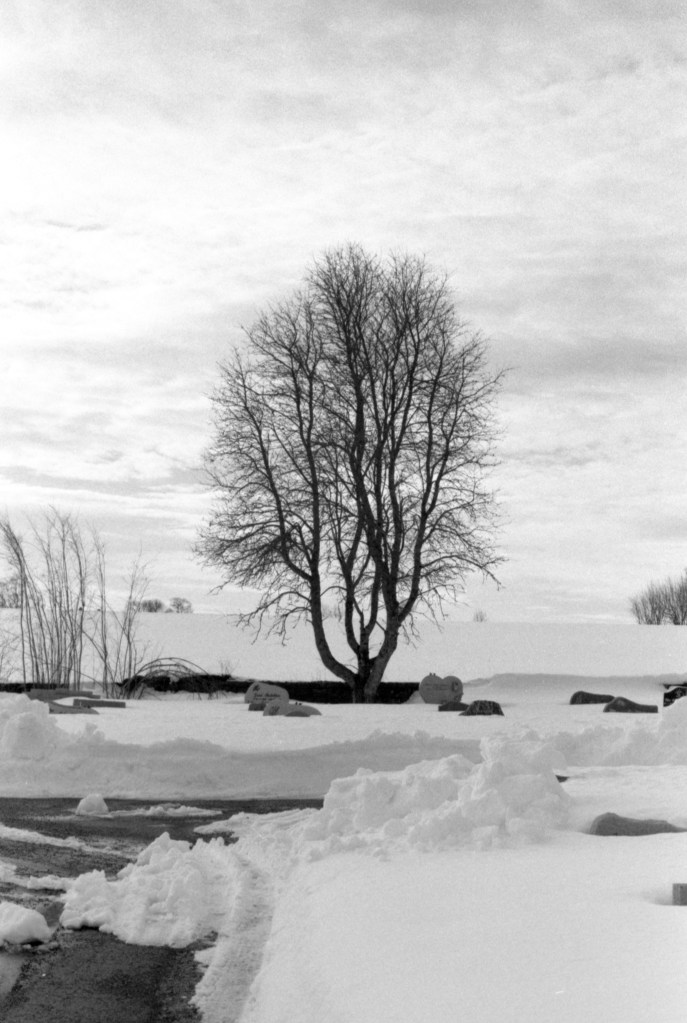
The same tree further away – Canon T70 – Rollei Retro 400s – Foma Fomadon Excel 1+0 7m30s

I also attempted a cool shot of the entry area of the church, but I am not very pleased with how it turned out. I find that it is a rather «bland» composition and that it does not either emphasis the contrast nor the shapes of the church in the way I imagined it would. This would probably have worked better if shot at box-speed.

Not very pleased with this one – Canon T70 – Rollei Retro 400s – Foma Fomadon Excel 1+0 7m30s

Playing around with a Petri 7s

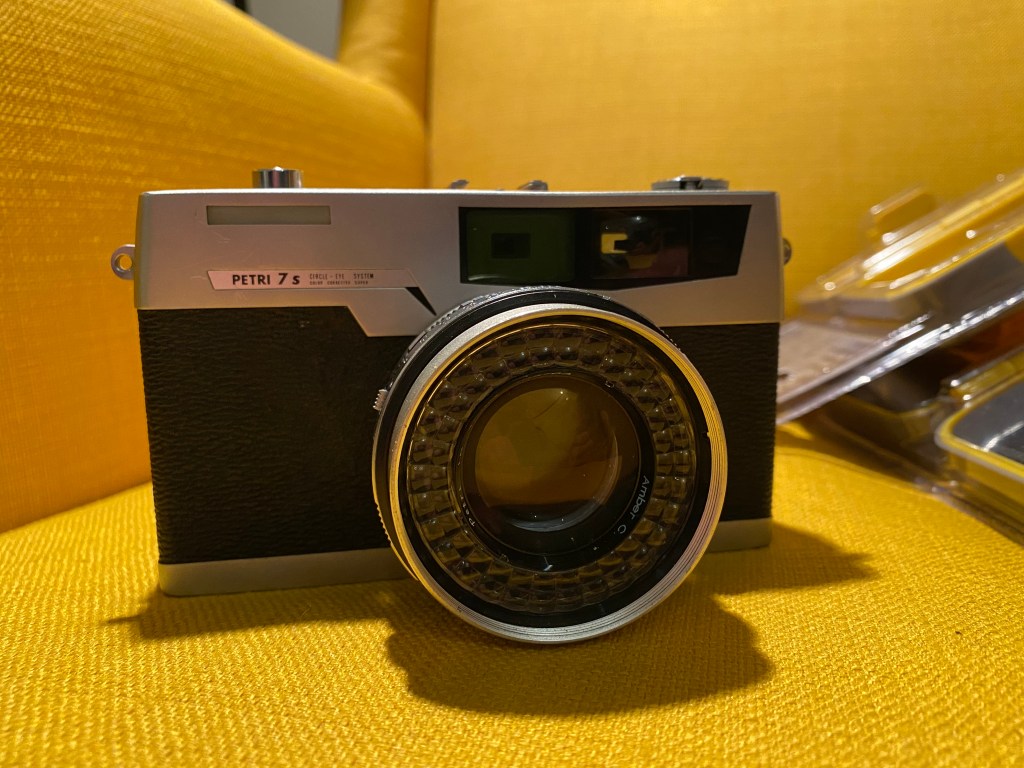
If you have followed this blog for a while, or read some of my posts, you may know that I have a Petri Racer that I really love shooting. I find the little Petri to be very reliable, accurate, light and handy as well as giving the images some character. I can’t really put my finger on why I like that particular camera so much, it is just a camera I enjoy shooting. A few weeks ago, I came across a Petri 7s on an auction online, and I won it on a very low bid.

The reason I was interested in this particular 7s was that it had the f1,8 lens, which some sources claim to be a six element lens with an interesting bokeh-pattern. Whether it is six element or four, as the f2,8 version, does not necessarily mean that much to me, but I do love nice bokeh and sharpness. For the very low price that I payed, it was worth the gamble at any rate.

The Petri 7s f1,8 Rangefinder camera w. amber coated lens

A gamble it surely was as this camera has a few personality traits that is very specific to this particular one. First of all. The Rewind-knob is loose, and you cannot turn the camera on its head without risking the film to lose tension as the rewind knob disengages. Another interesting «asset» this camera has, is a dodgy lock on the back. This means you will get the luxury of using electrical tape to secure it from opening mid-roll. In addition to this, the camera invites to a creative approach to focussing, with a rangefinder (although rather dim and dodgy) that jumps in and out of «sanity» a few times pr shot. I ended up guesstimating my focus because I trusted my own eyes more than the rangefinder unit.

Reklamer

These faults aside though, the aperture settings and shutter speeds are fairly accurate. When I took it to Lillehammer to try it out on the newly fallen snow, I got very good negatives. My test was done with half a roll of Fomapan 200, which I because of the lighting conditions shot at 100. I shaved 20% off the development time compared to box-speed, and ended up at 6 minutes with Xtol Stock.

As you can see, in some of my images, my lens fogged over. However, this is not lens-haze, but rather an issue of a swift temperature change and a forgetful photographer who didn’t remember to wipe the lens before shooting against the sun.

JCH Streetpan 400 for portraits?

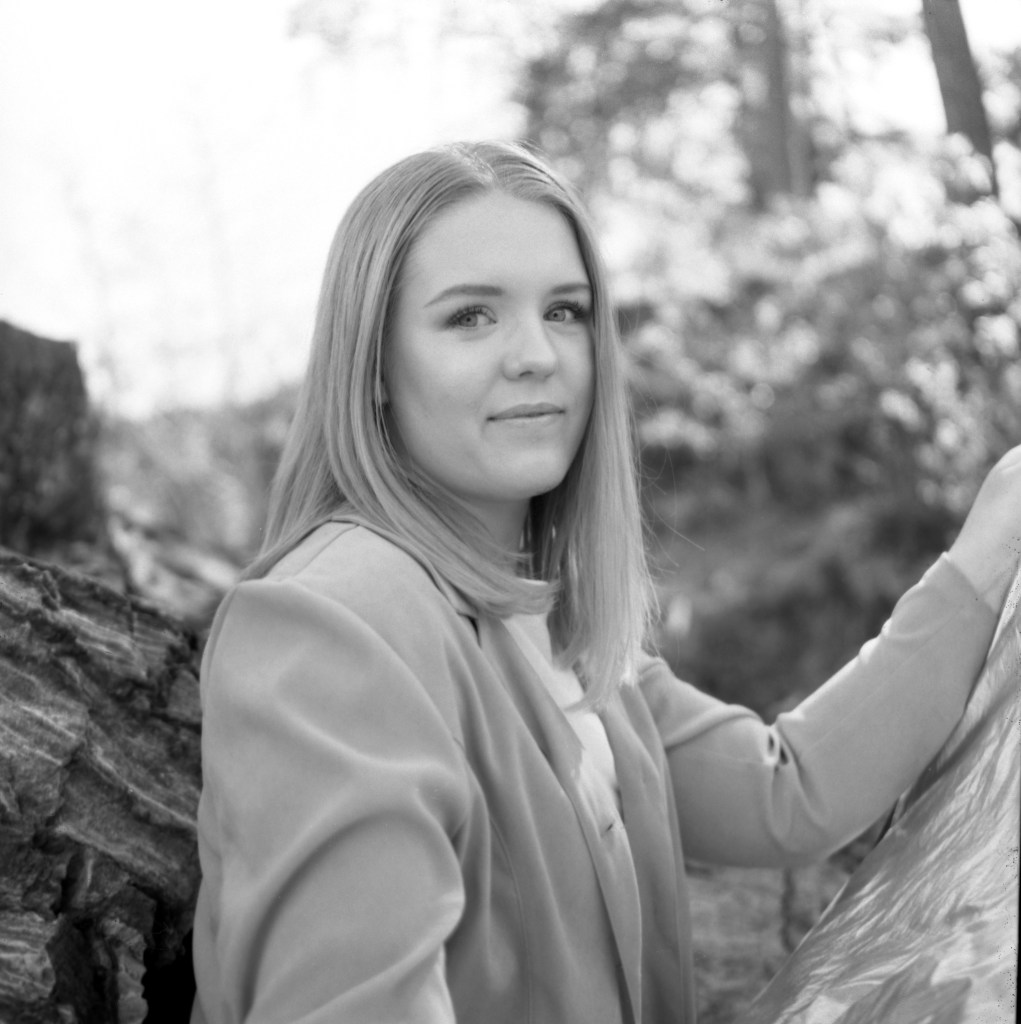
A little while ago, I was given a roll of 120mm film from Japan Camera Hunter named the «Streetpan 400». I tried it out and got beautiful results with high contrasts and exquisitely fine grain for a 400 iso film. The deep contrasts got me thinking. How would this film work for portraiture?

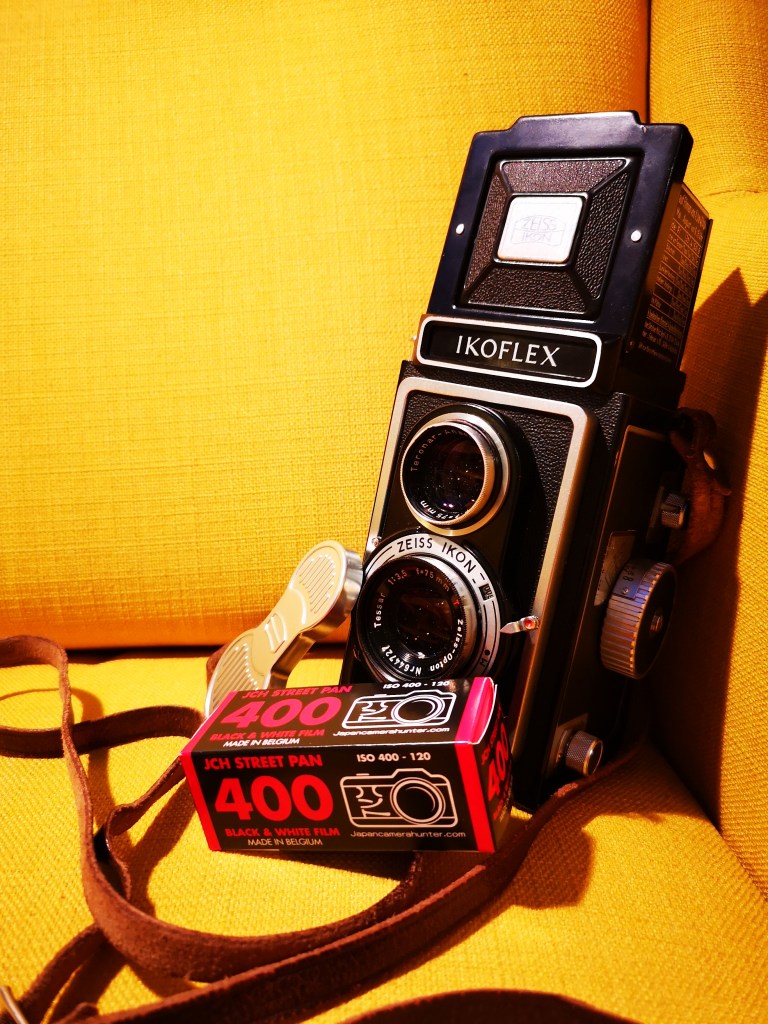
I bought a few rolls directly from JCH in Japan, and due to the Covid 19 situation it took a while for them to arrive. When it finally came I put a roll in my Zeiss Ikon Ikoflex, cheap TLR, and decided to bring it to take some portraits with Ada. We met at Kremmerodden, a lovely location in Norway and took some pictures.

The Zeiss Ikon Ikoflex, with a roll of JCH Street Pan 400

I decided to shoot the film at 200 and develop a bit shorter (pull processing) in order to retain some shadow detail. This film is widely discussed online for its ink-black shadows and high contrast, and for portraits in direct sunlight, this was not my biggest wish.

I will not go deep into anything technical about this film, I am no expert on emulsions and films, and there are millions of reviews and opinions about it available online.

I was very uncertain about how this film would handle being pulled a stop, but I am happy to report that it deals well with one stop over exposure.

My process was:

  • One minute presoak in water to remove the anti-halation layer. This water comes out nearly black.
  • Development in Kodak Xtol 1+1. Development time for this film at 400 is 17 minutes. Since I pulled it one stop, I reduced the development time by 20% and a total development time at 13 minutes 40 seconds with agitation every minute.
  • Water-stop and fix as usual
  • 15 minutes under running water for wash.
  • Final wash with Photoflo

I am happy with the results. What you see here are scanned negatives that have been merged and somewhat cleaned in Photoshop. I will take some of these negatives to the darkroom for printing there later.

Do I like this film for portraits? Yes. I would use this film again for portraits and pull it to 200 for certain portraits. Especially portraits where I want to retain some contrast and get a nice palette of grey. However, for portraits at this location, I’ll probably stick with Ilford FP4 box speed or Kodak Tri-X at 200.

Thanks for reading

“The camera is an instrument that teaches people how to see without a camera.” 

Dorothea Lange