Trying Infrared

A while back, I bought a few rolls of Ilford SFX 200 and shot it with a red filter. A normal red filter, as you would use for normal films. I likes the results and I decided that I wanted to take it one step further and try out the invisible spectrum. I bought a few rolls of Rollei INFRARED 400 and began looking into tips and ideas for dealing with infrared photography. I soon learned that what I thought to be infrared films were actually just normal films with an extended red-sensitivity and that it didn’t really go into the proper Infrared spectrum.

My first decision was that I wanted to try this out with my best equipment. I opted for my medium format cameras, the Bronica ETR and the Hasselblad 500c and bought a filter that would fit both of them. A relatively simple an straight forward 720nm filter off eBay, the brand is Greene or something along those lines and it seems to work very well. Although, no filter factor was provided, so for this round I only did two compositions and bracketed a lot to get to know the filter somewhat. From my experimenting, I found that the correct compensation for this filter is about six stops.

A little forest scene – Hasselblad 500c w 80mm Planar f2,8 – Rollei Infrared 400 Ilford ID-11 – f11 4 seconds

My first idea for this tryout was heading towards a little river passing not far from where I live. The area around the river was too overgrown for me to get any shots of at this point, so I decided to go for a forest scene for my first composition. The exposure time got into the multiple seconds, and the one I was most pleased with was the one at 4 seconds. It gave me the infrared effect that I was looking for.

I then moved on to look at the view over Gåstjernet, a little pond in the same area, and I noticed how nicely the clouds reflected in the water, framing the landscape very nicely within the 6×6 format. I think this became the stronger of the two compositions and I also did the same amount of bracketing on this.

Gåstjernet – Hasselblad 500c w 80mm Planar f2,8 – Rollei Infrared 400 Ilford ID-11 – f16 1 second

My next problem was development. I wanted to use a relatively fine grain developer to get the most out of the effect, and the only one I had mixed was Ilford ID-11. However, there were no instructions on how to use this developer for this particular film so I had to get creative. I extrapolated the Xtol-time, comparing it to other Rollei films and ended up with a development time of nine and a half minutes. This gave me very nice negatives and the ID-11 seems to have worked very well with this emulsion.

Scouting a location and shooting slow film

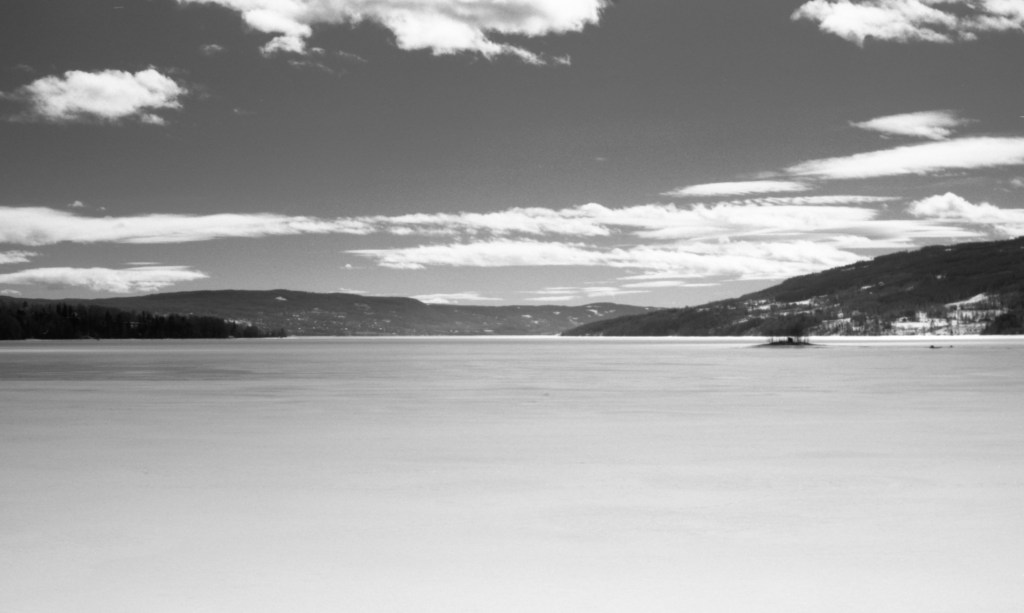
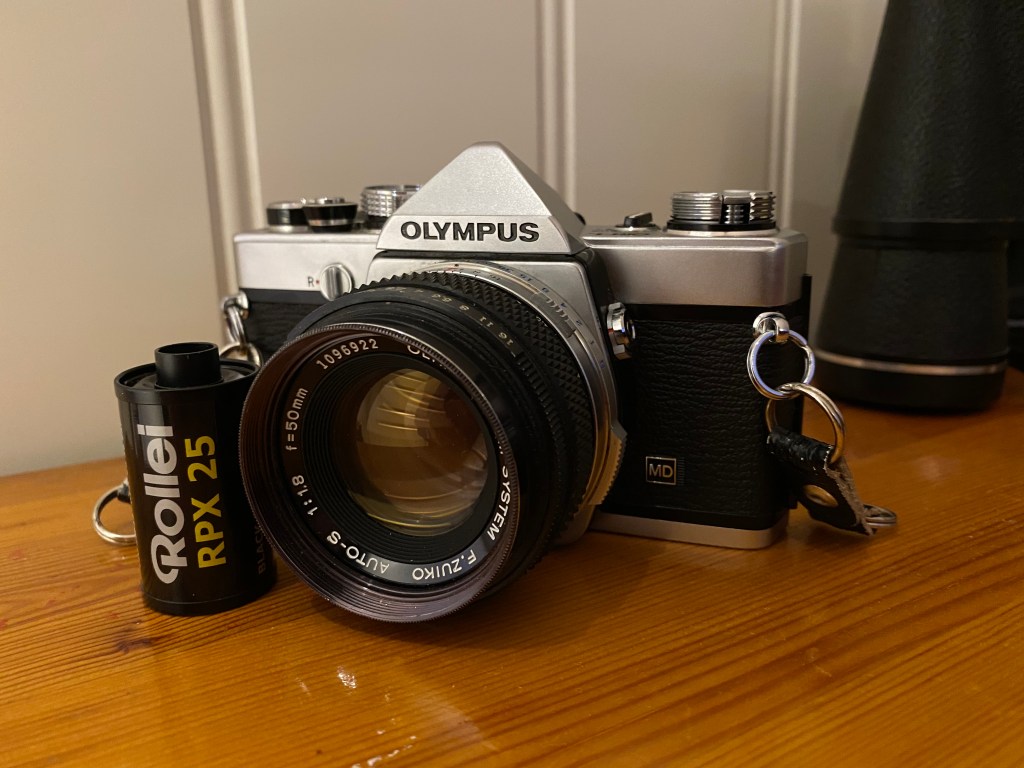
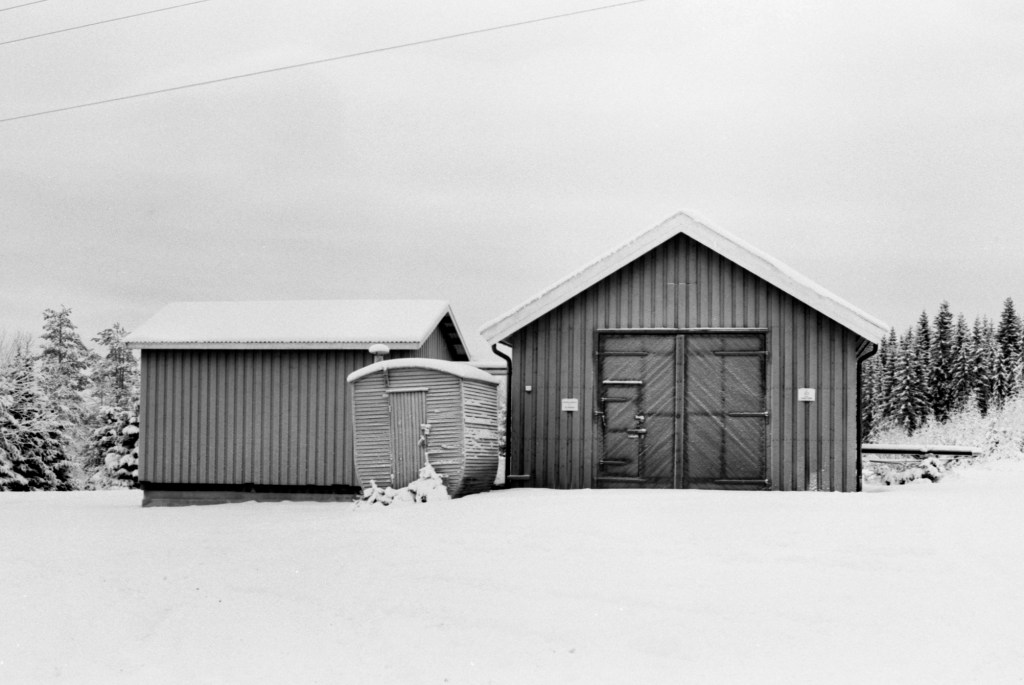
Today I was out and about with one of my lovely analog cameras again looking for locations for some early-morning sunrise photo trips. I came across this lovely location called «Husodden» not too far away from where I live. Being sensible and staying local is an important part of the world we currently live in. While I was walking around Husodden to shout for possible locations, I did some photographs with the Olympus OM-1 and a roll of Rollei RPX25. I metered it at around ISO 18 (My light meter goes to ISO25, so I opened the aperture slightly more) and shot with an orange filter to get the popping effect in the sky and boost the contrasts a bit.

Randsfjorden, the lake, was still frozen and it became a white carpet in many of my images, and gave some extra contrast as well.

Sky-pop over Randsfjorden – Olympus OM-1 Rollei RPX25@18 Kodak HC110 Dil-B

I tried to use the remainders of the snow as a lead-in line in many of my images, and I aimed for a very large separation between snow and sky. In retrospect, some of these images would have benefited more from being shot with a graduated filter rather than a fill orange one.

Sky-pop over Randsfjorden – Olympus OM-1 Rollei RPX25@18 Kodak HC110 Dil-B
Reklamer

I decided to develop the film with «an old friend». Kodak HC110. I have not used this developer for a very long time, but there was something about the shots I took today, that made me bring out the golden syrup and mix Dilution B. HC110 used to be my favorite developer and, it is very economical and gives really nice greys. Also, there is something about it that I just like. I don’t really know what it is, but there is something about using that thick concentrate and stirring it properly that really wakes the «geek» in me.

A quick and pleasant day out for me today, and I am really looking forward to visiting this location again at some point in the near future. Both for woodland detail work and for early morning sunrise-shots.

Eight frames of Retro 400s

On a foggy, snowy day a short while ago, I shot about half a roll of Rollei Retro 400s with my Olympus OM-1, aiming at capturing the hard contrasts of the really nasty weathered day. I cut the outing short because it got very difficult and nasty to work in the wet and snowy gale. I cut the film out of the camera, and saved the rest for another day. That day came, and I put it into my Canon T70 and went to a local church that I find very interesting to shoot.

Because of the conditions on this particular day, I chose to overexpose the film by one stop to 200, and shave off 20% of the development time. Basically a one stop pull. This would give me more shadow-detail and give me more to play on with the apertures on a bright afternoon in the snow. I never got to use that last point, as it turned out that the total number of frames left on the film was EIGHT.

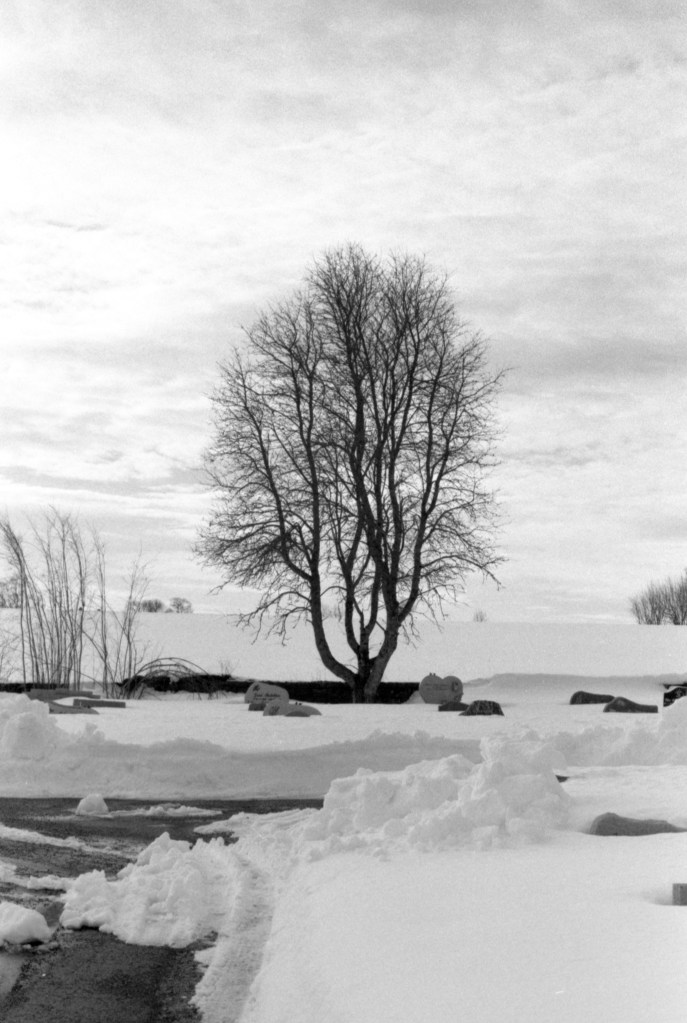
Aas church on a bright afternoon – Canon T70 – Rollei Retro 400s – Foma Fomadon Excel 1+0 7m30s

My negatives were more contrasty than I thought they would be, so I am very happy that I pulled the film one stop for this shoot. I mainly shot at f11 and f8 for this outing, and I have to say that I think the little 50mm Canon Lens performs rather well. For a standard kit-lens it is decently sharp and helps me capture the moods I want. I have, however, seen some diffraction on f22, and I avoid that aperture when using this camera.

Reklamer

The aperture-priority setting on the Canon seems to work very well. Even on these shots, where the sky was very bright, I managed to retain decent detail in the sky, showing the cloud-formations etc, without using any filters.

A naked graveyard tree – Canon T70 – Rollei Retro 400s – Foma Fomadon Excel 1+0 7m30s

I also have a hard time walking past an interesting looking trees, and I saw one at this grave yard by the fence by some graves. Because of the deep snow, I was not able to study the tree and identify what type of tree it was, but it made for a really lovely composition. I shot it from two different distances because I was uncertain which one that would be the most efficient. I will include both here.

The same tree further away – Canon T70 – Rollei Retro 400s – Foma Fomadon Excel 1+0 7m30s

I also attempted a cool shot of the entry area of the church, but I am not very pleased with how it turned out. I find that it is a rather «bland» composition and that it does not either emphasis the contrast nor the shapes of the church in the way I imagined it would. This would probably have worked better if shot at box-speed.

Not very pleased with this one – Canon T70 – Rollei Retro 400s – Foma Fomadon Excel 1+0 7m30s

Capturing snow and fog

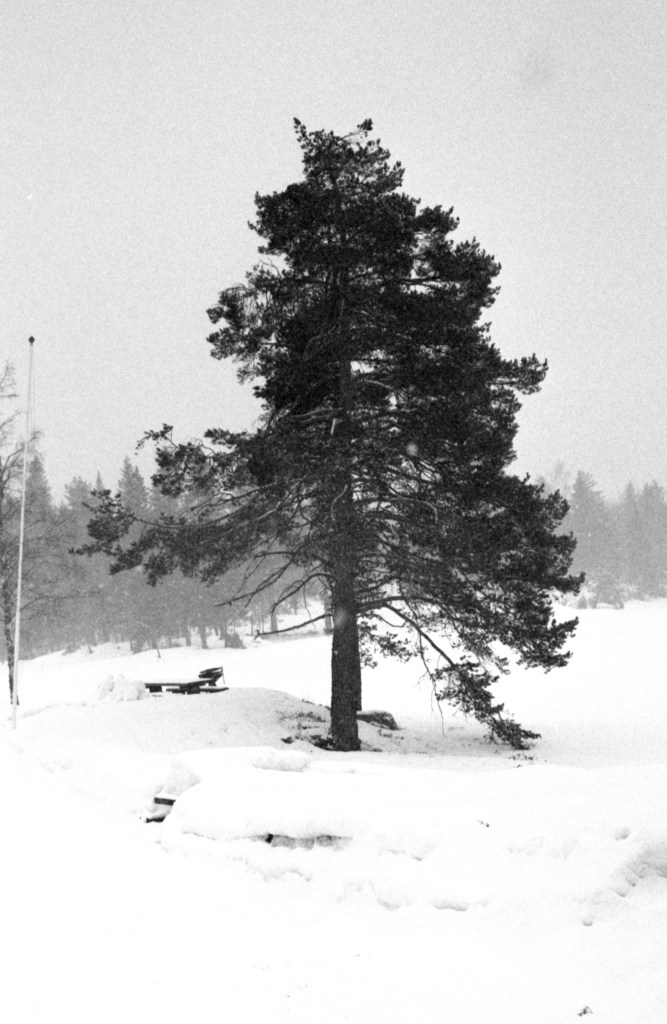
Yet again, the persistent winter of 2021 struck  back at us with all its wreath. After a few weeks of impeccable weather and a really pleasant spring mood, we were once again confronted with the face of King Winter. When I went out yesterday, it was blowing a gale and the snow flew thick in the air. Thicker than horse-flies at a swamp in the summer. The weather was bland and uninspiring  and being out there was nasty and uncomfortable. Yet, I had something in mind.

I wanted to capture the foggy and snowy day with a gritty and grainy mood. I chose to go for a BW film. The Rollei Retro 400s, which is a film I have used a bit before and that I find to suit my way of shooting very well. My thinking was that the 400 ISO film would give me just the right amount of grain and contrast, as well as giving me the opportunity to shoot hand-held, which is very handy in windy conditions, where camera-shake due to wind is a real danger, even with  a sturdy tripod.

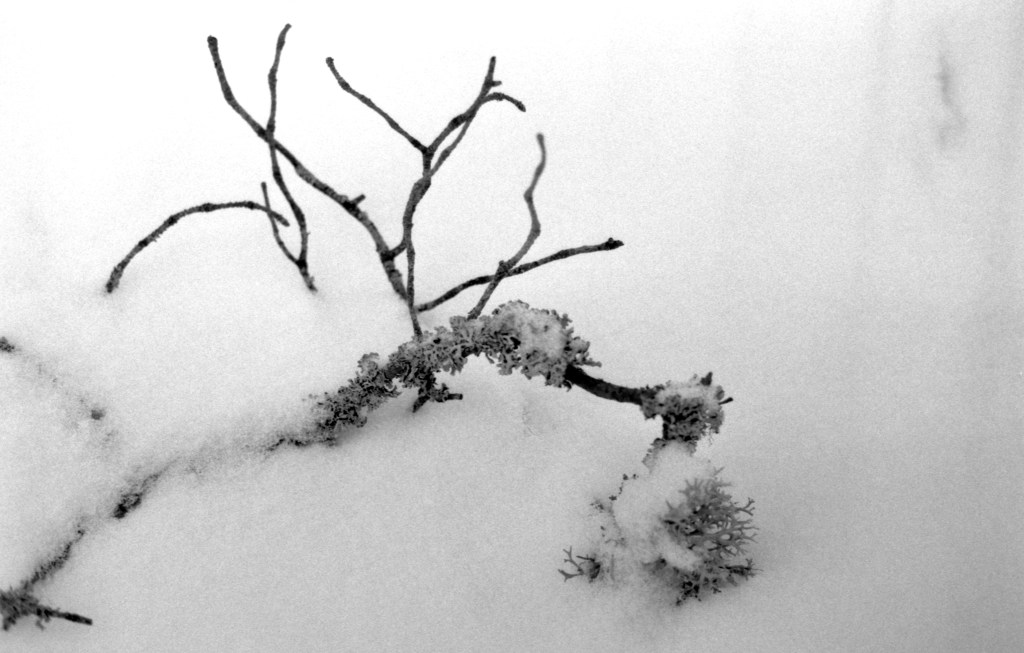
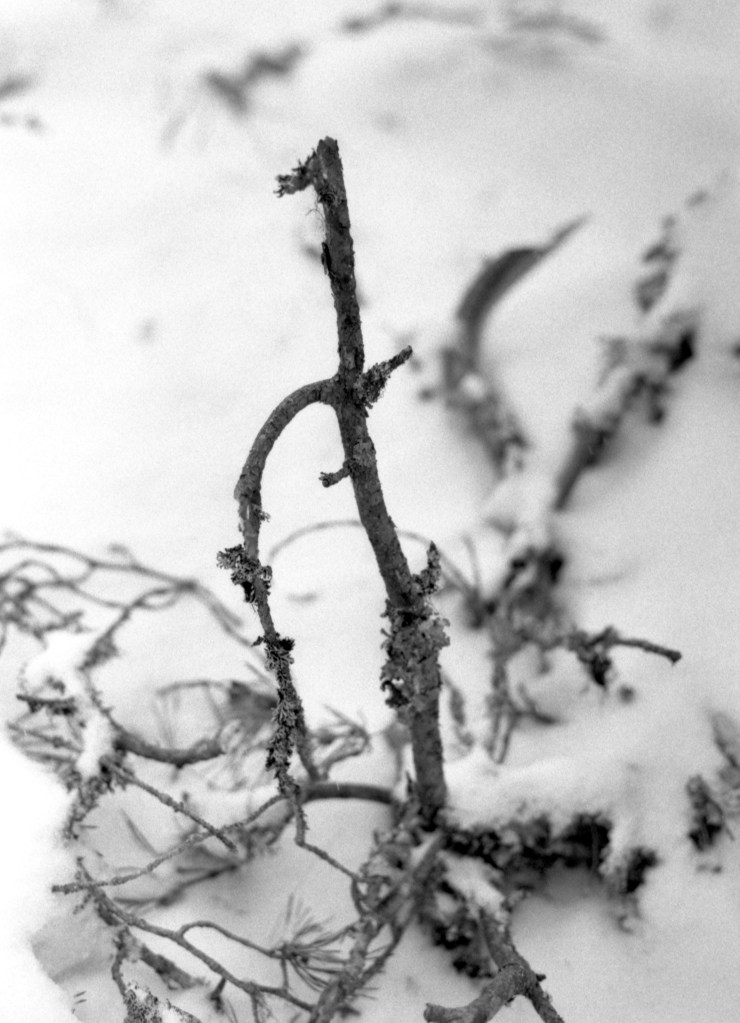
A fallen branch – Olympus OM-1 w 50mm Zuiko f1,8 – Rollei Retro 400s – Rodinal 1+100

I shot about half a roll of film, focussing on making quick compositions around branches that, over the winter with heavy snow, has broken off bigger trees. The foggy and snowy conditions makes these branches stand out as interesting shapes, and shows them for the beauty they are. WIth the added grain from the film and the additional grain and contrast from the use of Rodinal 1+100 Semi-Stand gave that somewhat “raw” look I was going for.

Reklamer

The camera I chose to use, was my brilliant Olympus OM-1. This is a camera I trust at all shutter-speeds and that I know will work regardless of conditions. However, I noticed two issues on this particular outing. first and foremost, there was a little piece of dust that obstructed my view through the viewfinder. I used it as it was when out shooting, because I did not want to take the lens off in the middle of the show-storm. When I took the lens off, there was a little piece of dust on the focussing glass. How this ended up there is unknown to me, I have not taken the lens off this camera for months, and it has not been there before.

A fallen branch – Olympus OM-1 w 50mm Zuiko f1,8 – Rollei Retro 400s – Rodinal 1+100

It also seems to give uneven exposures at the highest shutter-speed 1/1000th, I even got a blank frame that I know was shot with this shutter-speed. This has also never happened to me before, and I will keep an eye on this in better conditions. 

All in all, I got the images I wanted, and all in the matter of around 15 minutes in the snowy gale. Thank you for following and reading, I hope you enjoy my images.

Playing with a Point and Shoot

The market for film cameras has changed substantially over the last two-three decades. In the 90s there were a range of very simple easy cameras that you could use to get some pictures without knowing anything about photography nor wanting to learn about it. They were simple, fully automatic and would give you acceptable images with minimum effort. These were the fully automatic point and shoot cameras. They’d set the film speed through DX coding on the cassette, they would set the aperture and shutter speed accordingly. The small catch, you had to press the shutter release button yourself. The bigger catch, you had no idea what the images would look like.

This morning, I played around with one of these cameras. I haven’t used one of them for a long time, and I was curious about what it would «bring to the table» of images and quality. The camera was bought cheaply online and arrived by Norwegian snail mail two weeks after it was posted from a town reasonably nearby. Well done Snail Mail. After this wait, I was the confused owner of a Chinon Pocket Zoom AF.

The Chinon Pocket-Zoom AF – 38-60mm lens (probably f8 or something like that as widest aperture)

I was eager to test it out, and I gave it a roll of Rollei Retro 400s. The electronic and automatic wind-on mechanism did its job and rolled on a few frames that could have been used, and the display on the back showed «1». The Chinon was ready. I went out in very dull weather and the Chinon did not seem to be too fond of dull and «boring» light. It constantly set off the flash, and I had to manually reset it to «flash off» every time I changed compositions, as it would have reverted to flash mode automatically. It is a bit like an overbearing parent, the security net is always there.

Reklamer

Shooting the Chinon was like shooting with your phone. You aim vaguely in the direction of what you want to photograph, you press the shutter button and wait for a while while the small elves inside the camera gets to work setting up your exposure. This takes a while, and you would probably not use this camera to photograph running animals or people in action. If you used it to photograph someone playing football, they would be done with their game and home for dinner before the camera takes a shot. After a while, when you hear the reassuring sound of the shutter and the winding mechanism, you are ready for your next shot.

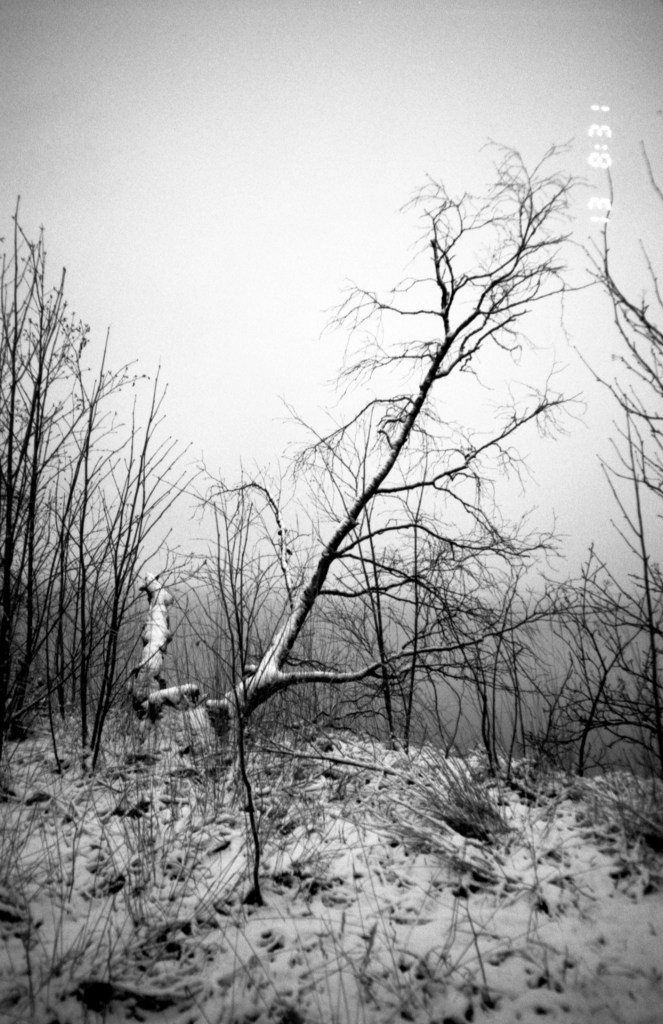
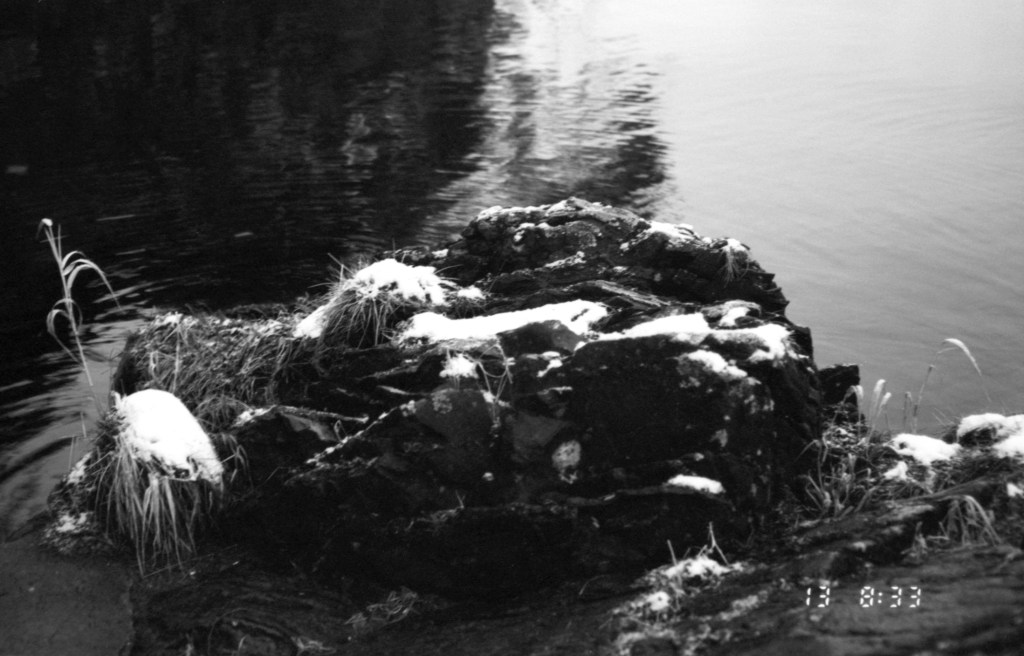
Chinon Pocket Zoom AF – Rollei Retro 400s – Xtol Stock

When looking at the final images, they are not that sharp and crisp as you would hope. But since I have not had any control in the making of there images other than pressing the shutter release button, I don’t really feel it is my fault.

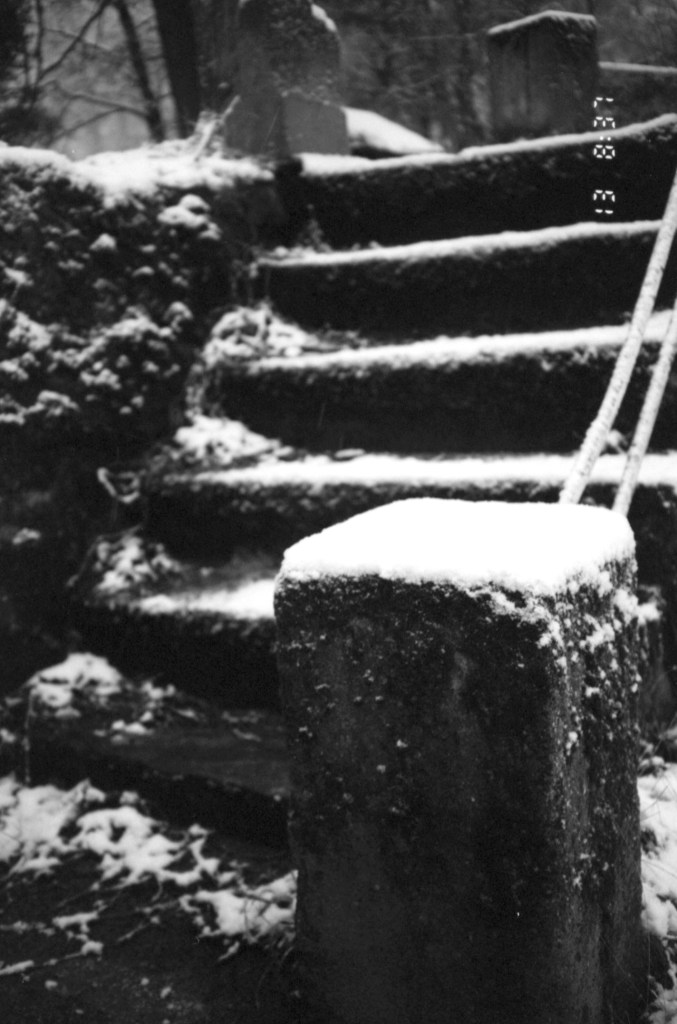
Some issues I see. The lens is probably not that bright and certainly not very sharp, and the images seem all slightly under exposed. They have a strange vignetting, much like the one you get while shooting a Holga camera, and the lens perfomance isn’t that much better on this Chinon. Also, you get these imprinted numbers on all your frames, and I was not aware that it would be printing numbers on my frames. I have left them here in all their atrociousness.

My conclusion. I will sell this camera to someone who will use it. I will certainly not use this camera again and if anyone wants it, please contact me.

I like this image because of the mood, and that it is evenly blurry all the way over.
Chinon Pocket Zoom AF – Rollei Retro 400s – Xtol Stock

Emptying the roll of RPX25

In my last entry, and video, I tried out the very slow Rollei RPX25 film. I shot it with my Olympus OM-1 and I used a yellow filter because of the lightning conditions that I found to be ideal for yellow filter. Also, I must say that I got images that I am very pleased with. I only shot half a roll of the film, and cut it out of the camera, much because I was not sure what to expect in terms of contrast and metering.

Today, I rolled up the rest of the RPX25 in the OM-1, and went for a little outing to shoot the rest of the roll. The weather was absolutely horrendously nasty, with snow/rain blend and temperatures around 0. A typical nasty early winter day in Norway, and I went to a location I know very well. A little lake close to where I live, Skumsjøen, and looked for something that would allow me to shoot wide-open, at f1,8 with the 50mm Zuiko lens.

Tree root abstraction – Olympus OM-1 w Olympus Zuiko 50mm f1,8. Shot wide open f1,8 with Rollei RPX25. Semi-stand development Rodinal 1+100 70 minutes, agitated beginning and midle of cycle.

I went for some very abstract close-ups of tree roots near the frozen water. I even took the risk of walking on the newly formed ice, as it felt safe, to get the best angles. Luckily I did not fall through.

From my last outing with this film, I remembered that I got very hard contrasts in the negatives, and I gave it a whole stop of over exposure to retain more grey-tones in the details. Another measure I chose to reduce some of the contrast while retaining the sharpness, was a cycle of stand-development with Rodnial 1+100. This is not a type of process I often use, but for slower films, I have found it to work well with my style. It also gives a certain «character» to the shots, that I find to suit my eye.

Reklamer

I am not in anyway competent to comment on the performance of this film, nor its abilities. I have not used it enough to know how to handle it properly yet, and I am no film expert. However, I find it rather enjoyable to play with this filming trying to rethink my exposures to get the results I want. Also, I have only shot the film in dull, overcast weather, but I find that the Rollei RPX25 gives me a fun challenge to work with. In short, this film is fun to work with.

A video will be available on Youtube soon. Search for Ccadventures.

Working with a slow film

I have shot some slow films before, especially PanF 50 and I love the way a slow film looks. Smooth, calm, invisible grain and deep contrast. I also love how they allow me to shoot with very open apertures and longer shutter-speeds without having to compensate using ND-filters.

A film I have tried some times before without success is the «Rollei RPX25». I bought some rolls of this film for my medium format cameras, and my experience was not that great. One of the films turned out to be incorrectly cut and was more or less impossible to reel for development, and when I finally got it reeled and developed, it had the nastiest mottling I have ever seen. From some research online, I understood that this problem could be down to lack of prewash. Wiser and happier, I went on to try another roll, but on this one, I got nasty camera-shake even though the camera was mounted on a tripod and triggered using a release cable.

Some weeks ago, I bought a few rolls of RPX25 for my 35mm cameras, and today I set out to try it.

My equipment for the day. Olympus OM-1 w 50mm Zuiko f1,8 and the Rollei RPX25 canister.

I wanted to try this film out in a snowy winter environment, to see if I could tame the contrasts the film gives and end up with a contrasty, but nice winter shot. I chose to shoot at f8 with a yellow filter, to have some aperture to go on, as well as not shooting very long shutter speeds. The yellow filter is also very helpful to shape the contrasts. To be on the safe side, I bracketed the shots to be sure I get something.

Reklamer

So why did I chose the OM-1? I chose this camera because I wanted a reliable camera that I know is fairly accurate both at aperture-settings and shutter speeds. I don’t worry too much about this when I have films I know and that has some latitude, but I was very unsure how this film would handle potential under-exposure, and chose to play it safe. I exposed the film at 20 ISO, which is the lowest my light-meter would go, and developed as shot at 25. My negatives were contrasty but actually rather good looking.

Here are some shots.

I am very happy that my shots didn’t completely blow out the white snow, and the yellow filter helped me keep the detail in the overcast sky, without adding too much extra contrast to the already dark buildings. I am happy with this try-out, and I will finish the roll at another time.

If you want to join the shooting and hear some Camera-babble, a video will be available on YouTube shortly.

Messing up a test

Testing old, cheap cameras is always exciting. Sometimes they work, and sometimes they don’t, but in mist cases, you get something. In this test, I got something, but I managed to damage the film when winding it out. More of that to come.

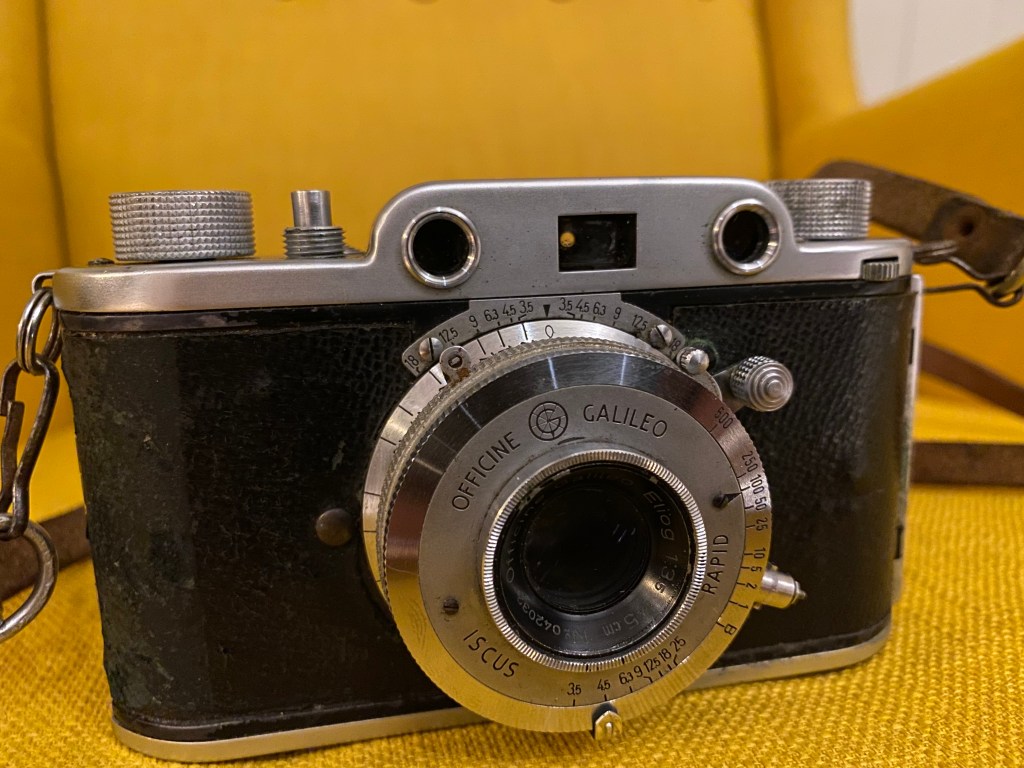
Some weeks ago, I found an interesting camera on eBay, that I had never heard of before. The camera is called «Condor I» and was produced in Italy from 1947 by the Italian manufacturer of optics Officine Gallileo. After a while, Ferrania entered and most of the cameras were sold with the Ferrania logo on it. Mine, however did not. Whether this means that mine is among the earlier cameras, I don’t know, but – in mild terms – the camera does have some patina.

My dirty and somewhat tatty copy of the Condor I.

The first thing that really struck me when I played around with this camera, was the unusual selection of aperture stops. 3,5 and 4,5 are not that strange, but 6, 18 and 25 are stops I have never seen before on any manual camera. However, the aperture selector is the only part of this camera that is easy and smooth to operate. It seems to me that this camera has not been used for a long while, and that it will take some «jiggling» and maybe some sewing machine oil to get the focusing mechanism and the shutter speed dial to move with ease.

Reklamer

After cleaning both the rangefinder windows (there are two of them on this camera) and the viewfinder window as well as a light wash with some glass cleaner over the whole camera, I loaded it with a roll of Rollei Retro 400s. Previously this day, I had spotted two lines of bicycle stands that I thought had an interesting look to them. I decided to shoot some frames, cut the film out of the camera and develop the film to check whether it does work.

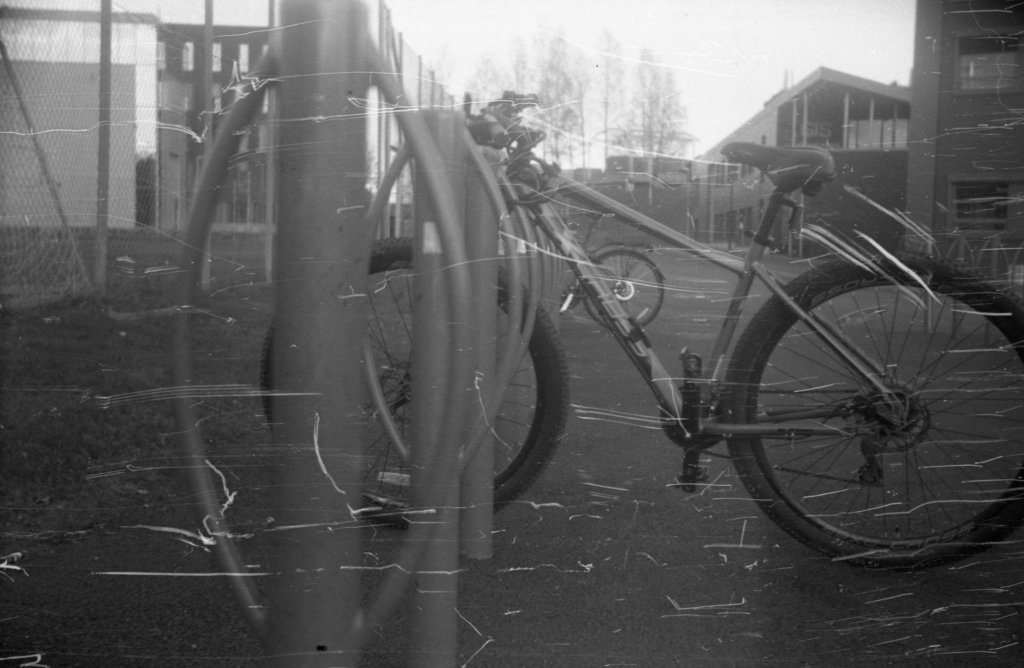
So far so good, I shot some frames and went home ready for developing the film. I loaded everything I needed into the changing bag and cut the film out of the camera as intended. But for some weird reason, the take-up spool would not accept the «rewind setting» and roll backwards. I fiddled a bit with it, and after a little while, the film spun up into my hand, and I was able to carefully wind it off manually. It does seem, however, that I was not able to do this carefully enough. I got nasty scratches and marks on my negatives, and I can only blame myself.

Condor I – Rollei Retro 400s – Xtol 1+0 9.30 at 20 degrees

The nasty scratches aside, the lens seems very sharp and the exposures fairly accurate from what I would expect with the settings. All shots are f4,5 at 1/100th and the Rollei film is shot at box speed. Also, the I love the smoothness of the grain I see in these scans.

I do definitely have to take this camera on a new test. The images seem to be decently sharp and pleasant for a messed up shoot like this. I’ll make a video about this little quirky camera and my next time shooting it.