Some days ago, while driving home I realized that there are a plethora of different types of lamp posts in my local area. Different both in design, placement and light source. I decided to spend a roll of Kodak Tri-X, a film I rarely use, to play with the lamp post and a red filter for contrast. I had never tried using a red filter in different conditions before, and I decided to just leave it on regardless if the lighting conditions changed from sunny to overcast. This turned out to be a mistake and some of the shots did not come out well. However, the well exposed turned out very nice.
To take these images, I had to look up into the sky, hence my idea to use a red filter for the backgrounds. I like how the sky and the contrast to the light post turned out. I see little bit of evidence of dust inside the camera house, which I will have to figure out at a later point.
This roll was also the first roll I developed using 510 Pyro, a developer I had heard so much about but never really tried. I bought a bottle that I will be trying out over the coming months. The concentrate is a bit gloopy, but not anything I haven’t seen from HC110 in earlier developments. All in all, I am very happy with the results. The grain is surprisingly fine on the well exposed negatives, and obviously more prominent on the underexposed negatives. This is my fault entirely.
A seagull started to dive towards me at one point. I like how the grain makes this image more active.
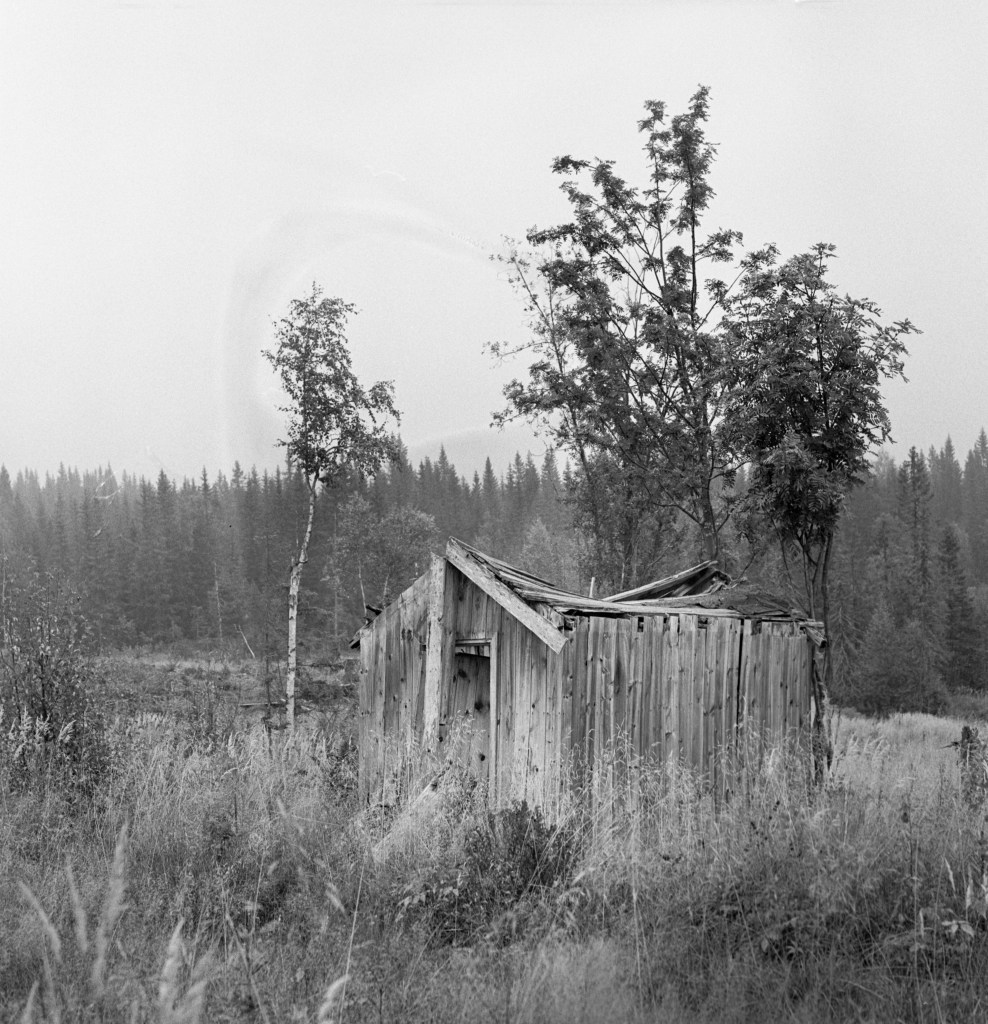
Over the last year, I have noticed an old wooden hut, standing on its own in a chopping-field a short distance from Gjøvik. The hut in itself is not really that beautiful to look at anymore. The roof has fallen down and the wood looks withered and dry. It would need significantly more than a lick of paint to make it shine once again. All the times I have driven past it or seen it when out walking, it has not worked because of the weather. I have pictured it to work well on a overcast and preferably misty day on black and white film. Today was the day that I would finally go for it and try this old hut, that I for my own amusement has named «Jabba». It is a bit amusing to tell yourself to go out shooting Jabba the Hut.
I rolled up the Hasselblad 500C with a roll of Kodak Tri-X 400 and brought with me a selection of filters, including yellow, orange and red, and I set off into the misty and drizzly morning. I found the hut in its usual condition, rather tatty and derelict, but this time, there was some mist in the background, creating a more interesting atmosphere around it. The scene itself is a bit messy and overgrown after a very lush summer, but the mist made it work.
My first frame of the day – Hasselblad 500C – Kodak Tri-X – No filters – Ilfotec ID-11 1+1
I decided to try the compositions in different ways with different filters, partly just to see what they would do to a scene like this. Especially, I was curious to what the red filter would do in conditions like these, and hence, I tried different approaches to learn a bit more about my filters. My pack of filters is rather inexpensive and are just plastic filters. At some point, I will upgrade my collection of filters, but not for this trip.
Trying again at Jabba – Hasselblad 500C – Kodak Tri-X – Orange filter – Ilfotec ID-11 1+1
Based on my rather limited access to the hut, as it stands in a rather difficult area to move around, I only made two different compositions this time. One straight on and one from the side. I did the latter without filter and with all three colors I brought – Yellow, Orange and red – and I must say that the results were a bit different than I thought. I expected that the red filter would give me deeper contrasts than the yellow, but actually, my results pointed in the different direction. That the yellow filter actually gave me much punchier images than the red, and the one without any filters gave me the best results.
What I see that the red filter does, and also to some extent the orange, is brightening up the greens and making the trees in the background brighter. For future reference, I will probably leave the two darkest filters at home for these days, but I do think it was worth the try.
Yellow – Orange – Red – No filter – Hasselblad 500C – Kodak Tri-X – Ilfotec ID-11 1+1
Another reflection I have after this shoot is that I remember why I have stopped using Tri-X and other Kodak-films for my images. At least to some extent. Their tendency to curl when trying after development is very annoying and makes it very difficult tu both scan and print them in the darkroom. I have not had this issue with ILFORD-films and since I really do not see any difference between Tri-X and HP5 at box speed, I usually save the Tri-X for the difficult lighting conditions where I have to push the film, as I see Tri-X to be a better push-film.




 Cheap Camera Adventures