Going slightly panoramic with Agfa APX 100

Over the last couple of weeks, I have done a lot of testing, trial and error of the cheapest film on the European market. The Agfa APX100. I have tried it for different types of scenes and landscapes and even in some cases some urban stuff. All in all, I am slightly underwhelmed by its performance and I have seen it having a really big tendency to become a grey mesh or insanely contrasty. This made me do something that I figured that I should have done far earlier. I looked into the data sheet for the Agfa APX100 looking for its spectral sensitivity curve. And I must say that this sensitivity curve was something I really did not expect. Compared to the films I have shot before and compared it to, the APX100 is not even similar at all.

The curve is jumping up and down all the way, indicating that this film has a dip both between blue and green, as most panchromatic films tend to have, but also a dip into the yellows. This would explain the difficulty I have in soft light where grass and boggy areas are shifting between greens and yellows. I’ll ad the curves for FP4 plus and Fomapan 100 under for comparison. These films have a much calmer curve and I am much more comfortable with films like that.

I then figured that maybe if I chose to shoot very high contrast scenes with this film and develop with Rodinal, that this would be a better use for its qualities. I therefore broke out the panoramic adapter and rolled a full length film, and went out as a cold-front marched in over the town to take images of trees along the lake.

Trees by the lake – Zeiss Ikon Nettar – Agfa APX100@50 – Rodnial 1+100

This time, I really saw something happen that I liked with this film. Even though my stand development technique gave me some slight maks on the negatives and that I got a weird light leak on one of the frames, I am very happy with how this outing went. The high sensitivity to blue made the sky blow out somewhat but the contrasty clouds made them come back in a really nice way, painting the skies beautifully.

Trees by the lake – Zeiss Ikon Nettar – Agfa APX100@50 – Rodnial 1+100

I chose to once again meter my exposures at 50 rather than 100, and I think metering a stop above is a very good idea with this film as it tends to get «inky blacks» very easily. It does also seem that Rodinal is a good choice when working with APX 100. I does really give a nice result. I chose stand-development for this round because I think it is a very relaxing way of developing films giving a very smooth result. And I found it to really get the nice tonality out of the Agfa.

Trees by the lake – Zeiss Ikon Nettar – Agfa APX100@50 – Rodnial 1+100

I should have looked into the data-sheet before beginning the work with this film, but now, a little bit wiser, I will use the film for its best use rather than at its weak points. For the rest of the bulk. For my morning soft-light grass-shoots, I will use FP4 or HP5.

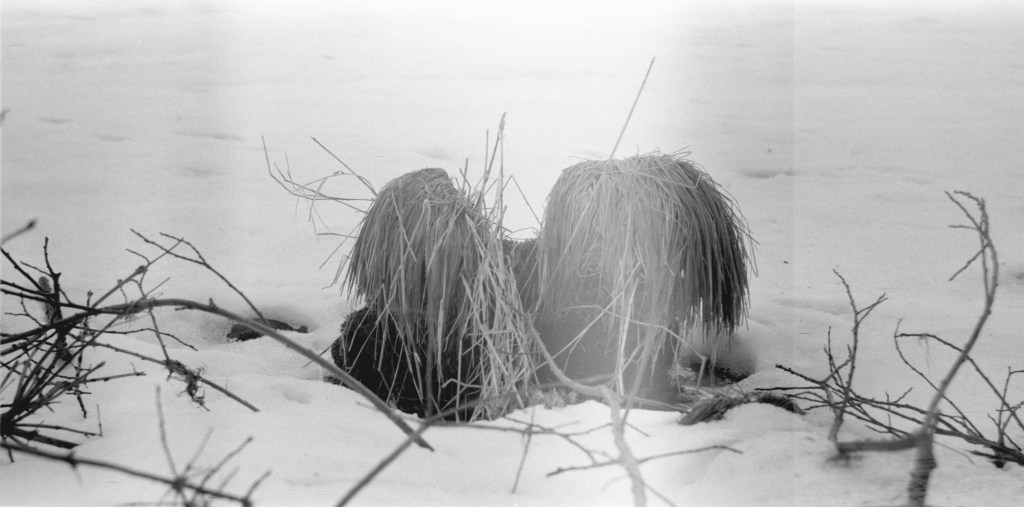
Going Panoramic in the fog

I have never worked with any kind of panoramic equipment before. I have held a Hasselblad X-pan in my hand at one point, but I never tried shooting it. Even so, panorama photography is interesting, and I have wanted to give it a proper try. Not that I will really try it properly in this entry, but I recently bought some very cheap 3D-printed (I guess) plastic parts off eBay. Specifically, the small plastic parts that you use for using 35mm film in your medium format cameras. To be honest, I didn’t really expect much results from this. My anticipation was the following:

  1. The film will not be kept dark enough after exposure and will be fogged.
  2. The film might not be kept flat enough in the camera.
  3. Composing the image will be difficult not having a proper viewfinder for it.
  4. Unknown amount of images pr film and difficult to know how far to wind.
The plastic-stuff and a canister of film. Not the one I used for this test.

I decided to give it a try in my Zeiss Ikon Nettar. This because it is the only MF camera I have where the film is inserted in the horisontal direction, allowing me to easily shoot landscape without turning my camera into portrait. I decided to go for a roll of Ilford Delta 400 and go for a little walk while the fog was lifting over the lake. I was looking for wide compositions, which was a new experience for me, and I felt that I often reverted back to looking for squares or normal rectangles rather than the super wide compositions that this line-up would allow for.

Didn’t quite nail it with this one. See the light leaks that I got for most of the shots on the roll. Luckily not too bad in this shot.

First of all, I can confirm the first part of my assumption. Using this system, with the 3D-printed parts, will give you severe light leaks between the shots. I know for a fact that it is not the light seals acting up, because I used black tape to ensure no light-leaks would come from that area.

Reklamer

For the most part, I think that the film stayed flat in the camera, and that the adapter kept it reasonably well aligned throughout the roll. I did; however, notice that the film was not as «in the middle» of the viewfinder as I had thought, and I shot a few of the frames «too high» losing parts of my intended compositions.

Over the rocks – Zeiss Ikon Nettar, Ilford Delta 400 Adox Atomal 49 Stock

Even though I like some of these images and the way they look and how they turned out, I am not certain I would use this adaptor system a lot. I will very likely do some more experiments with it and try it out at different occasions, and maybe I am luckier with my next rounds and avoid some light leaks. I find the system to be functional for shooting only one frame at a time. This would mean a lot of «cutting the film out of the camera» and «developing fragments of a roll». Not that I mind doing that, but it is a hassle.

Lifting fog – Zeiss Ikon Nettar, Ilford Delta 400 Adox Atomal 49 Stock